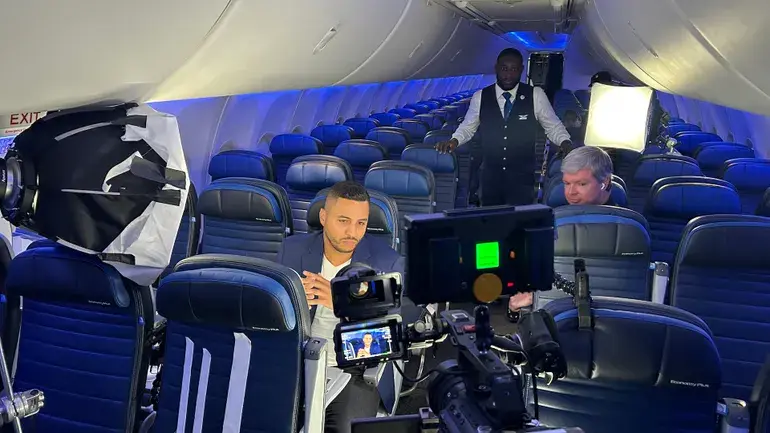
On a Tuesday night aboard a United 737 out of Dulles, ESPN's Tyler Fulghum joined the network's Fantasy Football Marathon live at about 35,000 feet, with a full production crew, brand representatives, and press on board. The stunt promoted United's gate-to-gate Wi-Fi, powered by Starlink — by using it for the most bandwidth-hungry thing you can do: a live broadcast.
Why a live show instead of an ad
"Fast" and "reliable" wash over people
United's chief advertising officer Maggie Schmerin explained the core logic: in advertising, words like fast, reliable, and seamless "wash over people." So United went for real-world proof instead. "We've been focused on real-world examples that say this is no different than your living room at home. The product is incredibly strong, and to be able to showcase that ESPN can broadcast live from the sky is the exact type of message we want to send." Don't claim the Wi-Fi is good — show a satellite broadcast running from the air.
Staged as a program, not a one-off stunt
The activation rolled out in phases: a promo spot and custom social content from ESPN's social correspondent before the flight, live picks with United branding and fan Q&A during the broadcast, and post-event highlights and behind-the-scenes content distributed across social. Disney Advertising called it what it is — a custom program built around a brand's KPIs. ESPN has 47,000 live events a year and a Super Bowl simulcast on ESPN and ABC coming in February; this doubled as the network's football-season kickoff for brand partners.
Our take: activation is the art of translating product truth into content
What makes this campaign work isn't the media buy — it's the translation. A product fact ("our Wi-Fi is good") became a content event ("ESPN can broadcast live from our plane"). When the product demonstration is itself the entertainment, the budget buys talkability, not just reach. The craft is finding the spot where a massive passion point (football) intersects your brand's actual, provable strength.
It's worth reading this against the broader industrialization of sports marketing — agencies are now organizing even the college-athlete sponsorship market, as we covered in Publicis Builds an NIL Joint Venture With Travis Kelce — Targeting a Fragmented $4.5B Market. And the phased, season-long build echoes brands turning cultural moments into owned IP, like Fanta Turns Halloween Into IP — Inside the Haunted Universe and Its 18-Month Build. United is pairing the proof stunt with a second track: its "Football Flies United" campaign returns September 7 — no call to action, pure vibe advertising meant to make the airline part of football culture. Proof plus belonging, run in parallel, is a structure worth borrowing.