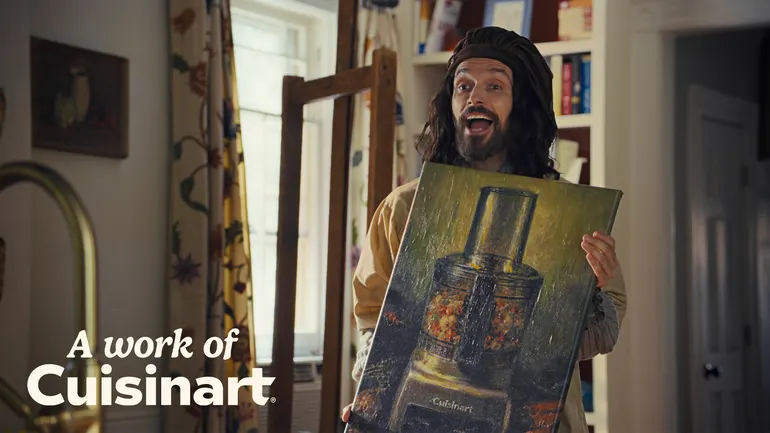
Kitchen appliance brand Cuisinart released "A Work of Cuisinart: The Starving Artist," its first episodic campaign made natively for social platforms. The premise is a sitcom: home cook Lucy deals with Bruno, a starving artist who has time-traveled from the baroque period. Publicis agency Fallon produced it, Kelsey Taylor directed, and Sue Li — known for NYT Cooking and Bon Appétit — handled food styling.
Why 14 Episodes With No Fixed Order
The design decision here is not the episode count. It is that there is no sequence. All 14 episodes are built to work regardless of which one a viewer sees first.
The reason is structural. On TikTok, Reels, and Shorts, the algorithm decides the order. A viewer landing on episode 3 and jumping to episode 7 is the default, not the exception. Traditional brand storytelling assumes a viewer starts at the beginning — an assumption that does not hold here. Order-dependent narrative loses by construction in an algorithmic feed.
Where the Products Sit
Six Cuisinart products appear across the series, including the ClearView Air Fryer and the FastFreeze Ice Cream Maker. But the weight is on dialogue and character friction, not specifications. The work extends the existing "A Work of Cuisinart" platform while breaking from static imagery and product-heavy messaging toward entertainment as the organizing principle.
Branded Entertainment Is Moving Again
Through 2026, branded entertainment has been reorganizing around quick-hit vertical series and soap opera–inspired microdramas. The bet is that several short pieces that catch a scrolling thumb outperform one long brand film. Platform-side momentum for vertical formats shows up in YouTube Adds Vertical Livestream Practice Mode.
Cuisinart is scaling video on another front too. An ad produced with Amazon's Creative Agent AI tool delivered 18% higher detail page views and a 14% lower cost per detail page view than a traditional brand-produced video. Agency Global Overview collaborated on the test, which came together in roughly four weeks — far shorter than a typical shoot. Human oversight was still required to keep the creative on brand.
Taking It Into Production
- Build multiple entry points. If you plan a series, every episode has to establish the relationship and situation on its own.
- Let the product be used, not described. Spec recitation invites the scroll.
- AI buys speed; people set the standard. A four-week turnaround only works if review stays in the process.
For a campus-casting approach to a first CTV campaign, see Urban Outfitters Puts 76 Students in Its First CTV Ad.