Optimization isn’t strategy
Mike Ryan, head of e-commerce insights at Smarter Ecommerce, shared lessons on AI Max and automation on the PPC Live podcast. His core point: automated tools can uncover opportunities, but advertisers shouldn’t confuse optimization with strategy. How you use AI Max guardrails decides the outcome.
His example: AI Max dramatically expanded a client’s traffic by targeting a much larger competitor. Performance looked good — but the advertiser had deliberately avoided those searches to prevent a bidding war, context AI Max couldn’t understand.
Trust, but verify
Check search terms from day one
Monitor new technology closely from the start, and look at actual search terms instead of assuming strong headline results mean everything is working as intended.
Don’t generalize early observations
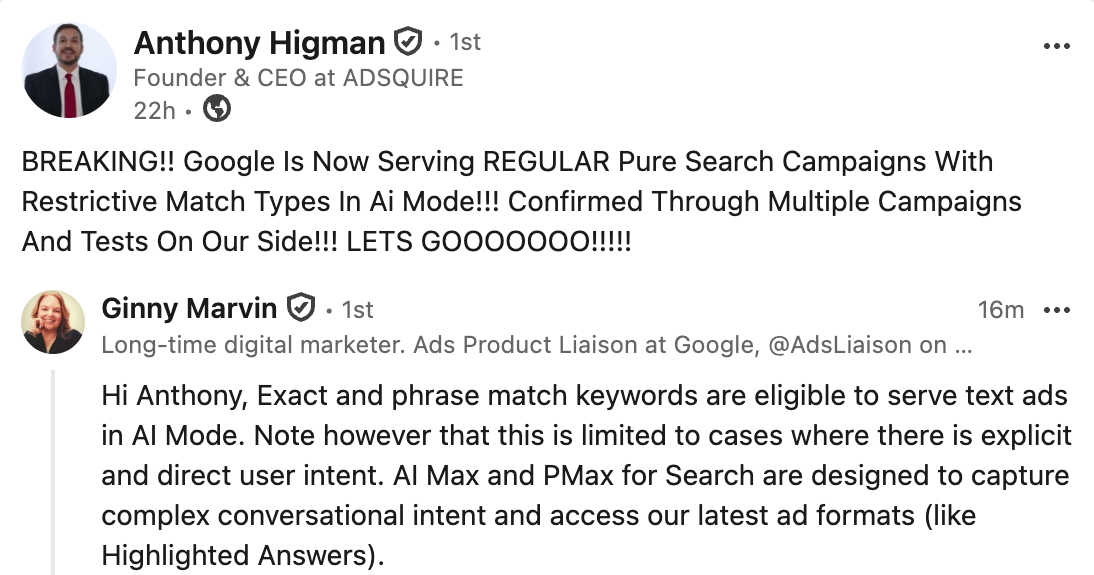
Ryan once concluded from several campaigns that AI Max favored the Search Partner Network and shared it on LinkedIn; more data showed it wasn’t generally true. Corrections rarely reach as far as the original claim, so influential voices should handle early observations carefully.
AI Max already has guardrails
- Negative keywords to block unwanted expansion.
- Brand inclusions and exclusions to control brand coverage.
- Search Partner Network settings.
- AI Max match type and match source reporting to see where expansion comes from.
Over-segmentation starves the AI
Highly granular structures can leave campaigns without enough conversions for automated bidding. Ryan’s research points to at least 30 monthly conversions — ideally 60 or more — for Smart Bidding to work consistently. He argues advertisers should move from tactical to strategic segmentation: every split needs a reason to exist.
One account had been divided by its CFO into extremely granular margin buckets, each with its own ROAS target. It sounded sophisticated but fragmented data so heavily the algorithm couldn’t hit the targets. Instead, custom labels can feed Google business context it doesn’t know — margins, sell-through and return rates — to optimize around real profitability.
New controls and updates
The PMax channel importance trap
A Performance Max feature lets advertisers adjust individual channels’ importance. Ryan warned that raising a channel’s importance may give Google more tolerance around CPA or ROAS targets, producing outcomes advertisers don’t expect — worth remembering with Performance Max channel prioritization controls.
The August 17 overreaction
Ryan’s early research found advertisers raised target ROAS around Google’s August 17 update, including campaigns not limited by budget that didn’t need changes. Uncertainty made them needlessly conservative — and those who moved the other way may have gained share. Google advised waiting one to two conversion cycles, yet many conclusions circulated before enough data existed.
Curiosity is a core PPC skill
Ryan’s overarching advice: stay skeptical and curious as automation grows. It fits with his analysis of rising Shopping CTR masking falling impressions and Matt Van Wagner’s warning to verify Google’s recommendations yourself.