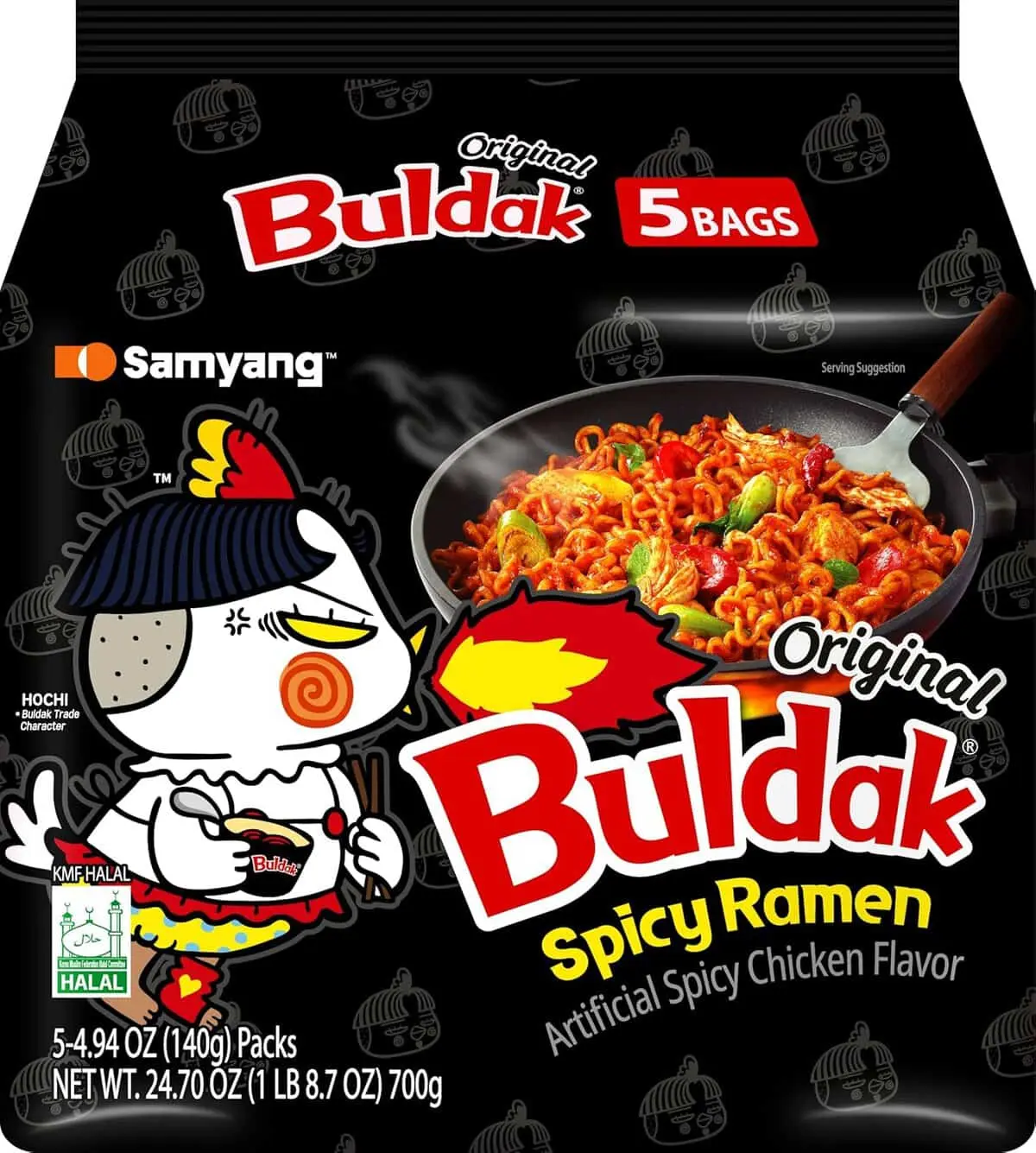
A ramen that launched in 2012 to reviews of "inedible" turned its maker into an export company earning 77% of revenue overseas within twelve years. Korean marketing outlet Mobiinside's breakdown of Samyang's Buldak (fire chicken) noodles starts by rejecting the usual question. How did Samyang sell this heat? It didn't. It left the selling seat empty — and consumers filled it.
Testimony, not advertising, was the distribution channel
For long stretches of Buldak's rise, the company is absent from its own story. In 2014, YouTubers — most famously "The English Man" (Korean Englishman) — filmed themselves suffering through the noodles, and the Fire Noodle Challenge spread as a game across borders. The extreme heat provoked the dare; the exaggerated reactions after eating became the content. The Buldak line grew for years with no significant advertising — consumer-made testimony functioned as the media plan.
Samyang's own framing at Cannes Lions — a declared break from "typical media-dependent marketing" — is usually misread as "they did digital well." It means the opposite: they stopped buying media to push messages, and deliberately left the authorship of the buzz to someone else. Even the decisive moment, #buldakchallenge, Samyang describes as "a viral phenomenon consumers created on their own" rather than claiming it as a campaign.
Designing the appearance of doing nothing
Call it luck and Samyang appears to have done nothing. The creativity is precisely that the "nothing" was designed. While the challenge spread, Samyang didn't reclaim it as an official campaign, impose rules, or wrap it in brand tone. Most brands do the reverse — launch the official challenge first, distribute the hashtag, buy the first wave of influencers. That approach isn't automatically wrong, but it casts consumers in a role instead of granting them authorship — and someone who believes they discovered a thing spreads it at a different speed than someone following instructions.
Restraint, though, wasn't inaction. Samyang held back only from authorship-stealing interventions. It scaled supply to meet challenge demand and kept widening the heat spectrum — 2x Spicy, Carbonara and beyond — laying new forks for the game to branch into. It separated staging the arena from starring in it: widen the stage, hand the spotlight to the audience.
What restraint returned
The numbers close the argument. Samyang's 2025 results: revenue of 2.35 trillion won, up 36%; operating profit of 523.9 billion won, up 52%; operating margin climbing from 19.9% to the 22% range; overseas revenue share from 77% to above 80%. The margin is the tell — the company sat on top of demand consumers had built, so marketing costs didn't scale with revenue. Buzz the brand doesn't buy never shows up on an invoice.
The test for your next campaign
One check: point to the blank space in your campaign plan that consumers — not you — will fill. If you can't, the plan gives consumers a role while the company keeps the copyright. The harder second check: pre-commit to the conditions under which the brand will not step in once the buzz starts. Campaigns usually die at exactly the moment they take off, when the company moves to reclaim them.
The structure maps directly onto K-beauty's export math — K-Beauty's Real Export Isn't Product — It's a Discovery System, Built on 2.4 Billion TikTok Views describes the same engine of consumer-driven discovery. And if you're publishing consistently without building fans, you may be requesting participation instead of staging it — worth auditing against Posting Consistently but Building Nothing? Design Content in Four Stages — Awareness, Interest, Trust, Fans.