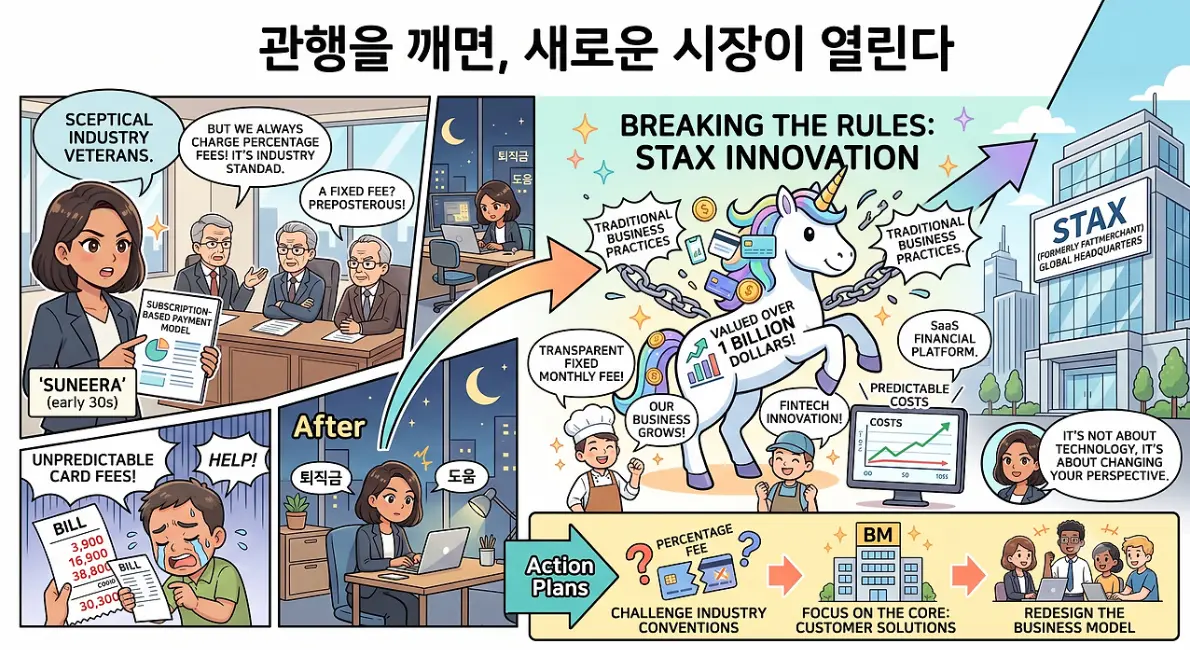
The most common wall in starting or scaling a company is not technical. It is the flat refusal: "that's not how this industry works." Fintech company Stax (formerly Fattmerchant) is a case of building past that refusal to a valuation above $1 billion.
Not an Invention — a Reframe
Founder Suneera Madhani did not invent a new payment system. She questioned a pricing model the industry had taken for granted for decades.
- Industry convention: 3–5% fee per transaction. The more a merchant sells, the heavier the burden.
- Stax's proposal: a flat monthly subscription on a SaaS model. Transparent, predictable cost regardless of volume.
Innovative companies do not always start from new technology. Sometimes they start from re-reading an inefficiency the market stopped questioning.
Why the Incumbents Couldn't Do It
The offer was obviously attractive to small merchants, and processing executives rejected it immediately. There were three reasons, all structural.
1. Percentage Fees Were a Honeypot
Processors earned more as client revenue grew, with no additional effort. Server and infrastructure costs do not scale proportionally with transaction volume, so the percentage model produced exponentially widening margins.
2. Complexity Created Useful Fog
A processing fee bundles dozens of components: card network costs, branding fees, PSP margin. The industry maintained that complexity deliberately. The murkier the structure, the harder it was for a merchant to see exactly what was taken — which is precisely what protected hidden margin.
3. Fear of Cannibalization
If a large processor launched a subscription tier, its highest-volume, most profitable accounts would switch first. Revenue would fall sharply and immediately. No incumbent had a reason to choose this innovation voluntarily.
Hence the answer Madhani received: "You can't make money that way." "It doesn't fit how the industry works, and it undermines our own base."
From $50,000 to a Unicorn
Madhani founded the company in 2014 with $50,000 assembled from severance and family support. The walls came early: PCI DSS certification and sponsorship costs required for independent payment operations ran into the hundreds of thousands.
Her workaround was a white-label strategy — renting existing infrastructure rather than building it. Even so, deposits and compliance costs consumed more than half the starting capital. With no marketing budget, the first customers came from a self-built website and door-to-door selling.
Merchants responded very differently than executives had. For businesses absorbing an unpredictable fee every month, a transparent flat subscription was a value proposition that needed no explanation. Stax grew beyond processing into a SaaS financial platform with financial management and data analytics, and by 2022 — eight years in — passed $30 billion in cumulative payment volume and a $1 billion valuation.
The Innovation Was Redefinition, Not Discounting
Stax's contribution was not lower pricing. It was redefining what the business is.
- The old processor: a toll collector taking a cut
- Stax: subscription financial software that helps a merchant grow
Word of mouth from customers who could see the savings monthly, plus best-in-class retention, became the growth engine.
Three Takeaways for Founders
1. Look behind the phrase "industry convention." The practices incumbents refuse to change are where customer frustration accumulates. The point an incumbent cannot touch because it would cannibalize its own revenue is a startup's widest opening.
2. Convince customers before investors. Through early VC rejection, Stax built trust on a saving customers could verify every month. Valuation follows trust; it rarely precedes it.
3. Convert transactions into relationships. A per-transaction model has to generate a new transaction every time. A subscription builds a continuing relationship. It is worth asking whether your own model can be redesigned from selling or brokering into an ongoing service.
For a method of finding out what customers actually need, see YC's Approach to User Interviews.