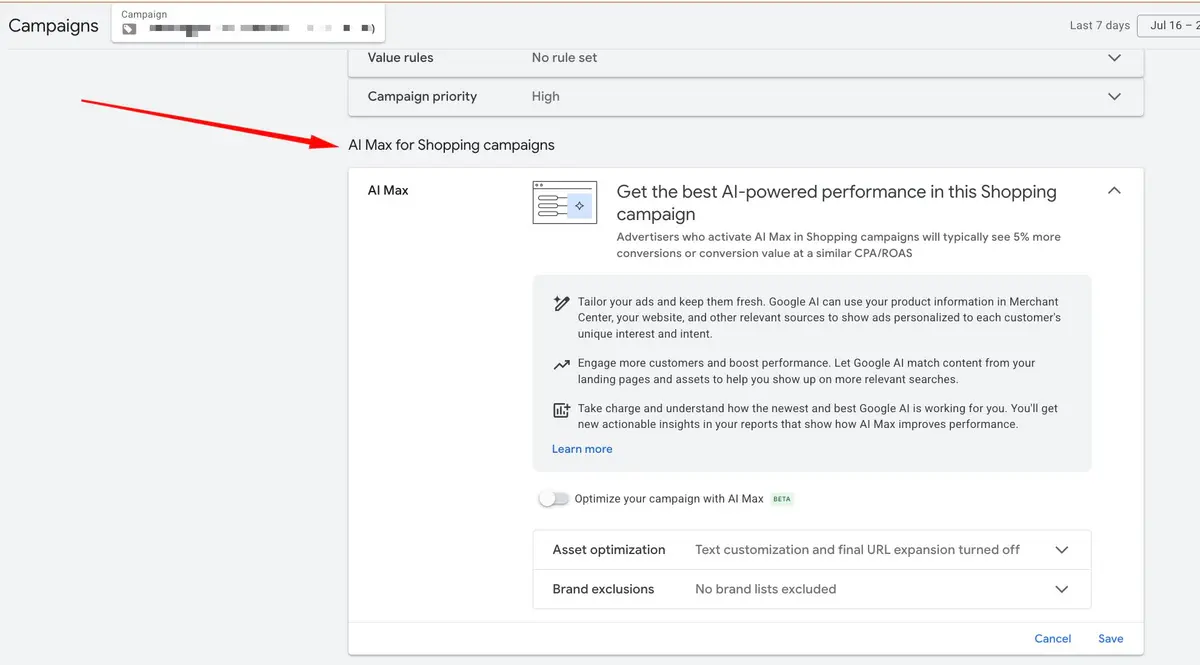
AI Max is making its way to Standard Shopping campaigns, bringing AI-powered query matching, ad customization, and landing page optimization to a campaign type that has historically offered advertisers more manual control. It was first announced in April.
The update could expand how Standard Shopping campaigns compete for search queries without requiring advertisers to migrate to Performance Max.
Five capabilities spotted
According to screenshots shared online, Google is rolling out AI Max features within Standard Shopping campaigns:
1. AI matching Shopping ads to conversational, long-tail search queries
2. Automatically generating ad copy using Merchant Center feed attributes such as materials, fit and durability
3. Final URL Expansion that directs users to what Google determines is the most relevant landing page rather than only the product URL
4. The ability for Google to choose between serving a Shopping ad or a text ad based on the user's query
5. Campaign-level controls for asset optimization, brand exclusions and Final URL Expansion
The screenshots also suggest existing bidding and targeting settings would remain in place, with advertisers able to disable Final URL Expansion if they want traffic directed only to Shopping ads.
Why we care
With these features, Standard Shopping advertisers gain many of the AI-driven capabilities that have largely been associated with Performance Max.
Better matching for conversational searches and dynamically generated ad messaging could help capture incremental demand while preserving familiar campaign structures.
However, advertisers will likely want to monitor performance closely to ensure AI-generated landing page choices and ad formats align with their business goals.
Bottom line
AI Max could significantly expand what Standard Shopping campaigns can do, blending AI-powered optimization with the controls advertisers have long preferred — but until Google officially announces the feature, advertisers should view the reported capabilities as an early look rather than a finalized product.
First spotted by paid search expert Arpan Banerjee, who shared it on LinkedIn.
Practical takeaways
"You don't have to move to PMax" is the headline. Getting automation used to mean surrendering control and migrating. This removes that trade — AI matching while keeping Standard Shopping structure.
Start with Final URL Expansion off. The screenshots show it can be disabled. If you don't want traffic leaving product URLs, turn it off at setup — for what this feature does during the DSA transition see Dynamic Search Ads Are Going Away.
Feed attributes become ad copy. Copy is generated from Merchant Center attributes like materials, fit and durability — an empty feed produces empty copy. Read alongside AI Shopping Starts With Your Product Feed.
Account for automatic format selection in reporting. Google choosing between Shopping and text ads means text ad performance mixes into Shopping campaign results.
Set brand exclusions first. One of the campaign-level controls — on why blended brand traffic distorts ROAS see Why Separating Brand and Non-Brand Campaigns Makes ROAS Honest.
Treat it as a sighting. Screenshot-based ahead of official announcement, so the spec may change and absence from your account is not a fault.
Apply it first to products getting no impressions — where AI matching can contribute most, per Reviving Zombie SKUs.