Yes — as long as the artist stays in charge
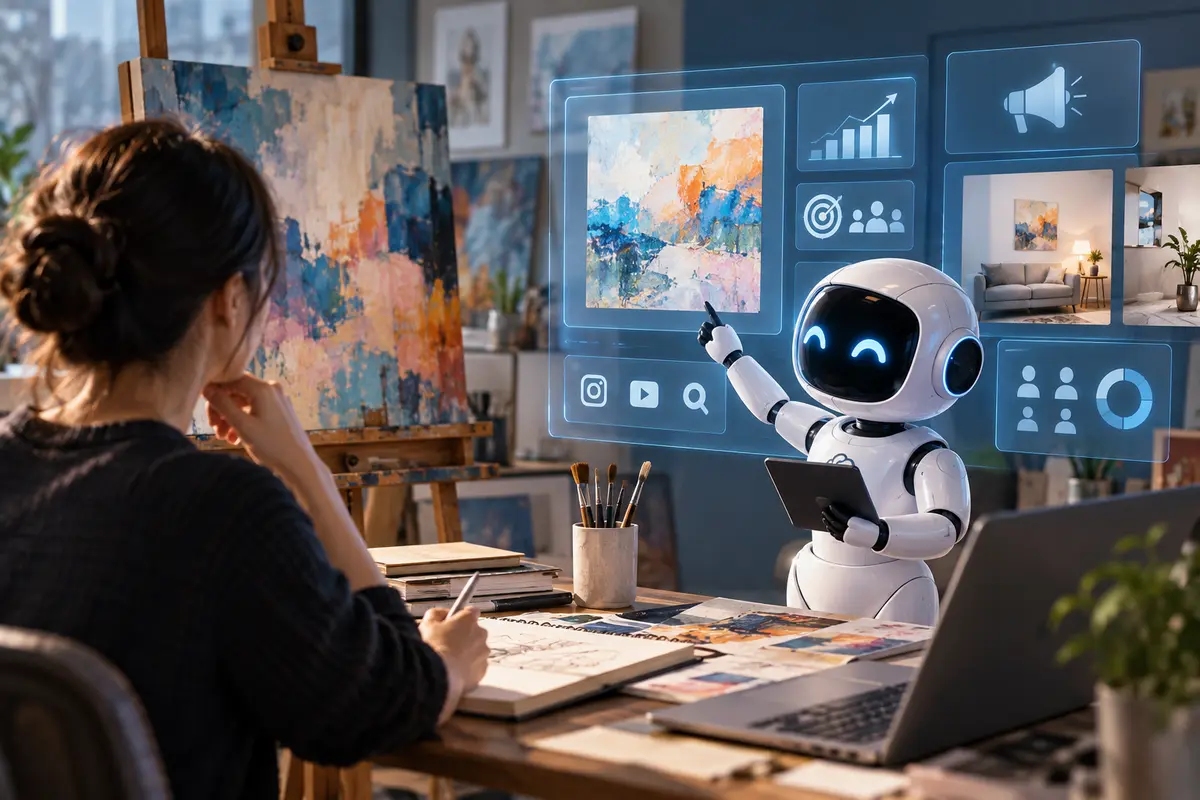
Can an independent artist use an AI marketing agent to promote their work? An essay by Gil Park, republished by Korean outlet Mobiinside, says yes — but not as a fully autonomous marketer. The practical model today is semi-autonomous: the artist defines the work’s meaning, price, budget and non-negotiables, and the agent analyzes audiences, produces promotional assets, runs ads and optimizes within those limits.
In art, AI adoption started with discovery and personalized recommendations rather than automated ad buying. Korean art platforms have introduced AI curation that recommends works based on user behavior and visual features, while Saatchi Art and VISII reported conversion gains from personalization in A/B tests. Most of these results are either undisclosed or vendor-reported, and platform-level automation claims from Google and Meta aren’t specific to artwork, so they shouldn’t be treated as forecasts.
Five levels of agent autonomy
- Analytical: reviews views, clicks, saves, inquiries and purchases by artwork.
- Advisory: proposes targets, copy, short-form scripts, budget splits and tests.
- Executional: builds and publishes campaigns a human has approved, then reports.
- Semi-autonomous: pauses weak ads and shifts budget within preset rules.
- Autonomous: takes a goal and loops through planning, production, buying and reporting.
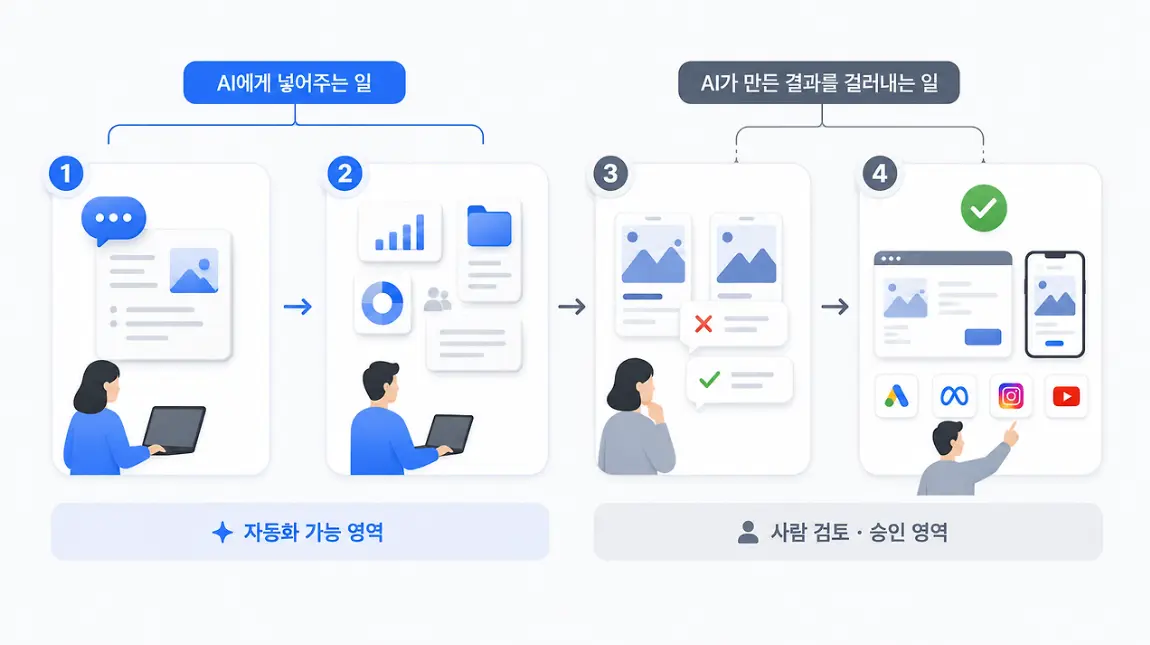
More automation isn’t automatically better for art. An agent that alters colors to lift CTR, invents interpretations or discounts prices on its own can damage the work’s value. Start at the executional level with human approval, then expand to semi-autonomous once results and controls are proven.
Match permissions to risk
Three approval tiers
Low-risk tasks — performance lookups, reports, copy drafts, UTM tagging — can run automatically. Medium-risk tasks — creating and publishing ads, changing targets, moving budget within limits — need one-click approval. High-risk tasks — generative edits to artwork images, price or discount changes, customer list uploads, total budget increases — need separate confirmation and manual sign-off. Approval screens should show what changes, why, the maximum spend and how to roll back. Log every action and keep a kill switch.
Write guardrails first
State explicitly: no color changes to originals, no unilateral price changes, no political or social interpretations the artist didn’t make, no unauthorized use of faces or personal data. Express goals as measurable actions, such as 20 artwork inquiries.
Budgets, content and measurement
At around 1 million won a month, skip custom systems and combine platform AI features with human approval. Pick three to five signature works and produce four assets for each — full image, texture close-up, process and the artist’s story — then invest in a landing page and conversion tracking. At around 10 million won a month, the author suggests starting with 70% media, 15% content and AI production, 10% data and automation and 5% test reserve, and connecting the ads API. These ratios are starting points, not rules.
Art sells infrequently, so likes and views are risky success measures. Early on, cost per qualified inquiry is the better north-star metric. Keep audience, budget and duration constant in A/B tests, change only the creative and run for at least a week. By the author’s calculation, detecting a CTR lift from 1.5% to 2.0% needs roughly 10,800 impressions per variant.
Copyright, AI labeling and privacy
Korea’s copyright commission published guidance in 2025 on registering works made with generative AI, so artists should keep originals, prompts, generated versions and records of their own selections and edits. Korea’s AI Basic Act, in force since January 22, 2026, includes labeling provisions for generative AI output, though whether they apply to an individual artist depends on the business setup. Regardless, voluntarily labeling AI-directed videos — for example, a still painting shown moving — protects trust. The IAB’s revised AI disclosure rules are a useful reference. Use only the minimum customer data needed, and require manual approval before any list leaves your systems.
The same model fits small brands
This setup applies beyond painting — to personal brands, small beauty and food brands, and merchandise. As the four foundations to build before Google Ads AI agents point out, jumping to autonomy without data and controls leads to expensive failures. The agent’s real value isn’t creating on the artist’s behalf; it’s learning which story and format make each work resonate with which audience.