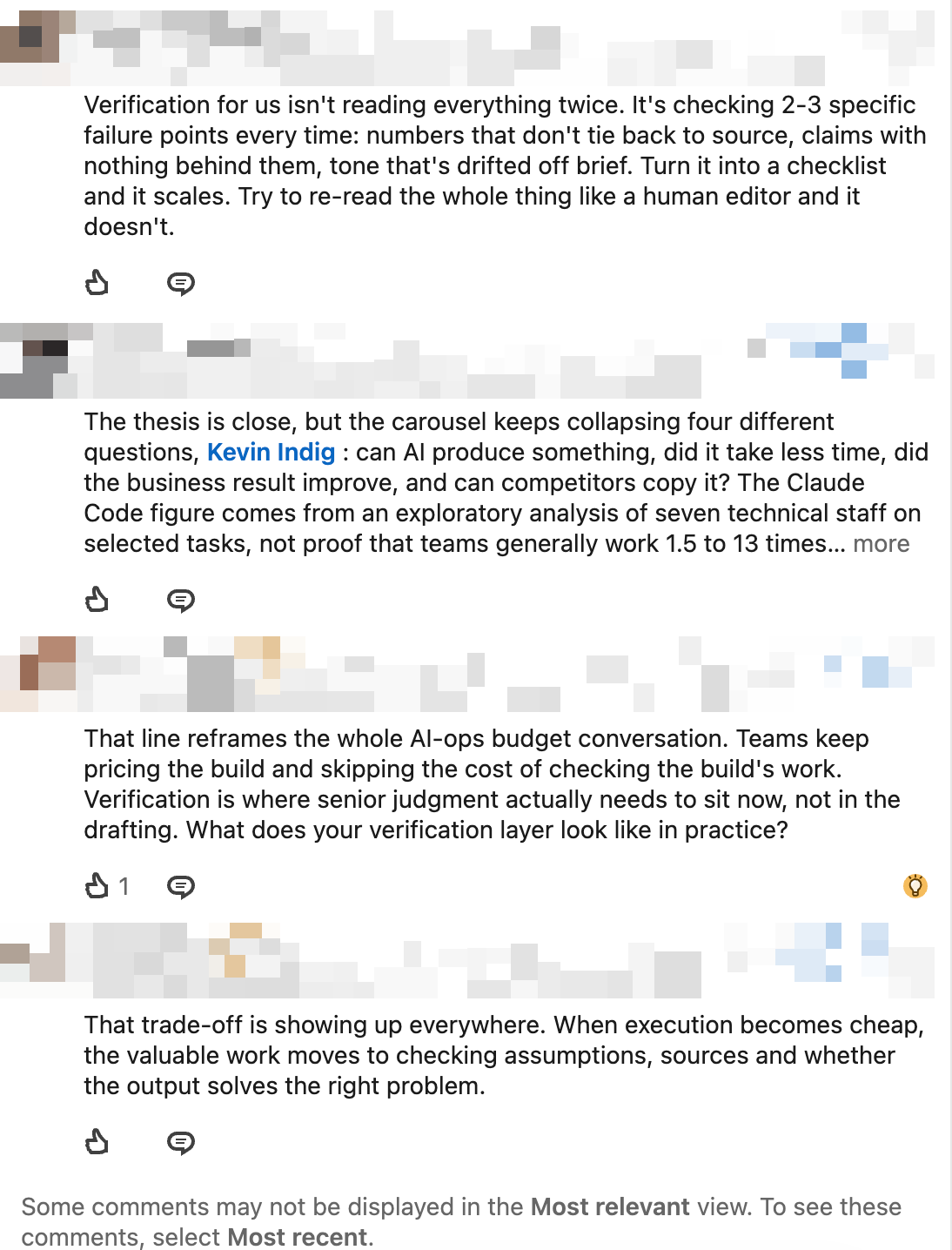
Most comments on LinkedIn posts lately look the same: they regurgitate the original post and add zero value. Viruses have no metabolism of their own and need a host to reproduce. Slop comments work the same way — the host is what you wrote.
Platforms have started noticing.
What Antibodies Do
Antibodies spot a target, neutralize it, and remember it so the next encounter is faster. Anti-slop systems do the same: flag low-value content, throttle its reach, and feed every catch back into the model.
LinkedIn Did Three Things in 10 Weeks
- Deployed systems that identify slop and limit its distribution beyond a poster's immediate network
- Started testing a "Seems like AI slop" button for users to flag posts and comments
- Killed its own "Enhance post" button, replacing it with a proofreader that fixes grammar without rewriting your voice
Every Other Platform Is Doing the Same
- Substack: rolled out site-wide use of Pangram to detect AI use in writing
- YouTube: demonetizes "repetitive, low-effort, emotionally manipulative video." In January 2026 it terminated 11 channels and wiped 6 more, erasing ~4.7 billion lifetime views, 35 million subscribers, and ~$9.8 million in annual revenue
- Reddit: went the anti-manipulation route rather than labeling. July 2026: AI-based detection of "manipulated and spammy content," claiming 23 million spam views blocked and ~2 million inauthentic votes revoked daily
- Pinterest: AI detection to label content, plus feed control letting users dial down "AI-modified" content in specific categories
- TikTok: requires AI labels, embeds invisible metadata watermarks, shipped a "limit AI content" feed toggle in November 2025, and in July 2026 began testing detection aimed at AI spam accounts
- Meta: "AI info" labels on Facebook, Instagram, and Threads since 2024, extended to ads in June 2026. Labels only, no user-side filter
- Spotify: attacked supply — 75 million+ spammy tracks removed, an impersonation policy, spam filters, and DDEX-based AI disclosure in credits
The Accuracy Trap
LinkedIn's defense system has 94% accuracy. That sounds good, and it is 60x worse than Gmail's spam filters — meaning one in 17 spam emails would be flagged as a false positive.
Watermarking Is Not the Answer
On August 11, Anthropic announced machine-readable watermarks on Claude text and file output at the model level worldwide, persisting across the API, Claude, Claude Code, and cloud access through AWS, Google Cloud, and Microsoft Foundry.
This was not pure goodwill. The EU AI Act's Article 50 requires providers of generative systems to mark their output in a machine-readable format, with penalties up to €15M or 3% of global turnover.
Why the Marketing Impact Stays Limited
- Watermarks prove an AI model touched text, but not to what extent. They are not an indicator of quality.
- Detectors need a minimum amount of text. Published benchmarks land at roughly 100 tokens at best, and SynthID's own evaluation truncates to 200. A LinkedIn comment is 20 to 50 tokens — below the floor.
- Editing, paraphrasing, translating, combining with other text, or chaining models can weaken or remove the mark. A paraphrasing attack presented at ICML 2025 achieved near 100% success against seven recent watermarking methods at $0.88 per million tokens.
- The escape hatch is open weights. Watermarking is applied by the sampling pipeline at inference, so run the model yourself and there is nothing to strip. If marked output ever gets penalized, slop moves to the models nobody marks.
Worth noting: Gemini has applied SynthID watermarks since August 2023 with no outcry.
The central argument: do not confuse "AI-generated" with "bad." Slop existed before AI — machine-automated work, legal and finance speak, press releases, and every SEO article opening with "in today's digital landscape." It is ultimately about quality.
Where the fear is justified is that quality has become a blurry but critical filter for distribution.
The Bottleneck Is Distribution, Not Production
The advice to avoid generic content is not new, just widely ignored. AI raises the viral load faster than the filter can clear it.
Content production is no longer the constraint. Permission to distribute is.
What the last 24 months taught is that AI's production gains do not offset the losses in distribution. If AI Overviews reduce clicks by 50% on average, doubling output looks like compensation — but that output growth comes at the expense of quality, which can hurt overall distribution. An article that smells like AI can cost fragile reader trust irreparably.
The Same Thing Happens One Level Up
- Google: shipped a spam update in June aimed at scaled content abuse
- Wikipedia: speedy deletion for suspected LLM-generated articles in August 2025, then an outright ban on using LLMs to write or rewrite article content in March 2026
Google demotes, Reddit detects, Wikipedia bans.
So why aren't platforms like LinkedIn, Reddit, and YouTube — the biggest slop slingers and most-cited domains — penalized themselves? They are, but more surgically. Reddit's machine-translated ?tl= pages collapsed from 6.14% of ChatGPT's Reddit citations in April 2026 to 0.30% by early June, while Reddit rose in aggregate over the same period.
Engagement may act as a rough filter. Semrush's study of 89,000 cited LinkedIn URLs found cited posts carry at least decent engagement — most with moderate engagement (15–25 reactions), about 75% of cited authors posting frequently (5+ posts in four weeks), and nearly half with over 2,000 followers.
The Distribution Cost to Companies
- A Copenhagen Business School study in Electronic Markets (n=325, n=371) on Instagram content labeled human-created, AI-enhanced, or AI-generated found labeling as AI reduced both affective and behavioral engagement by about half, strongest on emotional content and weakest on rational or informational content
- TikTok field data (1 million posts) shows AI disclosure leads to ~7% less engagement because people infer lower effort
- Pangram scanned 1 million+ posts between April and June 2026 and found 41% of LinkedIn long-form posts and 23% of comments were fully AI-generated — the highest of any platform
Run the math. LinkedIn catches 94% of slop and caps flagged posts at your immediate network. If 71% of an account's impressions come from beyond that network, multiplying the two means an account posting nothing but AI should expect to lose roughly two-thirds of its LinkedIn reach. Post AI a third of the time and it lands closer to 20%. Add 7% on short-form video, and 40% to 95% in SEO if you scaled a content operation.
This Is the Commodity Content Problem
That slop comments regurgitate the original and add nothing is the same idea as information gain and commodity content.
Danny Sullivan's slide at Search Console Live Toronto framed it. Non-commodity content is:
- Unique: brings a viewpoint, information, or content that others lack or can't easily replicate
- Specific: talks about a specific instance, situation, or thing, not general rules, steps, or generic information
- Authentic: demonstrates first-hand knowledge or experience
LinkedIn VP Laura Lorenzetti's framing is strikingly similar:
"This includes technology systems built in partnership with our editorial team that have been trained to recognize signals of AI slop and learn over time by identifying content that adds perspective, context, or expertise and content that feels generic or repetitive, even if it appears polished on the surface."
Reddit CEO Steve Huffman said the same on the Q2 earnings call:
"As AI makes information more abundant, the challenge is no longer finding content; it's finding context, personal opinion, and first-hand accounts. Everything online feels flat, polished, generated, or sponsored, so consumers are overwhelmed and increasingly skeptical."
Three organizations reaching the same conclusion: generic content has no value.
Is that new? No. What is new is the binary nature and the cost-effectiveness. Until a few years ago, generic content still earned residual traffic. Now Google won't even index it and LinkedIn downranks it.
Panda ran on proxies — links, clicks, dwell time, pogo-sticking — because judging whether a document contained a good idea was economically impossible in 2011. Now an LLM can assess that quickly and cheaply.
Slop Has a Shape
A COLM 2026 paper from Maryland and Google DeepMind ran 61,608 stories through a classifier deliberately denied every style signal and told to work from structure alone. It kept over 97% of the accuracy of models allowed to see word choice and sentence rhythm.
The finding: slop has a shape pattern.
The details are telling:
- AI states the moral outright in 77% of stories versus 52% for humans
- 79% of AI stories contain zero subplots versus 57% for humans
Over-explaining and single-track tidiness — exactly the LinkedIn comment pathology.
The Antidote: Own What a Model Cannot Produce on Demand
Proprietary information: your own data, your own experiments, your own customer conversations. If a model can generate it, it is a commodity by definition.
Attributable identity: a named author with a track record, and on LinkedIn, a verified one. Lorenzetti's post buried the tell — you can now filter the feed for LinkedIn's 100 million+ verified members. Verification is an antibody.
An owned channel: email, community, direct relationships. Somewhere the filter is not standing between you and the reader.
The test for all three is the same: would it be expensive for someone else to fake?
Connecting It
This argument lines up exactly with why the three-phase process for earning AI citations leans on third-party earned media. Trust that is expensive to fake cannot be manufactured in-house.
As slop filters tighten, technical accessibility rises in importance alongside quality — content that would pass the filter is worthless if crawlers cannot reach it. Four technical SEO fundamentals for AI search covers those prerequisites.
Bottom Line
Wish for the filters to work. Every throttled slop comment is oxygen back for someone who actually had something to say. Just make sure that when the feed finally clears, you're the source the machine decided to keep.