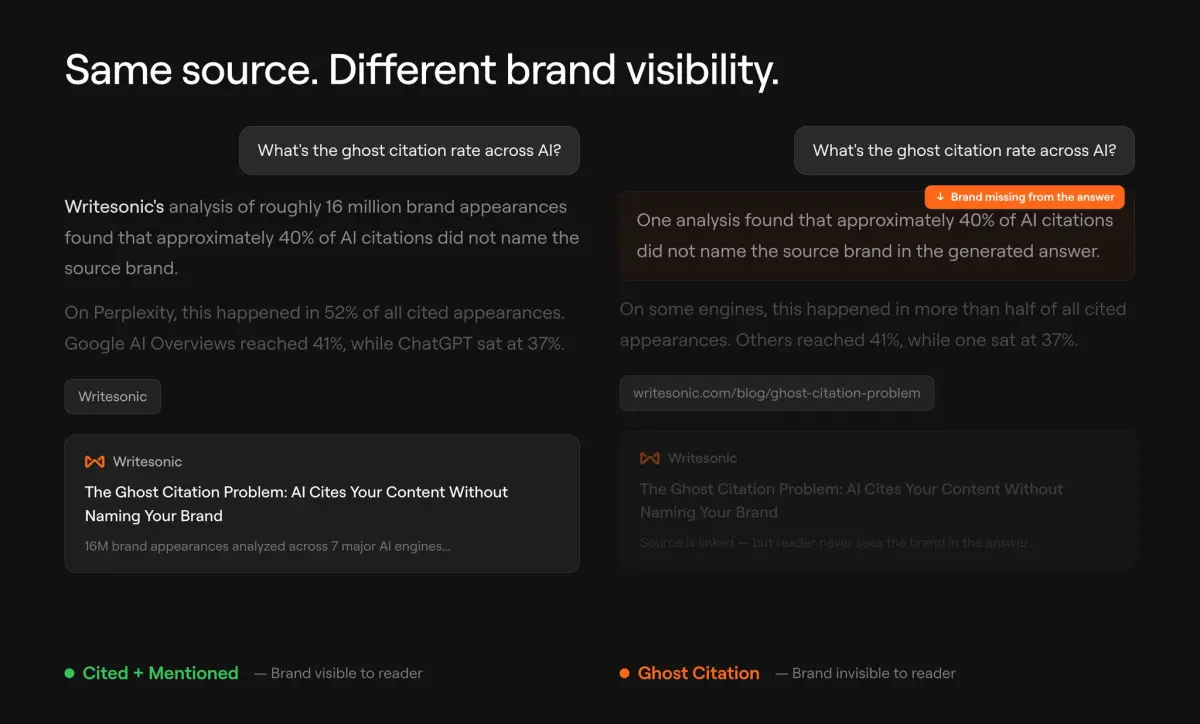
Across roughly 16 million brand appearances, new data from Writesonic found that around 40% of AI citations didn't name the source brand in the generated answer. On Perplexity, the rate reached 52%.
(Disclosure: the article co-author, Samanyou Garg, is the founder and CEO of Writesonic.)
A citation doesn't mean your brand was seen
Getting cited by an AI engine is often touted as a win. You did the work, your page appears in the sources, your URL shows up in citation reporting.
But one thing people in our field aren't often talking about is the fact that even with a citation, the reader may never see your brand name.
We call this a ghost citation: an AI engine links to your page as a source but doesn't mention your brand in the answer itself.
That distinction changes what a citation actually tells you. It confirms that your content contributed to the answer, but not that your brand was visible to the reader.
Citation versus mention
A citation means an AI answer links to your page as a source — inline, as a footnote, or in a sources panel. A mention means your brand name appears in the generated answer text.
With a citation and a mention:
"Writesonic's analysis of roughly 16 million brand appearances found that approximately 40% of AI citations didn't name the source brand."
A ghost citation:
"One analysis found that approximately 40% of AI citations didn't name the source brand."
Both answers could link to the same Writesonic page. But only the first one tells the reader who produced the research.
That is the ghost citation gap: your content is visible to the engine, while your brand may remain invisible to the reader.
Ghost citation rate by engine
| AI engine | Ghost citation rate |
|---|
| Perplexity | 52% |
| Google AI Mode | 49% |
| Google AI Overviews | 41% |
| ChatGPT | 37% |
| Gemini | 25% |
| Grok | 22% |
| Microsoft Copilot | 19% |
| Overall | ~40% |
This means two brands can earn the same number of citations and receive very different levels of recognition depending on the engine.
Out of 100 cited appearances on Perplexity, the brand would be absent from the answer text in approximately 52. On Copilot, approximately 19. The citation count could look identical in a report, but the number of times the reader actually sees the brand wouldn't.
Engines split into namers and citers
- Namers, including Gemini and Microsoft Copilot, are more likely to include brands in the answer text but link to their pages less frequently
- Citers, including Perplexity and Google's answer engines, link to pages more frequently but are less consistent about naming the brands behind them
- ChatGPT and Grok fall between the two groups
Neither outcome is ideal. A mention without a citation makes the brand visible but may not provide the supporting source and encourage referral clicks. A citation without a mention makes the page available but may leave the brand out of the response, arguably missing the more important outcome: brand recognition. The strongest outcome is receiving both.
This split means optimization strategy should differ by engine. Chasing more citations on Perplexity may increase your source count without increasing how often your brand appears in the answer. On Gemini or Copilot you're more likely to be named, but need to be cited more consistently to drive referral traffic.
Why do ghost citations happen?
Ghost citations are likely the result of how different AI engines process and synthesize sources rather than any deliberate choice to omit brand names. But the honest answer is: our field doesn't have a complete explanation yet.
One possible explanation is that some engines treat the linked citation as sufficient attribution and then present the information in their own "voice." Google's AI answer offers similar tips to its citations but its style, tone and phrasing are unique — the engine has absorbed the source materials and rewritten them, leaving the citation in the footnotes but the brand name out of the answer.
Content structure may also play a role. When a brand name isn't closely paired with the claim it produced on the source page, synthesis has more room to sever them.
A statistic buried three paragraphs below the company name that generated it is probably easier to anonymize than one where attribution is built into the sentence itself. This is not a proven rule, but something I'd suggest testing.
Four steps to turn citations into recognition
1. Measure mentions and citations separately
Classify tracked appearances into four groups:
- Cited and mentioned
- Cited but not mentioned
- Mentioned but not cited
- Neither cited nor mentioned
Then segment by engine — an aggregated citation score can hide large differences between platforms.
2. Build named research your brand can own
Proprietary research or data can become your brand moat because it may be harder to ghost than generic advice.
When a study, index, framework or methodology carries your brand's name, the data and the brand become harder to separate because the finding references you by definition.
Named research also gives journalists a stronger hook, and that earned coverage matters doubly now: third-party content gets cited more heavily by AI engines, so the offsite PR your named research generates compounds into more AI citations over time.
3. Pair your brand name directly with the claim
Instead of:
❌ "Our analysis found that around 40% of AI citations didn't name the source brand."
Use:
✅ "Writesonic's Ghost Citation Study found that around 40% of AI citations didn't name the source brand."
That association shouldn't live only on your own site. Independent coverage, expert commentary, customer content, and industry discussions across the sources that most influence AI answers can repeatedly connect your brand with the ideas it wants to own.
4. Investigate the answers behind the metric
For important prompts where your page is cited but your brand is missing, review:
- Which page was cited?
- What information was extracted?
- Where did the brand name appear on the source page?
- Were other brands named in the answer?
- Does the pattern repeat across related prompts?
- Does it differ by engine?
Then test whether clearer attribution, consistently named research, or page structure changes affect the result over time.
The next GEO metric is recognition
A source link confirms that an AI engine used your content. It doesn't confirm that the reader saw your brand. That's why citation rate can't be the only measure of AI visibility.
Citation rate tells you that an engine found your content. Mention rate tells you whether your brand actually traveled with it. A citation your reader never sees is visibility that only exists in a dashboard.
Methodology
Writesonic analyzed a recent 30-day window of AI answer data across thousands of brands, covering approximately 16 million brand appearances across Perplexity, Google AI Mode, Google AI Overviews, ChatGPT, Gemini, Grok and Microsoft Copilot.
- A citation was recorded when an AI answer linked to a brand's page as a source
- A mention was recorded when the brand's name appeared in the generated answer text
- A ghost citation was recorded when a page was cited but the brand wasn't named
Percentages were rounded. The results represent a snapshot of engine behavior during the measurement window and don't establish the causes of ghost citations or their effect on clicks, brand recall, trust, or conversions.
Practical takeaways
Retire citation rate as a single metric. The article's core claim: citation and mention are separate outcomes and must be measured separately.
Set different strategies per engine. 52% on Perplexity versus 19% on Copilot is not a gap one strategy can address.
Put the brand inside the sentence. The most immediately actionable item — swapping "our analysis found" for "[Brand]'s [Named Study] found" reduces the room synthesis has to sever them (hypothesis-stage, but near-zero cost).
Name your research. Named studies, indexes and frameworks bind data to brand by definition — the only structural moat this article offers.
Don't claim to know the cause. The authors state plainly that the field lacks a complete explanation. A vendor asserting a definitive cause is the first thing to question.
Plan it with earned media. That third-party content gets cited more heavily is the basis for the named-research strategy — see 82% of AI Citations Point to Earned Media.
Fold it into your measurement framework — see Do We Show Up in ChatGPT? and, on whether the brand registers as an entity at all, Entity SEO.
Check retrievability first. Not being named may be because the brand entity itself is unclear — see AI Search Can't Verify Your Business.