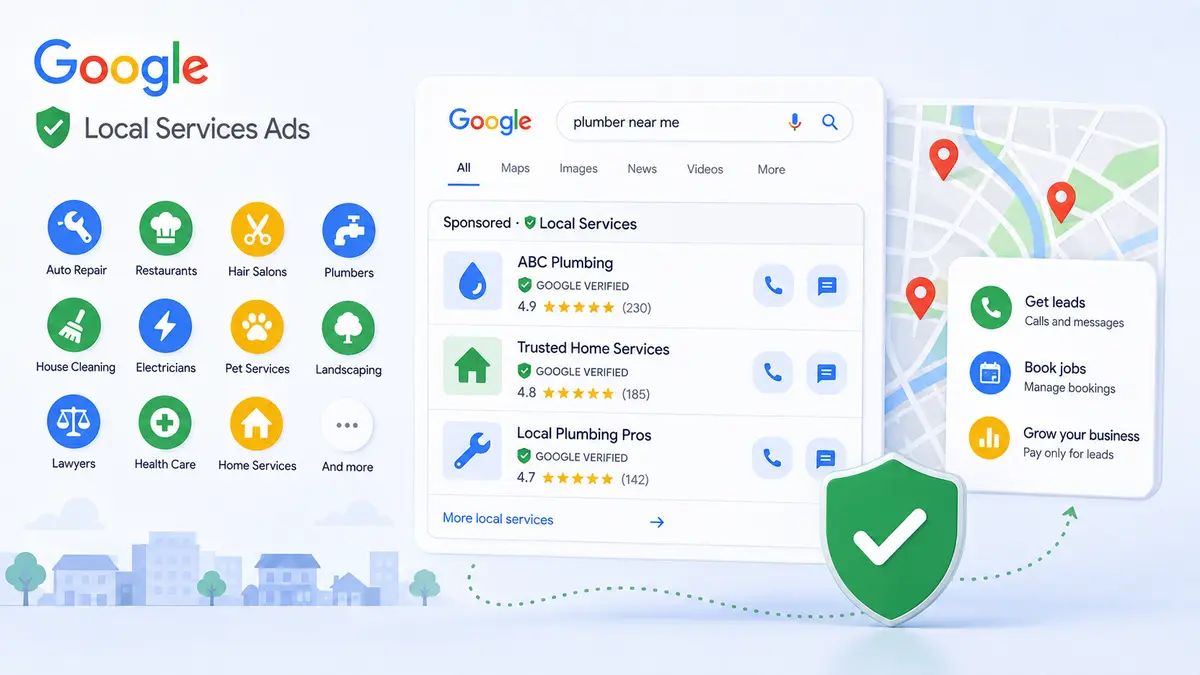
Google has substantially expanded the list of businesses eligible for Local Services Ads, adding far more specific categories across restaurants, automotive services and beauty — and it lands as the company prepares to migrate LSA campaign management into Google Ads.
What changed in the Local Services Ads categories
The previous documentation represented whole industries with broad buckets: Restaurant, Dessert and coffee, Auto repair shop, Car wash and detailing, plus a small set of beauty services. The updated document breaks those into far more specific options.
Restaurants alone now span dozens of categories, from American, Chinese and Italian to pizza, sushi, steak houses and vegan restaurants.
Automotive gets the deepest split
Automotive classifications now include Auto Air Conditioning Service, Auto Glass Repair Service, Brake Shop, Car Battery Store, Car Inspection Service, Oil Change Service, Tire Shop and Transmission Shop, among others. Google told Search Engine Land the specificity is deliberate: separating a transmission shop from general auto maintenance lets a business describe exactly what it does and reach customers searching for that specific service.
Pre-badge ads and a wider Verified exclusion
The documentation adds a new Pre-badge ads section. Businesses that pass preliminary checks can start receiving LSA leads while completing the remaining requirements for the Google Verified badge, though those listings appear below fully onboarded providers.
Google also broadened where the Verified badge is unavailable. The earlier document excluded dining verticals only; the current one excludes auto, beauty and dining categories.
The migration timeline
The category work sits inside a bigger transition. Google confirmed it continues investing in LSAs while gradually moving campaign management into Google Ads through 2027. Phase one starts with select U.S. home and storefront service advertisers in August 2026, expands to more advertisers later in the year, and reaches non-U.S. accounts and remaining categories in 2027.
What is not changing
Advertisers keep paying for valid leads rather than clicks, campaigns stay keywordless, and ads continue appearing only in their existing local placements on Google Search and Google Maps. Existing setups migrate into Google Ads automatically, so nobody needs to rebuild campaigns just because the management surface moved.
Why this matters beyond the category list
Granularity turns how precisely you declared your business into a lead-quality variable. A transmission specialist and a tire shop previously shared one bucket; now they receive different search intent, and the mismatch that used to be invisible becomes measurable.
Read it alongside where local discovery is heading. As covered in Business Websites Took 60% of Gemini's Local AI Citations — but Repeats Rarely Match, AI answers about local businesses lean heavily on the business's own site. Paid leads and organic AI citations are sending the same signal: precise, consistent business information wins in both.
The broader shift — verification moving off the customer and onto the system — is covered in Local 5.0 Is Here — the Verification Burden Moved From Customers to AI. The immediate task is unglamorous: re-pick the closest category from the updated list, and make sure your profile, website and LSA declaration all describe the same business.