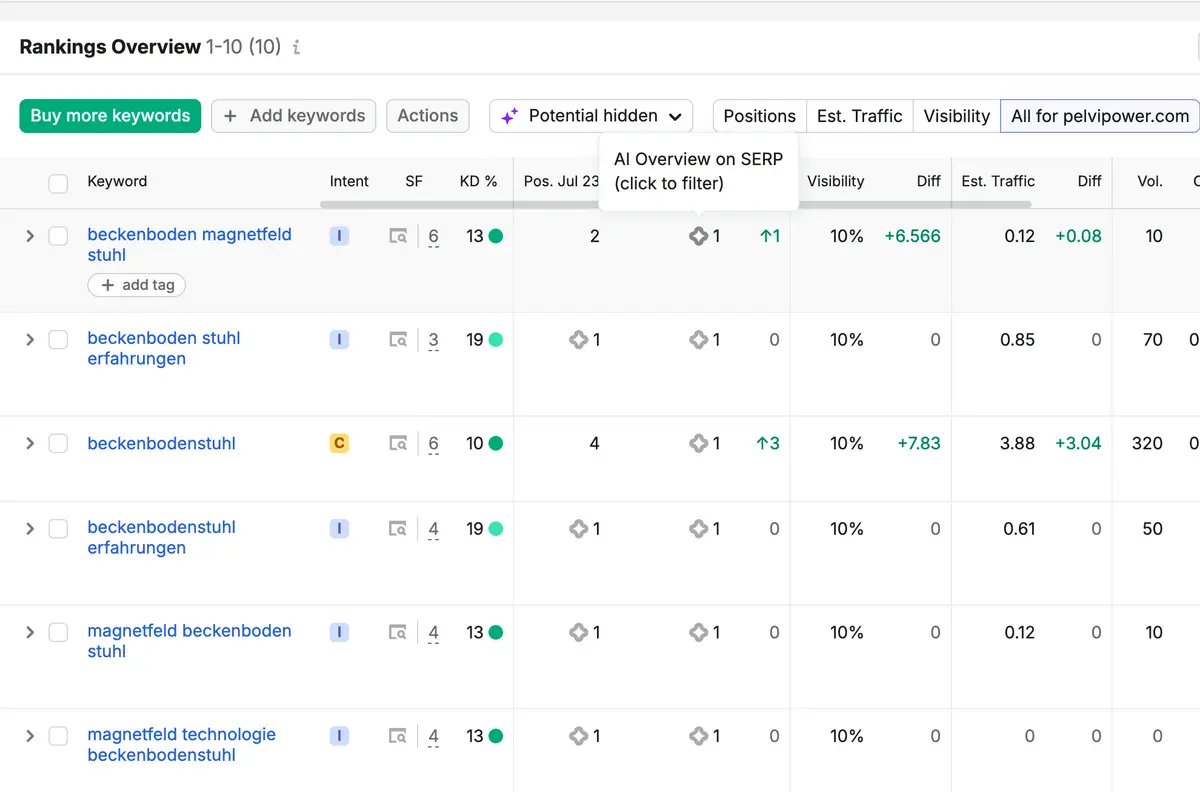
A B2B buyer can finish a large part of the decision before ever clicking through. While an AI Overview explains a technology, compares approaches, and surfaces brands, the buyer is still researching the market. By the time they click a result, they often already have a view of which companies are credible and which solutions belong on the shortlist.
That creates a gap. Winning the click and influencing consideration are two different outcomes. Traditional SEO metrics only capture the first.
Search Visibility No Longer Starts With the Click
Rankings, impressions, clicks, and sessions still matter. They no longer describe the whole search experience.
Take a healthcare professional researching a premium pelvic floor chair. Their questions run: How does magnetic pelvic floor stimulation work? How do the technologies compare? Which patients benefit? How does it integrate into a practice? What should a clinic consider before investing?
Previously they would visit several sites to build that picture. Now an AI Overview summarizes much of it inside the results page. The brands and sources inside the answer effectively assemble the list of companies worth investigating.
Being Cited Is Not the Same as Ranking
Traditional SEO asks where a page ranks. AI search adds a second question: is our content being selected as a supporting source?
A page can rank first without being cited, and a page can be cited without ranking first. So B2B content should cover more than one target keyword — it should answer the connected questions surrounding the purchase: how the technology works, who it is for, how it differs from alternatives, what evidence supports it, how it fits a professional workflow, what training and support exist, and what to weigh before investing.
Zero-Click Does Not Mean Zero Value
AI Overviews do reduce clicks on some informational queries. A search without an immediate visit is not automatically worthless. A buyer may still remember the brand, search for it later, recognize it in a paid ad, share it internally, and return once the project becomes commercially live.
In long B2B cycles this matters. A clinic or rehabilitation center rarely invests after a single interaction. An AI Overview becomes one of several trust-building touchpoints before the inquiry.
How to Measure AI-Driven Traffic
For what happens after arrival, GA4 remains the practical source of truth. With AI assistant traffic grouped into its own acquisition channel, it can be compared directly against organic, paid, and direct. The question is not only volume but behavior: do AI-referred visitors act like qualified prospects, or leave without a meaningful action?
GA4 should not be the final word on lead quality. It can confirm a form submission; the CRM determines whether that lead qualified, entered the pipeline, or produced revenue. For a layered measurement structure, see A 5-Layer Framework for Measuring AI Search Performance.
AI Visibility Supports Paid Search
Treating AI Overviews as an SEO-only topic misses their downstream effect. When a buyer first meets a brand inside an AI answer while comparing solutions, familiarity forms even without a click. When that same brand later appears in a paid search ad, the ad is not introducing an unknown company — it is reinforcing a name the buyer already recognizes.
The effect spreads across signals: branded search growth, recognition in paid results, stronger click-through rates, more trust on the landing page, better competitor campaign performance, more direct traffic, and easier sales conversations. It is also hard to isolate, because the AI exposure can precede the measurable click by days or weeks. Last-touch attribution credits only the final interaction.
For that reason SEO, AI visibility, and paid search should not be evaluated as separate systems. They act on the same buyer at different stages. For content requirements that earn citations, see LinkedIn Publishes an AI Citation Playbook.
The Goal Is Not Appearing Everywhere
A citation matters only when it reaches the right audience, answers a commercially relevant question, and moves the buyer toward a decision. What B2B marketers should optimize for is credible, evidence-backed content, demonstrated expertise, and visibility that feeds a qualified pipeline.
The conversion still happens on the site. Trust increasingly begins before the click.