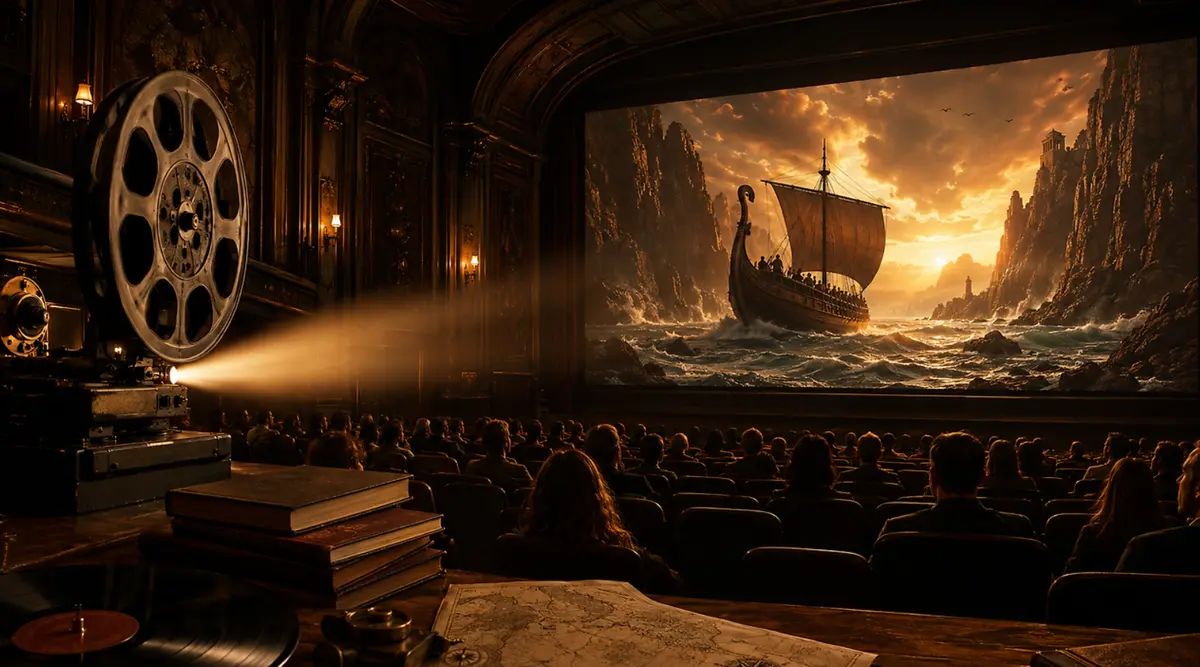
Movie theaters are busy again — a real shift from the recent stretch when they screened live sports and built nap rooms to fill seats.
One case stands out. The source material is roughly 2,800 years old, a Homeric epic with nothing new about it. Yet audiences deliberately seek out the more expensive IMAX screening. That's the case for experience marketing in one sentence.
Deliberately Choosing the Harder Way
Christopher Nolan is a famous analog holdout. In an era where most directors lean on CG, he insists on film and practical shooting. For Interstellar he planted actual corn for the cornfield scenes; for Tenet he used a real aircraft. His Odyssey is the first commercial film shot entirely on IMAX film cameras, consuming roughly 640 kilometers of film over 91 days.
Easier methods exist, and he picks the harder one anyway. What Nolan wants isn't film itself but the experience only that method produces. Audiences know it too — the same movie on a laptop and in an IMAX theater are entirely different experiences.
The Same Pattern in Content
Popular content shows it too. Idol content resonates not through polished presentation but through the specific unguardedness that only exists at that age; viewers experience their own nostalgia by proxy. Travel shows that navigate back roads with paper maps summon a sensation people encountered in childhood.
Podcasts follow suit. Where earlier podcasts served intellectual curiosity, today's fill a community experience modern life lacks — content taking on the role salons once played.
Consumption Habits Changed
In the U.S., 2022 vinyl sales (41 million) outsold CDs (33 million) for the first time since 1987. In Korea, domestic popular-music vinyl sales rose 262% year over year on one major retailer.
Why vinyl in an era where streaming suffices? People want the inconvenient process itself — pulling out the record, setting it on the turntable, lowering the needle. They're consuming the time spent listening to music, not the music.
Photography is the same. In an era where phones auto-correct even shaky images, people buy film cameras and seek out photo booths, because they want the physicality of a print you can hold. So are bookstores: online is cheaper and faster, yet people go to independent and curated shops — not to buy a book, but to spend time in a space where books sit.
When Efficiency Became the Default, Its Opposite Became Scarce
Technology keeps eliminating inconvenience while people pay for it. The reason is that efficiency became too common.
AI produces content in seconds and algorithms choose your taste for you. Convenience is no longer a special value — it's the baseline. Which made everything on the other side scarce: going somewhere yourself, waiting, touching with your hands, discovering by accident.
Scarcity becomes premium. Analog's return isn't simply retro taste. The faster and easier everything gets, the more valuable experiences that require spending time become.
What Brands Have to Sell
Brands face the same shift. In food and beverage campaigns, showing how good the product tastes used to be the job. That's no longer enough — there are too many good products, and taste is personal.
Consumers want to imagine what kind of time they'll have with this product, what feeling will remain. A cheerful evening with friends, or a quiet stretch alone. The brand with a clearly defined texture of experience is the one that gets chosen.
What brands must sell is not a product USP but an imagined experience. When someone owns the product, when they're with it, they should be able to picture the time they'll spend. When that sensation repeats consistently, consumers willingly experience the product and reinterpret it in their own way.
There's an old marketing line that the customer doesn't need a hammer, they need a hole. What we sell isn't the product but the result and the feeling it produces. What Nolan sold audiences wasn't a film — it was three hours of immersion that felt like traveling the journey itself, achievable only through analog production.
What experience does your product evoke? When people think of your brand, is there a feeling that comes with it?
The same current appears in Pinterest's rising hobby trends, where feed-fatigued consumers go hands-on. In a market where convenience is the default, what a brand can sell is the quality of time.