The content IP business case behind one hit drama
The Korean drama "Kim Bujang" opened at a 9.5% rating and passed 20% by its fourth episode. It traveled too: in its second week on Netflix it logged 10.5 million views, topped the non-English TV chart, and entered the top 10 in 79 countries including France and Canada.
The contract structure matters more than the numbers. SBS retained the drama's IP and sold Netflix only the distribution rights. Netflix originals typically work the other way — the platform absorbs most of the production cost and takes the IP with it. That lowers a studio's downside, but even a massive hit is hard to bank as a long-term asset. "Kim Bujang" used Netflix's global distribution while leaving sequels, remakes and spin-offs on the SBS side of the table.
A structure built in advance
SBS spun its drama division into Studio S in 2020. In 2024 it merged Studio S with SBS Contents Hub, the distribution arm, consolidating development, production and distribution into a single company — the same studio-system shift CJ ENM made with Studio Dragon and JTBC with SLL.
With that in place, SBS signed a six-year partnership with Netflix in December 2024, effective from 2025, supplying new and existing dramas, variety and factual programming, with some new dramas released globally on the same day. It was a step back from the terrestrial broadcasters' Wavve-centered independent distribution plan. Critics warned SBS would end up dependent on Netflix; the approach it actually took was to supply what Netflix needs while keeping the IP assets.
The season-series axis
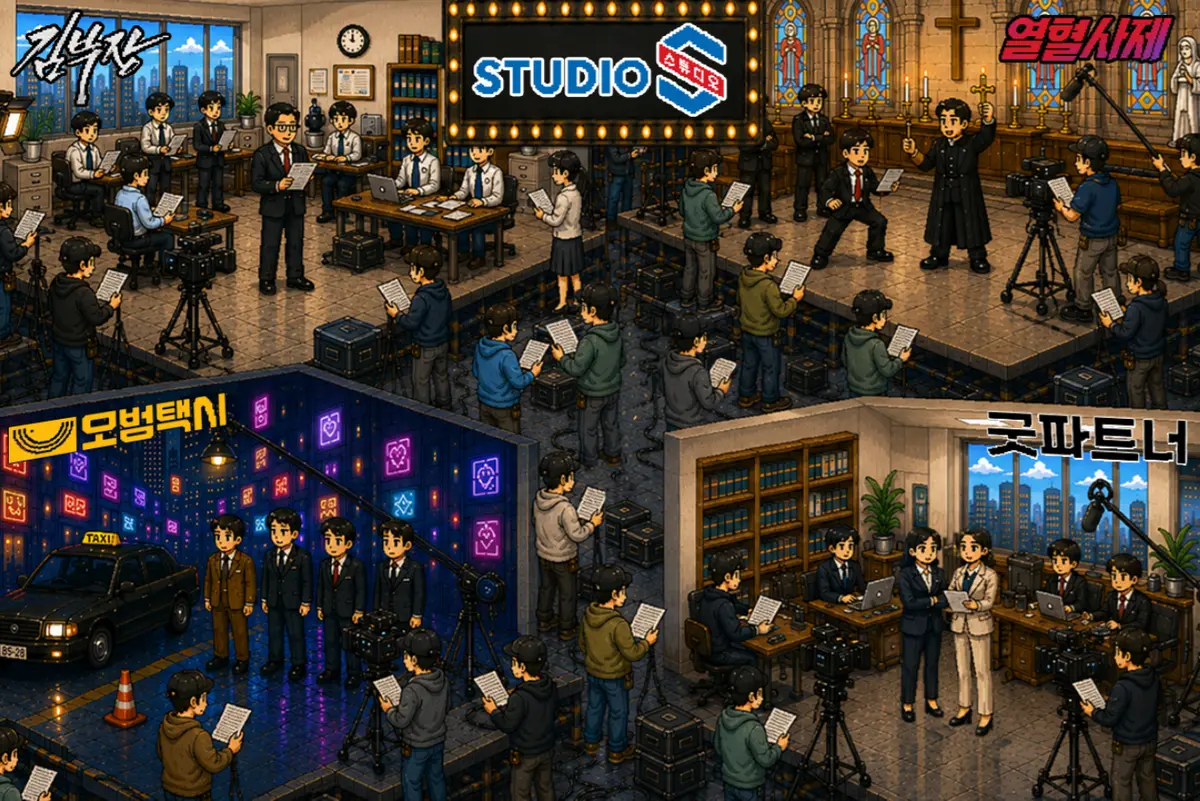
SBS has concentrated on returnable series — "Dr. Romantic," "Taxi Driver," "The Fiery Priest" — and describes "series power" as the core of its drama strategy. "Kim Bujang" fits: adapted from a popular webtoon, it arrived with characters, a world and a readership already in place.
Two problems still unsolved
The first is production efficiency. Hits cannot be guaranteed, so sustaining many attempts means controlling per-title cost without losing quality. "Kim Bujang" produced a roughly three-minute action sequence showing the protagonist's past using generative AI; Studio S says that scene cost more than 60% less than it would have without AI.
The second is IP monetization. Owning rights does not by itself generate revenue. Beyond sequels, a title has to extend into overseas remakes, format sales, spin-offs, soundtracks, merchandise and experiential content. "Squid Game" is the reference case for how long an IP's life can run once brand collaborations, products, games and experiences are attached.
The marketing read
This is not only a broadcaster's problem. It maps directly onto whether a brand discards its campaign output when the flight ends or keeps it as a reusable asset. The principle is the same: borrow the platform's reach, keep ownership of the asset. For how content converts into fandom, see Brand Message Becomes Content, Content Becomes Fandom.
The AI production saving belongs to the same loop. The number that matters is not 60% on one sequence, but that the saving funds more attempts, and more attempts produce more IP candidates.
FAQ