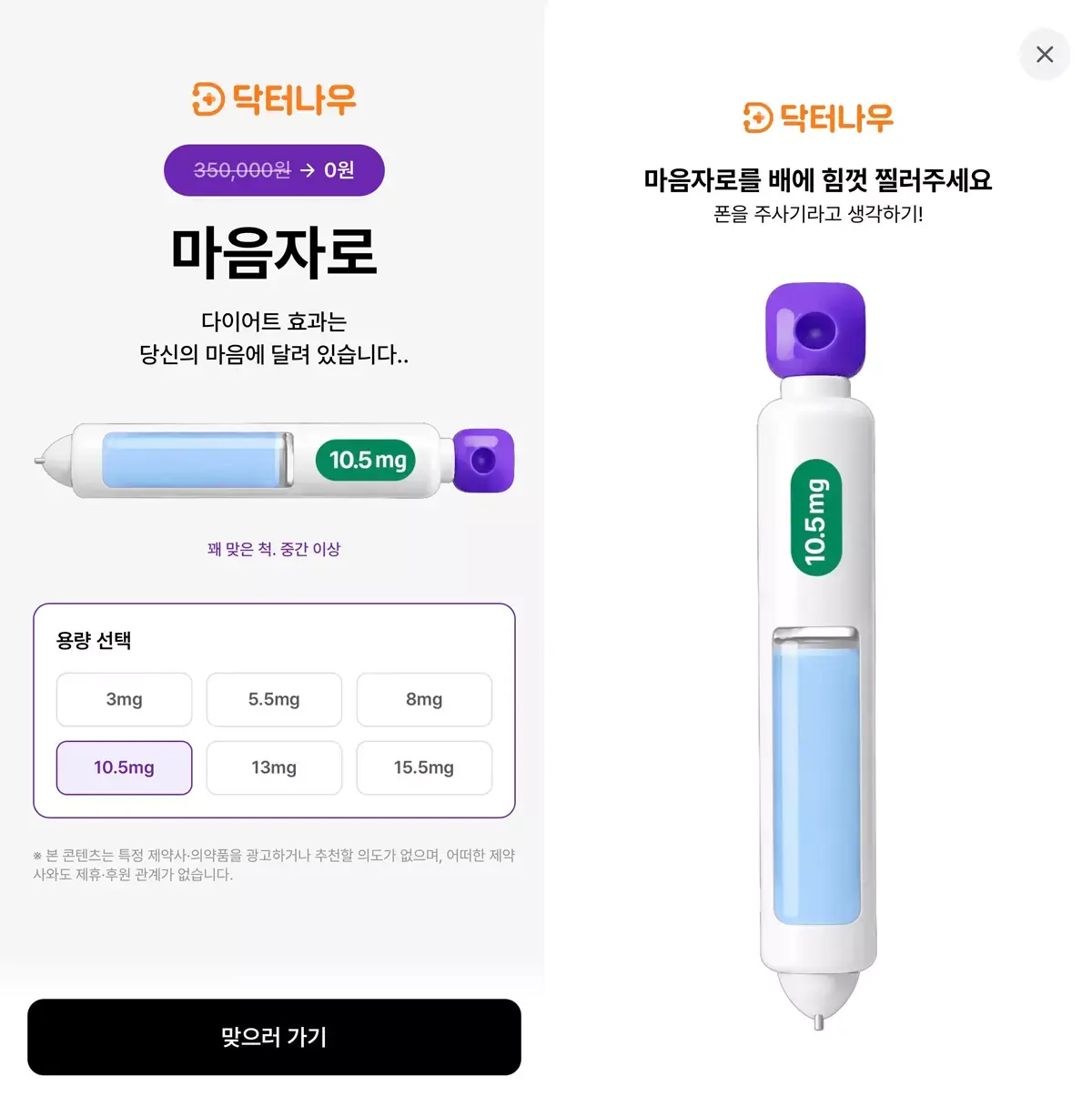
A viral injection is making the rounds on Korean social media. It is called Maeumjaro — a play on Mounjaro, the well-known weight-loss drug. It is not a real injection but content that simulates receiving one. Pick a dose, hold your phone against your stomach, and the screen's syringe empties as the device vibrates. When it finishes, a message appears: "the fake-cebo effect made your appetite disappear!" It then recommends "a dinner your heart approves of." Users report genuine psychological relief from the attention to detail.
The coinage does the work. It twists the placebo effect — symptoms improving because you believe you took medicine — into something further removed. Here there is not even a sugar pill, only content on a screen. Hence the joke embedded in the name.
From the mood economy to mood value-for-money
The "mood economy" describes consumers opening their wallets to manage how they feel. What is visible now goes one step past that: minimizing cost while maximizing psychological payoff. Persistent inflation is the backdrop — spending freely to buy a feeling is no longer available to most people.
Three strategies show up.
Buying fun without spending money
Virtual shopping malls, which appeared first in Japan and now exist in Korean versions, are the clearest case. You add items to a cart and complete a simulated checkout; log in and you can leave reviews. The products do not exist. A review for an "infinitely multiplying planter" complains that after a short trip, the scallions had multiplied and the whole house smelled of onion.
There are virtual delivery apps too. Add food, enter an address and phone number, complete payment, and you get an order confirmation, an estimated delivery time, and a live map of the driver's route. What arrives at delivery is not food but a message: "you resisted again today!" The structure isolates the feeling of ordering from its cost and calories. As AI makes app-building cheap, more of these keep appearing.
Buying the premium feeling at minimum cost
Five-star hotels and fine dining deliver a sense of being treated specially at a price most people cannot absorb. So consumers route around it. Instead of booking a room, they use the pool, spa and lounge and post photos that read as a hotel staycation. Or they plate food at a mass-market buffet to look like fine dining — the recent viral photo reviews of the Korean buffet chain Kuu Kuu do exactly this, arranging a few items on an ordinary plate into restaurant-style presentation.
Cooking competition shows have made technical culinary vocabulary common. Consumers understand premium food culture well; the desire for premium experience has generalized even where the spending power has not. So they reproduce the signal, wittily, without the cost.
Buying peace of mind cheaply
Some things cannot be solved by spending. A couple planning an outdoor wedding cannot buy good weather. What they can buy is less anxiety. On Etsy, "weather spells" promising to hold off rain on a wedding day sell for roughly $4 to $40. Nobody believes the weather actually changes. What they are purchasing is the feeling of having done everything possible — psychological insurance.
The industry effect: dupes as a category
This cost-minimizing behavior reshapes markets. Historically, consumers hunted value on practical purchases but accepted high prices on emotional or symbolic ones. Now finding a reasonable price is the default across nearly every category, fun and premium experience included.
Hence dupes — products imitating the performance of famous brands — have graduated from trend to industry. Business of Fashion declared the state of the beauty industry a "Superdupe Era" in July. Dossier, which reproduces designer fragrances, started as a dupe brand and has since secured distribution through Walmart, Target, CVS and Boots in the U.S.
What this means for marketers
The striking part is the attitude. Rather than treating a tight budget as bleak, consumers respond resourcefully and often absurdly — using AI to make free virtual content, staging luxury signals with cheap products. "Whimsy-core," now emerging among younger consumers globally, runs on the same logic: treating whimsy as an aesthetic goal, decorating daily life in storybook colors, inventing ridiculous recipes, converting a hard reality into a brighter register.
That defines what brands are being asked for. Not aloofness, and not pure consolation, but a brand that talks like a friend and repaints ordinary days in pastel.
Two operational implications follow.
First, cutting price and providing mood value-for-money are different moves. A discount reduces spend; mood value-for-money raises psychological payoff per unit of spend. What a virtual delivery app sells is not food but the feeling of ordering, at zero cost. Finding which emotional fragment of your experience can be detached and given away for free usually returns more than another discount.
Second, check who actually decides. As Mom Outranks Every Creator in Gen Alpha Brand Choice showed, the person consuming and the person deciding are frequently different people. Mood spending is no exception: separate who pays from who gets the feeling.
Finally, this fragmentation collides with marketing built around an average consumer — the same failure described in Your Customer Journey Doesn't Work Because It Was Built for an Average Customer. Consumers optimizing for mood value-for-money are not sitting near an average. Each one runs their own cost-benefit arithmetic.