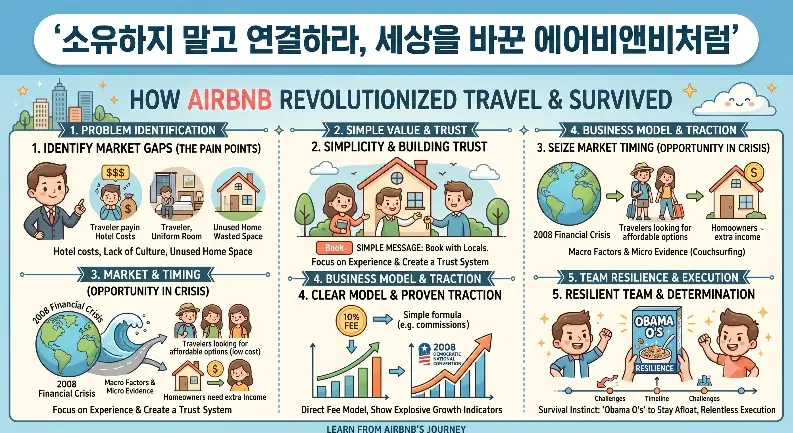
Airbnb, the company that reshaped global lodging, started amid severe investor skepticism and a cash crisis. In 2008, sleeping in a stranger's home — or hosting one in yours — read as dangerous and unrealistic.
Here is how they made the case, broken into five layers that transfer directly to early-stage pitching.
1. The Problem — Find the Fatal Gap in a Market That Looks Complete
Investors do not think "a new service exists." They ask where legacy industries have left customer needs unresolved.
Airbnb focused on how the hotel industry's centuries-old standardized service had itself become a barrier and a source of isolation.
- Price pain: hotel bookings in major cities impose heavy costs on travelers.
- Emotional isolation: hotels offer the same bed and wallpaper everywhere, disconnected from the actual life of the place.
- Wasted space: locals' homes are full of empty rooms and couches — assets with no legitimate, convenient platform to monetize them.
The key move was not citing a supply shortage statistic. They designed a frame that solved price, isolation, and waste simultaneously.
2. The Solution — Simple Value and Engineered Trust
Rather than showcasing complex technology, they moved the competitive arena from buildings to platforms.
- Cheaper than a hotel, lived like a local: beyond low-cost lodging, a passage into the real life of a neighborhood.
- A spare room becomes income: anyone could generate side income from space without special skills or capital. Sharing became an economic instrument that covered rent, not an act of goodwill.
- Trust built as a system: the anxiety of staying in a stranger's home was converted through two-way reviews, profile verification, identity confirmation, pre-stay messaging, secure payment intermediation, and host guarantees.
Their pitch deck skipped feature lists entirely and carried the business value in one line: "Book rooms with locals."
3. Market and Timing — Capture the Historical Moment
Investors are unmoved by "the market is worth X billion." They look for why the world changing now makes this business inevitable.
The macro case: the 2008 financial crisis became the engine. Travelers urgently wanted lodging cheaper than hotels but still safe; homeowners urgently wanted income to cover rent and mortgage interest. Airbnb targeted economic scarcity on both sides of the marketplace.
The micro evidence: to the objection "will people sleep in a stranger's house?", they cited that Couchsurfing already had more than 1.33 million registered users. Shared lodging was already socially accepted.
Sizing method mattered too. Instead of top-down "if we capture just 1% of the global market," they used bookable inventory × average price — bottom-up data. They defined the initial target narrowly, as short-term stays during events and festivals, then proved the expansion path logically.
4. Business Model and Traction — Show Cash Actually Moving
Investors want the mechanism — how do you earn the first dollar and grow it to ten? — plus evidence the market is responding.
Clarity of revenue: no vague "we'll add ads once users accumulate." They presented a simple, powerful formula: transaction value × 10%. Revenue scales directly with the business.
Traction as proof: during the 2008 Democratic National Convention, when hotels ran short, hundreds of bookings landed in a compressed window. Real event, real numbers. It converted the pitch into a conviction: if this happened under special conditions, systematizing it makes it ordinary.
5. Team and Execution — Resilience Over Résumé
The earlier the round, the larger people risk looms. Investors want to know whether the team has the core capability to solve this problem, and whether they will stay when things break.
Domain fit: founders Brian Chesky and Joe Gebbia did not present themselves as technologists. They emphasized being design professionals from the Rhode Island School of Design — UX experts able to design the anxiety of unfamiliar space into trust and beautiful experience, beyond what a technical system alone delivers.
Legendary execution: when investors passed and funding ran dry, they produced and sold limited-edition cereals — Obama O's and Cap'n McCain's — raising $30,000 in operating capital to keep going. That episode convinced investors this team would push through anything.
The team slides listed clear roles and a record of solved problems rather than credentials. "We moved this relentlessly to solve this problem" proved far stronger than "we are smart."
The Pattern Repeated
Airbnb's success came from relentless execution rather than a clever idea. During the early cash crunch, following the advice to "build something a few people love," the founders met New York hosts in person to lift booking rates. During the 2020 pandemic — an existential threat — they cut staff quickly while reading the demand shift toward nearby travel and long stays, then went public.
Five Transferable Lessons
- Connect rather than own. Before buying assets, look differently at idle resources that already exist.
- Design trust like a product. Trust does not emerge on a platform by itself. The mechanisms that create it — reviews, verification, payments — are the core product.
- Do things that don't scale first. Before obsessing over automation, build an experience a small early group loves.
- Redefine the problem. Markets reorganize when the question changes from "how to build a better hotel" to "how to make spare space useful."
- Stay flexible in crisis, hold the core. Change the business shape quickly, but protect the essential value you exist to deliver.
A Marketing Postscript
The third principle — do things that don't scale — holds in marketing too. Constrained budgets often produce sharper execution and better outcomes, as seen in three low-budget campaigns that went viral precisely because there was no money.
So does the fourth. Redefining a category changes who you compete with — the logic behind why Burger King Korea made truck-stop diner signage and why a sharp reframe travels.
Bottom Line
Airbnb's pitch did not work because the idea was good. They defined the problem in three layers, engineered trust as a product, sized the market bottom-up, reduced revenue to one line, and proved execution with an anecdote. Each layer answers a different investor doubt. The structure is the lesson.