A recent study published by Incogni found that social media dynamics are shifting — becoming less about social posting and updates, and more about entertainment, algorithms and short-form content.
The insights are based on a survey of 1,000 Americans asked about their social media usage and how it has changed.
55% post less than five years ago
| Measure | Share |
|---|
| Posting less to social media than five years ago | 55% |
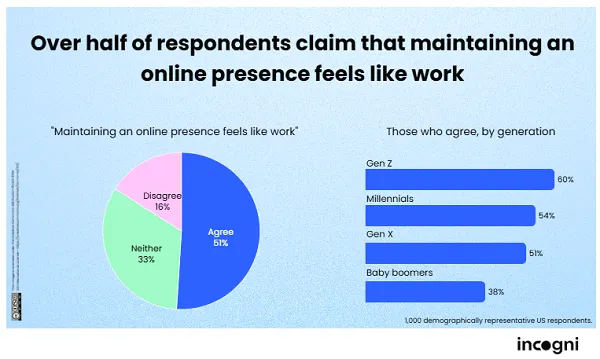
| Say maintaining a social presence "feels like work" | More than half |
That aligns with other trend data showing fewer people posting online, and more people sharing updates with closer friends within private DM groups.
Active posters were always a minority
- 2019 Pew Research data: around 80% of all tweets on Twitter were published by just 10% of the app's users
- The 90-9-1 principle, published by The Guardian in 2006: across collaborative websites including social apps, about 90% of participants only read content, 9% edit, and just 1% are active creators
A lot has changed online in 20 years, but this proportion appears to be holding steady. In fact, it could be more exaggerated now, given the trends reported by Incogni.
That would mean only a small fraction of profiles are ever sharing anything, which points to limits in online perspectives.
Creator burnout
Social media's reliance on such a small percentage of creators could also be leading to social posting burnout.
More than half of respondents said maintaining a presence "feels like work," and that pressure is particularly felt by younger creators, who are more likely to aspire to make money online.
The successes of creators including MrBeast have paved the way for a new generation of users who may believe that making money online is relatively easy. But it's not.
| Source | Finding |
|---|
| Influencer Marketing Hub | More than 48% of creators make less than $15,000 per year from their online efforts |
| TubeFilter (2015) | 95% of all YouTube views were driven by just 5% of active accounts |
Breaking through is tough. And as a new generation of users has been sold on the concept of simply doing what they love online and getting paid for it, it's becoming clear that it's a lot of work.
These figures also point to a potential reason why people generally feel more relaxed when they take a break from social media and messaging apps.
Political content and algorithmic division
Another factor is the increased presence of political content and algorithm-driven division.
Algorithms incentivize users to post content that triggers an emotional response, which then drives more partisan posting. The resulting angst gives creators a dopamine-fueled rush of likes and comments.
Per the report, that incentive has played a big role in sustaining political division, which has driven more people away from social apps.
But: is time spent actually falling?
Whether users are actually reducing their time on social media, as opposed to just saying they are, is another question.
Meta has reported that time spent on Facebook and Instagram has increased in recent years, primarily due to its increased insertion of short videos into user feeds.
Again, this points to a larger shift: people are moving away from the social and connective aspects and toward using social apps as a form of entertainment.
That's an important note for marketers to be aware of.
Practical takeaways
Drop the word "social" from the strategy. If people use these apps to watch rather than to connect, brand strategy should look more like programming than conversation design.
Separate falling posts from falling time. 55% post less while Meta reports rising time spent — the two metrics running opposite directions is this report's central tension. UGC campaigns get harder while ad impression supply grows.
Calibrate UGC expectations to 90-9-1. If only 1% are creators after twenty years, the addressable pool for "users make it with us" campaigns is small from the start.
Factor creator economics into casting. More than 48% earn under $15,000 a year, which changes where partnership terms become materially meaningful to a creator.
Don't ride emotionally triggering content. An algorithm that rewards outrage is a risk for brands — you gain reach and lose trust.
Move to a format-led strategy to reduce per-post burden — see The New Fundamentals of Social Brand Strategy. "Feels like work" applies to brand accounts too.
Watch the discovery-to-purchase gap on entertainment-consumed channels — see Social Commerce's Trust Gap.
Assume a worsening signal-to-noise ratio. What fills the space people vacate is covered in Can Social Media Survive the Flood of AI Content?.