This piece reconstructs a fiction-format column interviewing retired computing technologies. The format is invented; the facts within it are drawn from the record.
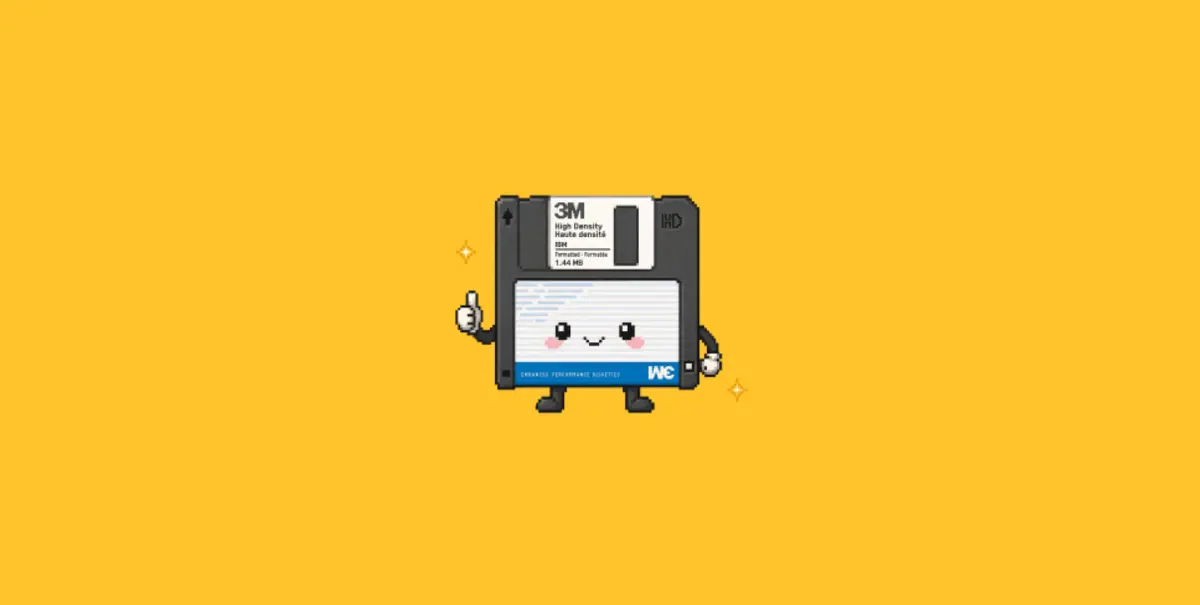
A rectangular object was delivered to the studio one morning. A young staffer studied it for a while and said, "Save icon merch? Cute." They assumed it was a novelty made to look like the icon.
Then the rectangular object spoke. "Not merch. I'm the original."
The staffer apologized but wasn't especially shocked. It was the first one they had ever seen. They press that icon dozens of times a day and had never encountered the object.
"Probably the Only Machine More Famous as a Portrait Than an Object"
The family began in 1971. The eldest was 8 inches, roughly LP-sized; the middle was 5.25 inches; the youngest, 3.5 inches. Capacity: 1.44 megabytes. Not enough for one modern photo, but back then an entire graduate thesis fit inside. Four years of somebody's life lived in there.
The peak was 1998: 2 billion units sold worldwide in one year. When the internet was slow or absent, data didn't travel down wires — it traveled in someone's hand, on foot. Installing one program could mean swapping thirteen disks.
There was a shared national tragedy of the era too: splitting a large file across many disks and hitting an error on the last one.
The Body Died and the Face Got a Job
The world moved to gigabytes while the capacity stayed at 1.44. CDs came, then USB drives, and in March 2011 the last factory closed.
What happened next is the interesting part. The body died and the face got hired — as the save button in every program on earth.
The Post-Retirement Postings Were Remarkable
The U.S. Air Force nuclear missile force, until 2019. Built in the 1970s, it ran for decades without incident. The paradox: floppies are physical media not connected to the internet, so hacking one requires physically entering a missile base and inserting a disk. Remote compromise is impossible. That is exactly what officials meant by "outdated, therefore safer." Additionally, nuclear control systems require full revalidation for a single line change, so replacement cost and risk exceeded maintenance cost.
Japanese government offices, until 2024. That case was legal rather than technical. More than 157 Japanese laws and enforcement ordinances specified physical storage media, with 1,034 provisions explicitly naming floppy disk submission or retention. Bureaucrats didn't prefer them — the statutes literally said "submit by floppy disk." It took the Digital Agency years to repeal them, largely completed in 2024.
Guarding nuclear weapons on one side, carrying residence registration forms on the other.
"It Works Even When You Don't Know — That's What Makes It a Letter"
Younger users don't know why the save button looks that way. Isn't a button whose image nobody can read a problem?
The rebuttal: "It's not a problem that it works without understanding. It works without understanding, which is precisely what makes it a letter."
At first the picture pointed to an object. After thirty years of use, the picture itself came to mean "save." Nobody writing Chinese characters knows what picture each one originally was. They read the meaning anyway.
"Compression used long enough and widely enough stops needing to be decompressed. When compression hardens, it becomes a letter."
To the Younger Icons
Magnifying glass, gear, envelope, telephone handset. Their originals are disappearing too. Who searches with a magnifying glass, turns a gear, or makes calls on a handset shaped like that?
"Don't be afraid. A symbol is only complete once the original is forgotten. The object dies and the meaning remains. That's the road from picture to letter."
What Designers Should Take From It
Count them on your phone tonight. The handset on the call button, the envelope for mail, the gear for settings, the magnifying glass for search. Not one of those objects has been in your hands recently. We conduct daily conversation in portraits of vanished things.
1. The Principle of Skeuomorphism
Giving new functions the face of old objects. The name is difficult; the principle is simple. Something unfamiliar wearing a familiar face doesn't need to be learned. Without the envelope, people would have needed considerable teaching to understand that email was mail. A good interface doesn't make users study.
2. When the Original Dies, the Picture Becomes Independent
Common sense says the image should die with the object. The opposite happened. The picture separated from its original. Compression used long enough and widely enough no longer needs decompressing. At that point it is no longer compression — it is a symbol. A picture that squeezed an object into a few pixels outlives the object as meaning. The road Chinese characters walked is being walked again by pictures on screens.
3. The Weight of Icon Work Is Not Drawing Skill
At any company, proposals to modernize the save icon eventually die. A single company cannot revise a symbol that billions of people agreed on across decades.
Icon work is a posture toward symbols before it is drawing ability.
4. The Highest Place an Interface Can Reach
Not a beautiful picture — a symbol. Something readable without explanation, even after the original is gone.
Which of today's designs becomes a symbol in thirty years is decided not by us but by the people who use it.
The same principle governs brand symbols. Why changing a long-accumulated visual asset is handled so carefully shows up in what brands had to check when Instagram changed its wordmark after a decade.
Retirement Card
- Active years: 1971 (family) to March 2011 (last factory closed) — though the face remains on active duty
- Technology: 1.44MB, a clicking metal shutter, and two human feet
- Reason for retirement: capacity ("only the body retired; the face is on indefinite extension")
- Legacy: the letter meaning "save"