Neko Health, the Swedish health tech company founded by Spotify co-founder Daniel Ek, raised a $700 million Series C in 2026 at a valuation of roughly $7 billion — about 4x in a year and a half. It's a preventive healthcare business built on customer experience and data structure rather than a new piece of technology.
1. The 60-Minute UX
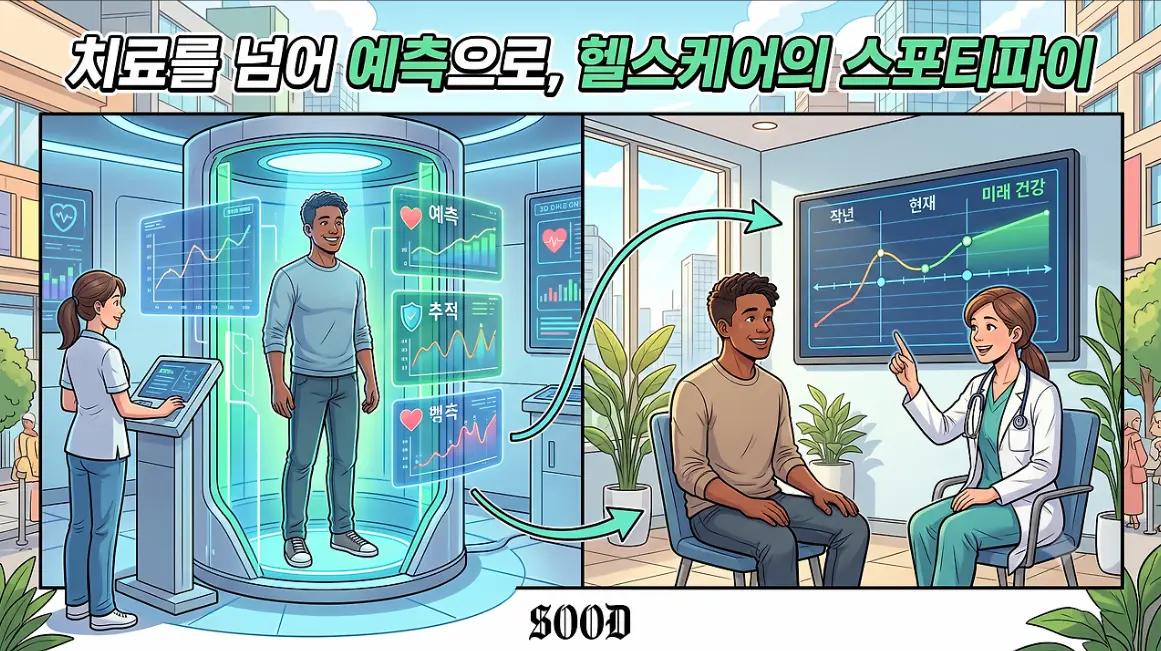
Rather than developing a specific technology, Neko focused on compressing the entire journey into 60 minutes: a 10-minute multi-sensor scan, point-of-care blood testing, and a same-day physician consultation.
- 2,000 high-resolution full-body images build a 3D map to track moles and pigment changes over time, supporting early screening by clinicians.
- ECG, limb blood pressure and aortic pulse wave velocity are measured simultaneously as multiple biosignals.
- On-site analysis equipment produces glucose, lipid and inflammation markers immediately, eliminating multi-day waits.
- Body fat is measured optically without ionizing radiation from CT or X-ray, or expensive MRI, with grip strength tracking physical resilience.
2. From One-Off Diagnosis to Time-Series Lock-In
Traditional checkups ask "do you have a disease right now?" Neko builds personal time-series health data that tracks "what changed since last year?"
It's the same structure Spotify used to achieve hyper-personalization through listening pattern data rather than the music itself. The core asset becomes the ability to compare a customer's accumulated history against their current state.
That means each repeat visit increases the comparative value of the data. 75% of first-time customers prepay to book the following year's scan. Retention comes out of the product design itself.
3. Clinical Evidence and Its Limits
From a Stockholm cohort of 4,362 people: 18.7% of all participants were routed to specialist secondary care, and in 1.2% (54 people) who were asymptomatic, serious conditions including melanoma and cardiovascular abnormalities were caught early.
Follow-up produced measurable change too. About 77% of returning visitors with serious findings moved into managed status, with significant improvements in blood pressure, glucose and lipid levels.
The limits are clear: this is real-world data, not a randomized controlled trial. The significance lies in using precise data feedback to drive lifestyle correction and early treatment, not in causally proving prevention.
4. Expansion: Attacking Public Healthcare Bottlenecks
In the U.K., Neko targeted the NHS's chronic waiting-list problem, landing commercially in London and Manchester at an accessible £299 price point.
In the U.S., it's positioning as premium D2C medical deep tech, building from a New York SoHo flagship clinic with a 25,000-person waitlist into the large private healthcare payment market.
5. Business Takeaways
Integration over invention: Instead of developing a new sensor, Neko wove sensors, point-of-care testing, physical space, clinicians and an app into one system. The advantage is the combination, not the components.
Redefining the customer: The target isn't the patient seeking treatment after the fact, but the healthy consumer actively paying to extend healthspan — creating a new market rather than splitting an existing one.
Keeping the human touch: A same-day in-person specialist consultation follows the AI-driven analysis, securing diagnostic credibility while driving immediate behavior change — and functioning as lock-in.
Real PMF validation: Not waitlist numbers, but voluntary repurchase and a 75% prepaid rebooking rate. That's retention-based unit economics.
Accumulating measurement into a comparable asset to create lock-in translates directly to marketing, which is why using a customer's accumulated data as personalization material isn't industry-specific.