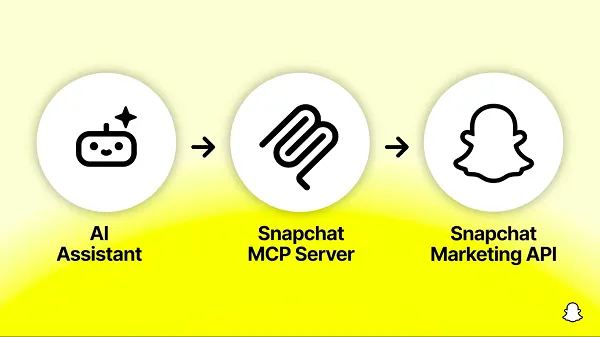
Snapchat launched its Snapchat Ads MCP Server, letting advertisers create and refine Snapchat campaigns with guidance from third-party AI tools.
What the connection does
MCP (Model Context Protocol) server connections feed platform data into third-party tools so those tools can give better-informed strategic guidance. Companies already standardized on Claude or ChatGPT can now fold Snapchat ad creation into the assistant their staff already use.
"AI tools are becoming an important part of how advertisers analyze performance, uncover insights, and plan what to do next," Snapchat said. "But AI can only work with the information it can access. Without data from Snap Ads, Snap performance is missing from that analysis. The Snapchat Ads MCP Server changes that by providing an official, Snap-hosted connection between Snap Ads API and supported AI agents, including Claude, ChatGPT, and Gemini."
Permissions
Organization administrators must authorize each AI agent separately and set its level of access, providing per-system control over data sharing.
"At launch, all approved connections are read-only," Snapchat said. "When write capabilities become available in an upcoming release, Admins will be able to decide which AI agents remain read-only and which are granted read and write access." That opens the door to agentic campaign creation later, with administrators retaining approval rights over expanded access.
An industry pattern
As AI tools spread through marketing and advertising, more platforms are adding third-party integration options. Meta launched similar MCP connector options in April, and TikTok and Pinterest also offer MCP integrations. Eventually most platforms will likely expose third-party connections enabling custom AI-powered management — potentially automating campaign creation and launch.
Agency checklist
Decide which agents get authorized and by whom. Because approval is per-agent, set standards in advance for which tools receive which account data.
Use the read-only window deliberately. Until write access arrives, the practical use is performance analysis and reporting automation — building prompt patterns and report formats now means you can scale immediately when write lands.
Design the approval gate for write access before enabling it. Once an agent can create or modify campaigns, you need an internal checkpoint that prevents unreviewed changes going live.
For research methods on the platform, see Four Steps for Snapchat Marketing; for creative standards with younger audiences, see Snapchat Tries to Teach Brands to Be Funny.