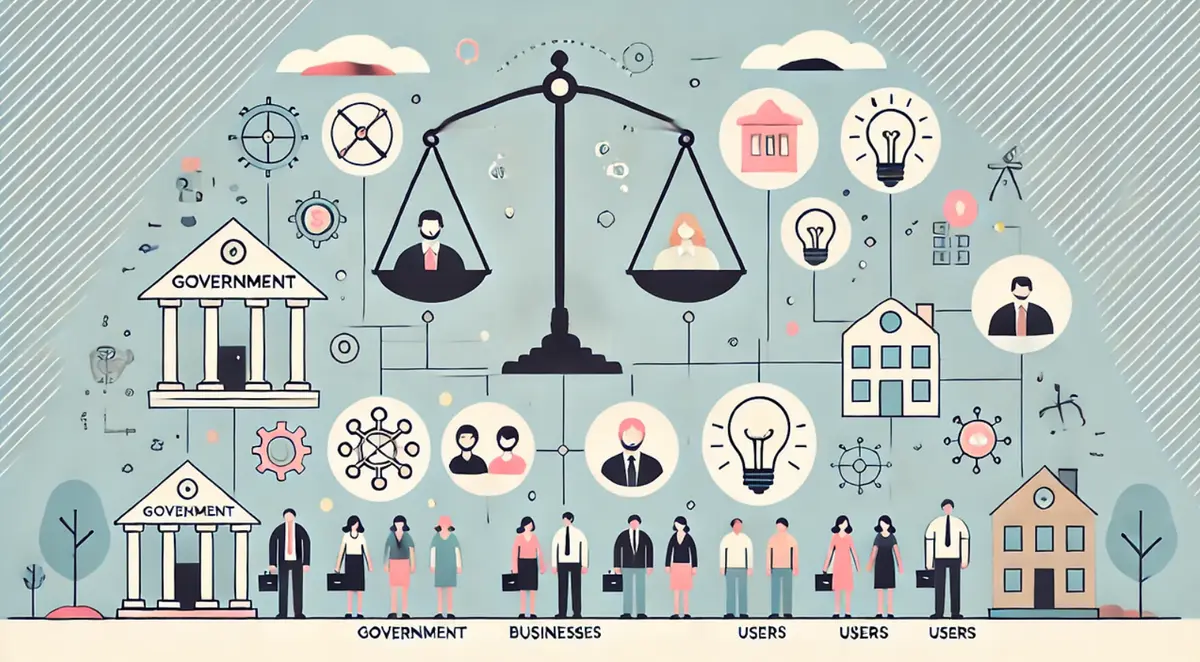
No product or service gets built by one party's effort alone. Markets function when three actors — government, company and user — each do their part and cooperate.
The logic is simple. Government has to create fair conditions for a market to be sustainable; a company has to innovate within regulation and deliver value to survive; and users both improve their own lives and improve the product through feedback. Sustainable product strategy lives where those three balance.
This piece looks at how a supplier should understand each of the three.
1. Government — Regulation Sets Direction, Not Limits
Treating government purely as a source of constraints is a mistake. Regulation exists to maintain fairness and stability in a market, and as a result it points toward how to innovate responsibly.
Data protection law provides clear standards for handling user data; complying earns user trust. Mandated refund policies for online retail and strengthened electronic payment security create conditions where consumers transact with confidence.
Toss, the Korean fintech, delivered innovative experiences through simple transfers and free credit score checks while investing heavily in compliance, building trust with both regulators and users.
Government also encourages better products, not just order. When new technology arrives, it supports adoption while writing rules that prevent harm — mandated EV charging infrastructure and strengthened privacy law are examples.
Understanding regulation as a partner to work with beats treating it as an obstacle to overcome.
2. Users — Participants, Not Consumers
Users don't stop at consuming; their feedback drives improvement.
Baemin, the Korean delivery platform, added real-time delivery estimates and personalized menu recommendations in response to user requests. Apple has steadily improved security and UX through iOS updates informed by user feedback. Toss made its interface more intuitive on user request and added practical features like utility bill reminders.
Accepting feedback helps you understand the problems users actually face and recalibrate product direction. Users aren't passive — they're active participants using the product to solve their own problems. Suppliers should trust them and act on their input.
3. The Company — The Axis of Sustainability
A company doesn't just build and sell; it has to ensure the product survives in the market with a sustainable business model. That means complying with regulation while still delivering innovative value.
Baemin adopted the contract structures government required to protect delivery riders' working conditions and built a fair commission structure to earn trust from both users and merchants — while improving delivery speed with AI-based routing and order tracking.
Apple achieved user-centered innovation while strictly complying with privacy regulation. App Tracking Transparency in iOS gave users control of their data while satisfying global regulatory expectations.
Toss simplified complex financial services while complying with financial security regulation, and went further by letting users control their own financial data.
4. The Priority Order
Three perspectives should govern product work: user-centeredness (the product begins and ends with the user), social responsibility (consider the product's effect on society), and long-term growth (sustainability built on regulation and trust rather than short-term profit).
As a priority order:
- User safety and trust — a product that isn't safe or has lost trust cannot succeed. Always first.
- Regulatory compliance — regulation maintains market order and protects everyone; ignoring it becomes a long-term problem.
- Balancing revenue and innovation — stabilize the revenue structure for sustainability while continuing to deliver innovative value.
Well-Built Products Negotiate Better
There's a benefit worth naming separately: a product designed with all three actors in mind holds a stronger position in negotiations with both government and users.
Governments take a more favorable posture toward products that comply and deliver social value, and users show higher trust and loyalty toward products that reflect their needs. Both raise the supplier's growth ceiling.
How regulation actually reshapes market structure is visible in Google keeping AdX under behavioral remedies and the FTC's case over hidden surcharges in Amazon's ad auctions. Defer regulation as a risk to handle later and you eventually have to rebuild the product structure itself.