Query fan-out is the AI search mechanism that breaks a user's question into multiple sub-questions, searches them simultaneously and assembles the results into a single answer. It drew attention after being introduced as a core technology of AI Mode search at Google I/O 2025.
Search systems now run several additional searches to understand one question, gathering information from many pages to construct AI Overviews and AI Mode responses. Content that explains one topic from multiple angles now outranks content that repeats a keyword.
What fan-out actually changes
Traditional engines found pages most relevant to the entered keyword and ranked them. Under fan-out, the engine analyzes the meaning of the question, generates related sub-questions, collects information for each and composes an answer. The result is not a list of pages but a synthesis of sources.
An example expansion
For "summer trip to Jeju," AI Mode expands into questions like:
- Average summer temperature and weather on Jeju
- Jeju attractions worth visiting in summer
- Recommended accommodation for a summer Jeju trip
- Summer festivals and night attractions on Jeju
It gathers information for each from different pages, groups it by theme, and summarizes it into one answer.
Four stages of the pipeline
1. Query analysis
AI Mode interprets intent, difficulty, the required answer format (explanation, comparison, recommendation) and how much context is missing. Broad or ambiguous questions trigger deeper fan-out with more sub-queries.
2. Decomposition into synthetic queries
One question becomes several. "Is remote work productive?" is recast into queries targeting related topics, implicit questions, comparisons, recency and user context — pros and cons of remote work, productivity research, hybrid work case studies.
3. Parallel retrieval and thematic organization
Sub-queries run in parallel across the web index, knowledge graph and databases. The engine analyzes the retrieved pages, extracts themes such as cost, tradeoffs and adoption stages, and clusters pages by theme.
4. Ranking signals and synthesis
Documents within each theme are evaluated on information quality and accuracy, source credibility and expertise, recency, consistency with other documents, and relevance to the question. Representative documents and passages are then selected for citation, which is why AI Mode answers carry per-sentence citation markers.
Designing content for fan-out
Start by reverse-engineering which sub-questions AI Mode generates for your keywords.
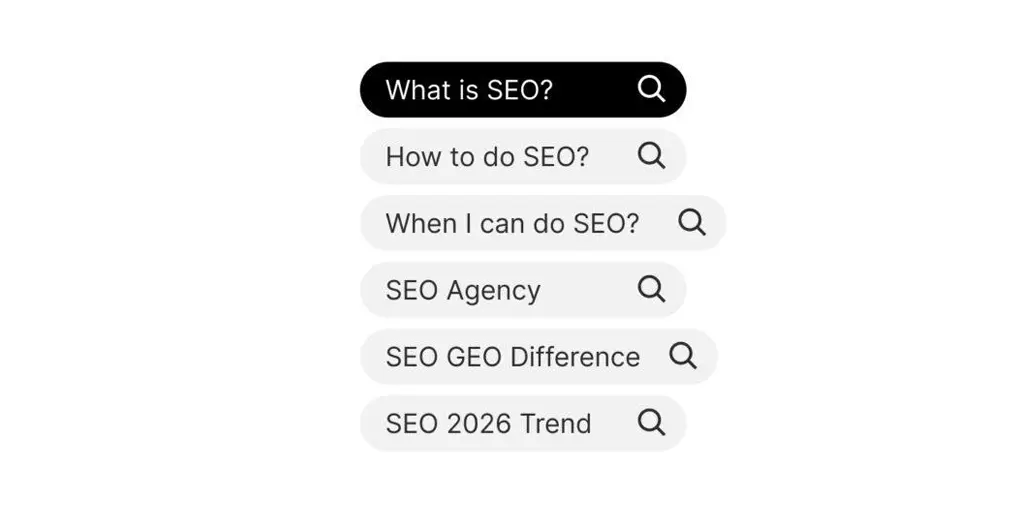
- Analyze the SERP. Related searches and autocomplete often mirror the question structures Google generates — the lowest-effort signal available.
- Read AI Overview and AI Mode answer structure. When an answer splits into paragraphs, those paragraphs frequently reflect the sub-question structure behind it.
- Study competitors' question structures. Recurring H2/H3 patterns in top-ranked content reveal which questions the topic reliably raises.
- Add qualitative long-tail research. Community and Q&A posts surface the questions people actually ask. Slowest to gather, highest in value.
- Build the structure from collected questions. Each section: a question-form subheading, a conclusion-first body, then explanation and supporting data.
Two differentiators
Analysis beats aggregation
Google's Helpful Content guidance explicitly values content that adds original analysis or interpretation. Industry-change analysis, insight drawn from comparing multiple sources, strategy recommendations grounded in practice, real project cases and self-collected data are hard for other pages to replace — which is exactly what makes them a differentiating signal when the system compares sources.
Place quotable passages deliberately
AI Mode cites at the sentence and paragraph level, so include material that is easy to lift: one-line definitions, summary paragraphs of a core strategy, condensed statements of data or research findings. Put the answer to the most important or most common question near the top.
For the concept-to-source framing behind this, see Entity SEO: AI Search Looks for the Source of a Concept, Not a Keyword; for treating prompts themselves as research input, see Put Prompt Research Next to Keyword Research.