The gap in ‘research natively’
“Don’t translate keywords. Research them natively.” It’s standard international SEO advice, and still correct. But before research begins, someone has to choose the first phrase. Search Engine Land contributor David Carrasco Pamies argues that the first seed is an assumption about how a market names itself — and it decides which parts of the market become visible in international SEO keyword research.
When a plausible description opens the wrong door
In the same U.S. database on the same day, “commercial drone operator training” returned nothing, while “drone pilot training” opened a 26,520-keyword set that surfaced “FAA Part 107.” Spain showed the same pattern: “curso de operador profesional de drones” returned no data, while “curso de piloto de drones” returned 292 normalized terms with “AESA A1 A3” at rank 14.
He calls these terms market artifacts: locally meaningful labels that govern eligibility, compliance or professional practice but can’t be derived from a category description — Part 107, EPA 608, NMLS, Spain’s TIP security credential. A translator can render “commercial drone operator training” perfectly without knowing the U.S. pathway runs through Part 107 and the FAA Remote Pilot Certificate.
The 80-query test
After discarding a first comparison invalidated by how broad match works, the author locked eight cases — four in Spain, four in the U.S. — each with a neutral descriptive seed, a local occupational seed and a verified artifact, then ran 80 combinations across Semrush and DataForSEO on August 21, 2026.
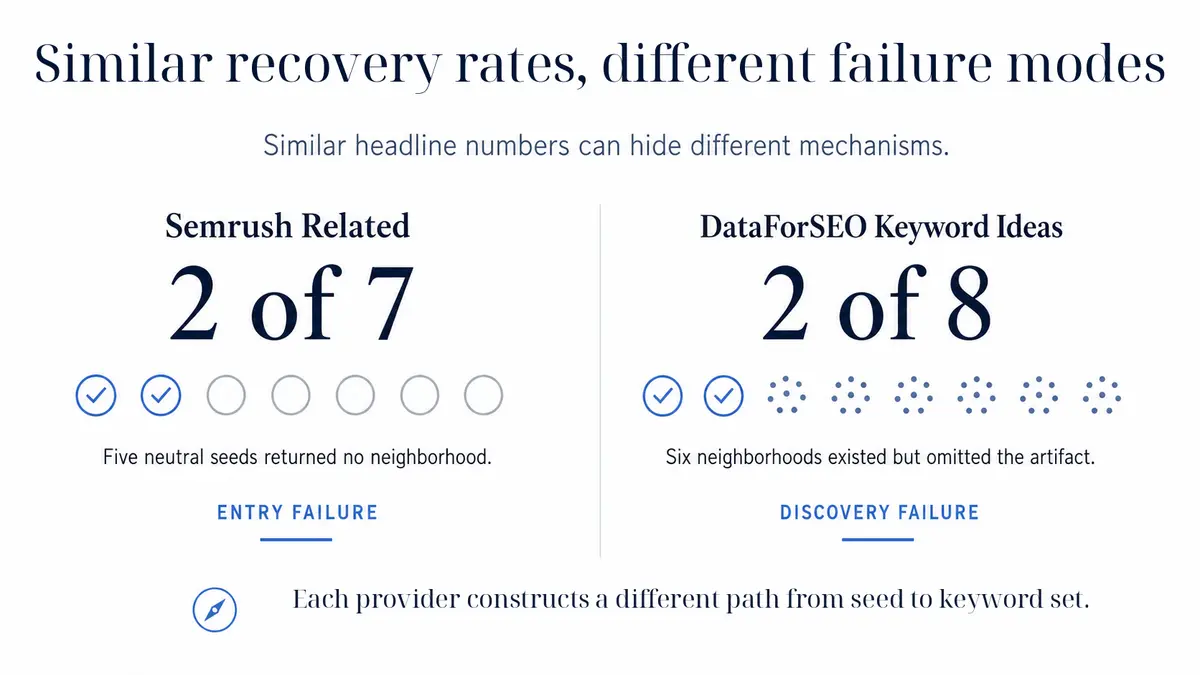
- Semrush Related: the neutral seed recovered the artifact in two of seven observable cases; all five failures were empty sets — entry failure.
- DataForSEO Keyword Ideas: two of eight; every neutral seed returned results, but six omitted the artifact within the first 1,000 rows — discovery failure.
- The providers disagreed on which cases worked.
- Local occupational seeds helped in Semrush but not in DataForSEO, so “use the market’s own term” isn’t a universal fix.
A keyword universe isn’t the market; it’s the market as constructed by a seed, an index and a retrieval system.
From keyword list to market-entry map
Before opening a tool, write down four entry points:
- Neutral description: what a competent outsider or translator would say.
- Local occupational term: what workers, customers, employers and sales teams actually say.
- Institutional artifact: the license, card, exam, title or code used by regulators.
- Commercial or legacy term: brands or old labels still in use.
Record where each came from, and read the regulator before the competitor. Run the four families separately at first so you know which door opened the market. Local reviewers should help build the map, not just check translations.
Diagnose failure before measuring demand
- Entry failure: a zero isn’t a demand conclusion until other seed families, the local SERP and a second provider are checked.
- Thin entry: supplement with job listings, site search, paid-search queries and customer language.
- Discovery failure: if a key artifact is missing, reverse-seed from the artifact.
- Provider disagreement: label outputs by provider instead of averaging.
The author’s rule: no zero enters a market-sizing deck until at least one alternative seed family, one non-keyword source and one second retrieval route have been checked.
It changes content architecture too
“Drone pilot training” supports a service page; “Part 107” opens questions on eligibility, the exam, preparation, renewal and rules. Lexically distant, commercially adjacent. Artifacts often deserve their own hubs, linked to the offer. Pair this with putting prompt research next to keyword research and using social data to find category entry points to capture questions translation misses.