Keyword research has long been the foundation of organic strategy: it tells you what people type, how often, and with what intent. There is now a second demand signal beside it — what people ask AI assistants.
When someone opens ChatGPT, Perplexity or Google's AI Mode, they describe a problem in a full sentence. That looks nothing like the short phrase they would type into a search box, and it exposes demand keyword research alone does not capture.
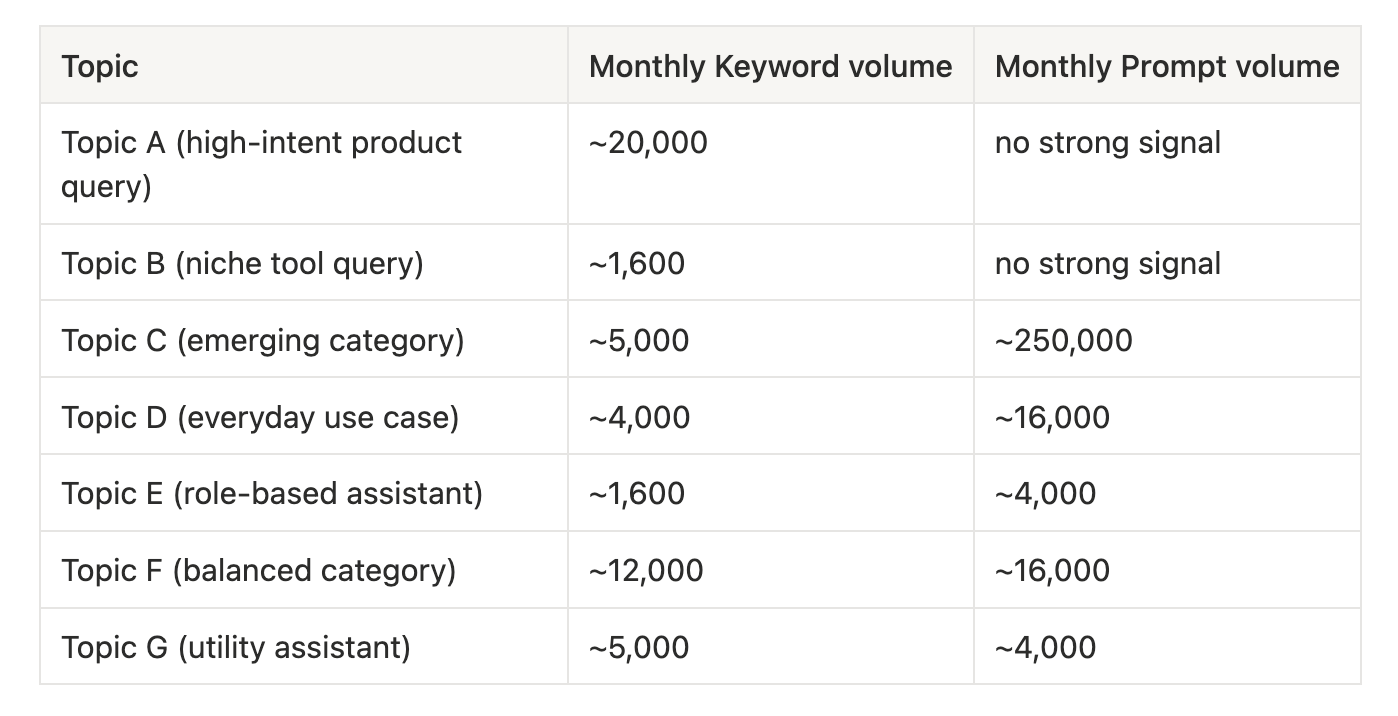
Two numbers, one table
Keyword volume is how often a phrase is typed into search. Google Ads Keyword Planner, cross-referenced with a third-party tool such as Semrush or Ahrefs, covers it.
Prompt volume is how often people ask AI assistants. Tools like Profound's Prompt Volumes draw on datasets of real prompts submitted to ChatGPT, Gemini, Claude and Perplexity, then model how often a topic appears across those conversations.
Read both carefully
Keyword Planner merges close variants, so near-duplicate phrases report identical figures — don't count them as separate demand. Prompt volume is more directional: reliable for comparing orders of magnitude, less so if you lean on specific numbers.
What the gap tells you
With both columns filled, topics sort into strategic buckets.
Keyword-strong, prompt-weak — write the classic SEO page
A topic pulling roughly 20,000 monthly searches with almost no prompt demand means people search for it but don't ask an assistant to walk them through it. Use a traditional brief: study what ranks, what the top pages actually answer, where they are thin, then decide what you can say that nobody else is saying. Match title and H1 to keyword and intent, answer the question early, and structure the HTML for easy parsing with clear headings and short definition blocks. Don't force an AEO rewrite onto a search query — but make the page substantive enough that there is something to pull from if AI starts citing the topic later.
Prompt-strong, keyword-weak — write the answer, not the SERP
This is the group keyword research misses entirely. One topic reported about 5,000 monthly searches against roughly 250,000 in prompt volume — search understated demand by about 50x. People aren't typing exact-match keywords; they're describing the problem and asking what to do. Another showed 4,000 searches against 16,000 prompts.
These need content built to be the answer: clear definitions, direct responses to the questions people actually ask, and structure an LLM can extract and cite. The goal is citation inside the answer. Topics that look small in Keyword Planner routinely dominate prompt volume, and teams working from keywords alone never get them onto the roadmap.
Strong on both — build the flagship
A topic at roughly 12,000 searches and 16,000 prompts deserves pillar-level funding. Keyword research tells you how to structure and title the page; prompt research tells you which questions to answer and how to phrase them so an assistant will pull from it.
An empty cell is not zero
A blank prompt column often means the demand is bundled into a broader head term, not that nobody cares. It reads as "no clean matching term here." Check the head term before writing a topic off.
Turning the table into a roadmap
The table only matters if it changes what ships.
- Keyword-strong → the traditional SEO queue: ranking pages matched to intent
- Prompt-strong → the answer-engine queue: referenceable, extractable content
- Strong on both → flagships built for both surfaces
Then measure the surfaces separately. Split classic search traffic from AI-referred traffic instead of blending everything into one organic number, so you can tell whether a piece earned traffic on the surface it was built for.
Keyword research was enough while search was the only discovery surface. That stopped being true once a meaningful part of the journey began before the click. For measurement, see How to Measure Your Brand's Visibility in Gemini, and for organizing topics as concepts, Entity SEO: AI Search Looks for the Source of a Concept.