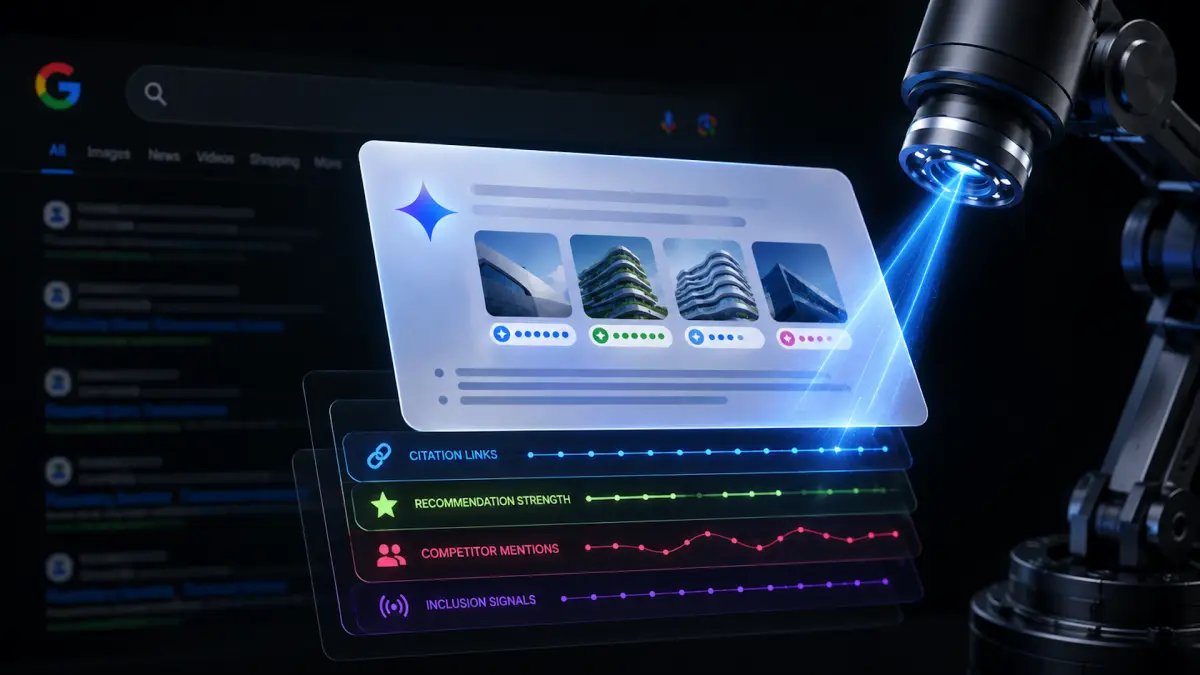
Your brand could be influencing buying decisions inside Gemini long before analytics ever sees it. Gemini brand mentions don't appear in Search Console or Google Analytics. A buyer may discover you in a Gemini response, keep researching through Google Search, then return later via branded search or direct traffic — by which point the AI interaction itself is invisible to traditional reporting.
Why this is hard to measure
Traditional SEO measurement assumes a consistent result exists. Gemini doesn't work that way. One query can produce different responses depending on follow-up questions, search context, location, personalization and model changes. Google has already begun introducing more personalized Gemini experiences that can incorporate signals from Gmail, Photos and Search for users who opt in. Two people asking the same question may see meaningfully different answers.
There is no single "Gemini ranking." Measure patterns instead: how often you appear across an important prompt set, how consistently you're recommended, how you're positioned against competitors, and whether that improves.
Method 1: Monitor important prompts manually
It won't scale forever, but it gives you context automated tools can't.
Build a prompt library
Collect what your audience actually asks across the journey. Awareness ("What is customer data platform software?", "Best CRM software"), consideration ("Salesforce vs. HubSpot", "Best CRM for manufacturing companies"), decision ("Is HubSpot worth it?", "Salesforce pricing"). Go past category keywords into branded searches, competitor comparisons, industry questions, use-case queries, location prompts where relevant, and common follow-ups — Gemini conversations unfold across turns, and a brand absent from the first answer often appears later.
Record more than whether you were mentioned
A yes/no spreadsheet tells you the mention happened, not why it matters. For each prompt, capture position, competitors included, sources cited and whether the messaging was accurate. That's how you catch being consistently listed after competitors, or being described with an outdated product line. Tracking cited pages also reveals which content Google treats as authoritative on a topic.
Repeat on a cadence
Weekly for highly competitive markets, monthly for most organizations. Watch shifts in inclusion, positioning, citations and competitive set rather than reacting to single responses.
Method 2: Use AI visibility monitoring tools
Manual review works for dozens of prompts; consistency matters once you track hundreds. Dedicated platforms include Profound, Scrunch AI, Otterly.AI and Peec AI, alongside AI visibility features rolling out in Semrush and Ahrefs. They can track answer inclusion rate, competitive share of voice, citation frequency, response position, historical trends and prompt coverage.
Know the limits. Most platforms test predefined prompts under consistent conditions, so real responses still vary with personalization, location, conversation history and model updates. They measure directional performance, not every user's experience.
Method 3: Read AI influence in analytics
Visibility says whether you show up; analytics says whether it matters. Where Gemini does drive visits, watch referral traffic, landing page performance, engaged sessions, conversions and assisted conversions. Beyond referrals, watch branded search volume, direct traffic growth, assisted conversion rates, performance of frequently cited pages, and demand shifts following sustained visibility gains. No single metric proves AI influence, but moving together with tracked prompt visibility, they make a strong case.
What actually changes
SEO has mostly measured outcomes — rankings, clicks, sessions, conversions all describe what happened after discovery. Gemini opens the door to measuring something earlier: whether your brand was present while the decision was still forming. That is measuring consideration, not acquisition.
For the tooling side of this shift, see Microsoft Clarity Splits AI Queries Into Branded and Non-Branded, and for the citation-without-attribution problem, 82% of AI Citations Point to Earned Media.