Tech/AI모비인사이드
OpenAI DevDay 2026 Recap — ChatGPT Becomes a Shared Workspace for People and Agents
OpenAI DevDay 2026 introduced the always-on agent Dots, GPT-6.1 Sol and ChatGPT Spaces. A recap of the shift from model races to work platforms.
Technology's advance is no longer just about efficiency — it's restructuring entire organizations and business models around AI. That shift plays out across three broad paradigms. The first is the chatbot era, where interaction is one-off — a user asks, AI answers, and AI remains a passive assistant. The second is agentic AI, where AI understands goals, builds plans, and multiple AI systems collaborate to solve complex problems, while humans move from issuing instructions to collaborating and supervising. The third is the AI-native enterprise, where AI is assumed infrastructure across planning, data systems, culture, and UX/UI — the whole organization runs like a single intelligent operating system.
Stage 1 — Personal productivity tools. Individual employees experiment with standalone chatbots like ChatGPT, Claude, or Perplexity to boost their own output. This stage demands prompt engineering, model selection, and the judgment to catch hallucinated results. Humans are active experimenters and final reviewers; AI is a one-off assistant for tasks like summarizing documents or drafting text.
Stage 2 — Internal AI tool-building. Organizations start building custom tools to automate repetitive work — voice-coding tools like Codex or Claude Code, automation platforms like Make or Zapier, and custom GPTs wired into internal documents and APIs. Humans become process designers who define automation rules and guard against data leaks; AI becomes an automation executor that learns internal manuals via retrieval-augmented generation (RAG) to answer questions.
Stage 3 — Agentic AI collaboration. AI starts acting like a proactive team member, and internal data integration becomes the central task. Knowledge hubs like Obsidian, multi-agent platforms, and advanced knowledge management systems (KMS) appear. Humans become knowledge gatekeepers who standardize and clean data into AI-readable structure and prevent the AI from learning distorted information; AI becomes a partner that absorbs organizational knowledge and proposes complex solutions on its own.
Stage 4 — The agent OS era. People, agents, and external tools mesh organically so the entire business operating system itself becomes AI-driven. Humans stop writing code or building pipelines directly and become the Director — setting business goals, defining the scope of authority, providing broad context, and approving outcomes. AI understands the higher-level goal, generates its own sub-tasks, and calls other specialized agents or external APIs as needed to create end-to-end value without human intervention. The skills this stage demands are agentic engineering (designing and governing autonomous agent systems), orchestration across multiple agents, and context design that lets AI execute correctly without misreading the business environment.
Applied to UX/UI design, a designer who once focused on pushing pixels in Figma now needs to systematize design principles, component structures, and user scenarios into AI-friendly data, delegate tasks to autonomous agents, and act as director overseeing whether the output meets brand identity and user-experience standards. The conclusion: evolving from "interface maker" to "director of the rules and environment that generate interfaces" is what makes a designer irreplaceable.
This four-stage framework maps directly onto marketing organizations. Most teams are still stuck at Stage 1 — individuals pulling copy or ideas from a chatbot. The real competitive divide opens at Stages 2 and 3: refining brand guidelines, past campaign performance, and customer data into AI-readable structure, and embedding automation into internal workflows. The "data sovereignty" and "gatekeeper" roles emphasized at Stage 3 suggest that marketers' future job isn't producing content directly — it's curating the quality of brand knowledge that AI will learn from.
So the immediate task isn't chasing every new tool — it's auditing how AI-readable your own marketing knowledge and data actually are. Writing good prompts is already table stakes; the next differentiator will be orchestration and context design — accurately defining goals and context for multiple agents and supervising the result against brand standards. If your team is early in this journey, our guide to getting non-developers started with no-code AI is a practical first step, and Best Partner's services can help design the roadmap from there.
The chatbot era (one-off Q&A with AI as passive assistant), agentic AI (AI plans and collaborates while humans supervise), and the AI-native enterprise (AI is assumed infrastructure across the whole organization).
Stage 1 is personal productivity tools (individual chatbot use), Stage 2 is internal AI tool-building (custom automations and GPTs), Stage 3 is agentic AI collaboration (AI as a proactive team member via KMS and multi-agent platforms), and Stage 4 is the agent OS era (AI runs end-to-end with humans as Director).
Humans become the Director — setting business goals, scope of authority, and context, then approving outcomes — while AI generates its own sub-tasks and calls other agents or APIs to create value end-to-end without direct human execution.
Most marketing teams are still at Stage 1 (individual chatbot use); the real competitive edge comes at Stages 2–3, refining brand guidelines and customer data into AI-readable structure, with marketers evolving into curators/gatekeepers of the knowledge AI learns from rather than direct content producers.
To apply what you just read to your own site, start with a free audit of where things are now.
A strategist replies within 24 hours on business days.
OpenAI DevDay 2026 introduced the always-on agent Dots, GPT-6.1 Sol and ChatGPT Spaces. A recap of the shift from model races to work platforms.
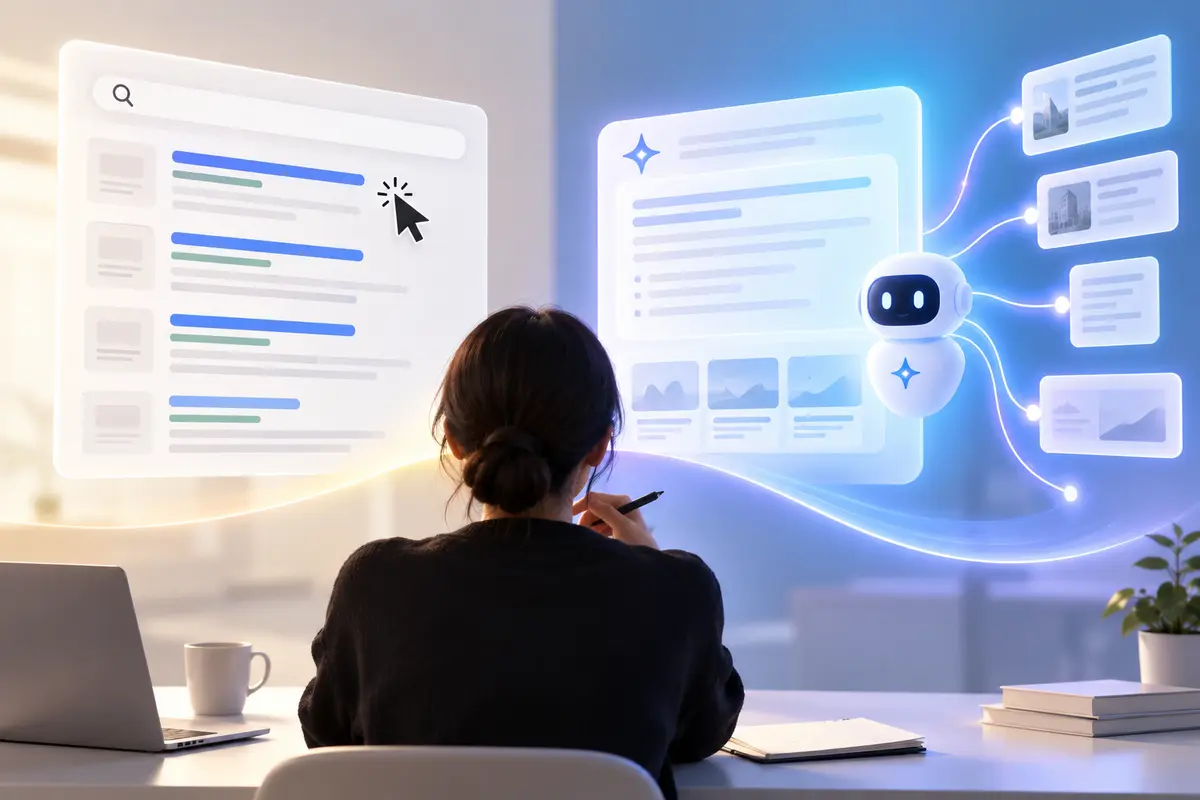
Zero-click GEO explained from TBWA's observations: 68% of U.S. Google searches end without a click, so extend existing SEO content into AI citations.
Claude Fable 5.1 improves coding and research while cutting cache costs, reducing false safety interventions, and introducing regulatory watermarking.