Tech/AI모비인사이드
OpenAI DevDay 2026 Recap — ChatGPT Becomes a Shared Workspace for People and Agents
OpenAI DevDay 2026 introduced the always-on agent Dots, GPT-6.1 Sol and ChatGPT Spaces. A recap of the shift from model races to work platforms.
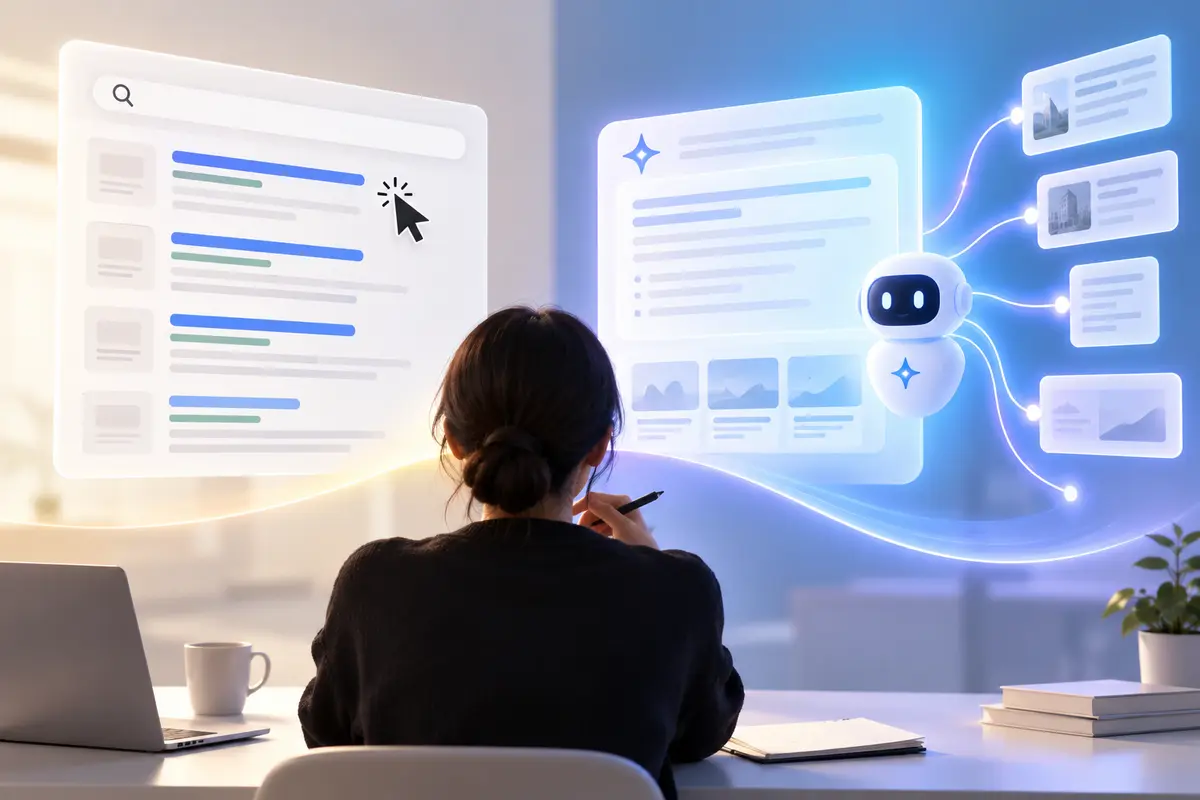
Search rankings hold steady, yet clicks and visits are not what they were, and asking ChatGPT, Perplexity or Google AI Overview the same question often leaves your brand out of the answer. TBWA observed this across real SEO projects and concluded that SEO has not stopped working; the criteria for judging search have changed. Here is a summary of what matters for zero-click GEO.
Per 2026 research from SparkToro and Similarweb, 68% of U.S. Google searches end without a click, up from roughly 60% in 2024. When an AI Overview appears, only 8% of users click another result, versus 15% when none appears. TBWA also saw content whose impressions rose while clicks fell, especially for sentence-style question queries rather than short keywords. Clicks alone no longer explain brand presence; you also need to track how often AI cites your brand, for which questions and with what image.
SEO aims at ranking; GEO (Generative Engine Optimization) aims at being cited inside AI answers. Search engines rank by keyword relevance, backlinks and page speed, while generative AI picks the information that best answers a question regardless of rank. According to Google's May 2026 guide to generative AI search, AI features work through retrieval-augmented generation (RAG) and query fan-out, which expands one question into several related searches. For each sub-question, citations depend on relevance, source trust and expertise, freshness and consistency, so a top-ranked page can still be left out if it answers only some sub-questions.
There is no need to start from scratch.
AI treats a brand as an entity rather than a set of pages, forming an association structure from repeated phrasing, third-party mentions, PR, media exposure and customer questions. TBWA repeatedly asks the same questions across several generative AI models to track how often the brand appears and what it is associated with; gaps in expertise go to the content team, gaps in external trust to PR, and message consistency to the brand team.
Start by asking several AI tools your ten most important customer questions and check whether your brand is cited. For related search shifts, see Publishers Are Buying Back Their Own Traffic: Media Search Ad Spend Up 41% as Zero-Click Bites, and for the debate on paying for content used in AI answers, Google Tests Paying Publishers When Their Content Powers AI Mode, AI Overviews and Gemini.
Ending a search without clicking any result, usually after reading an AI answer on the results page. In 2026 research, 68% of U.S. Google searches fit this.
SEO targets ranking; GEO targets citation inside AI answers. AI selects sources by relevance and trust, independent of rank.
No. Restructuring it with FAQs, comparison tables and sentences that carry numbers turns existing SEO content into GEO assets.
To apply what you just read to your own site, start with a free audit of where things are now.
A strategist replies within 24 hours on business days.
OpenAI DevDay 2026 introduced the always-on agent Dots, GPT-6.1 Sol and ChatGPT Spaces. A recap of the shift from model races to work platforms.
Claude Fable 5.1 improves coding and research while cutting cache costs, reducing false safety interventions, and introducing regulatory watermarking.
AI literacy is the ability to separate what AI can support from what humans must judge and own. The three components, practical application, and corporate training examples.