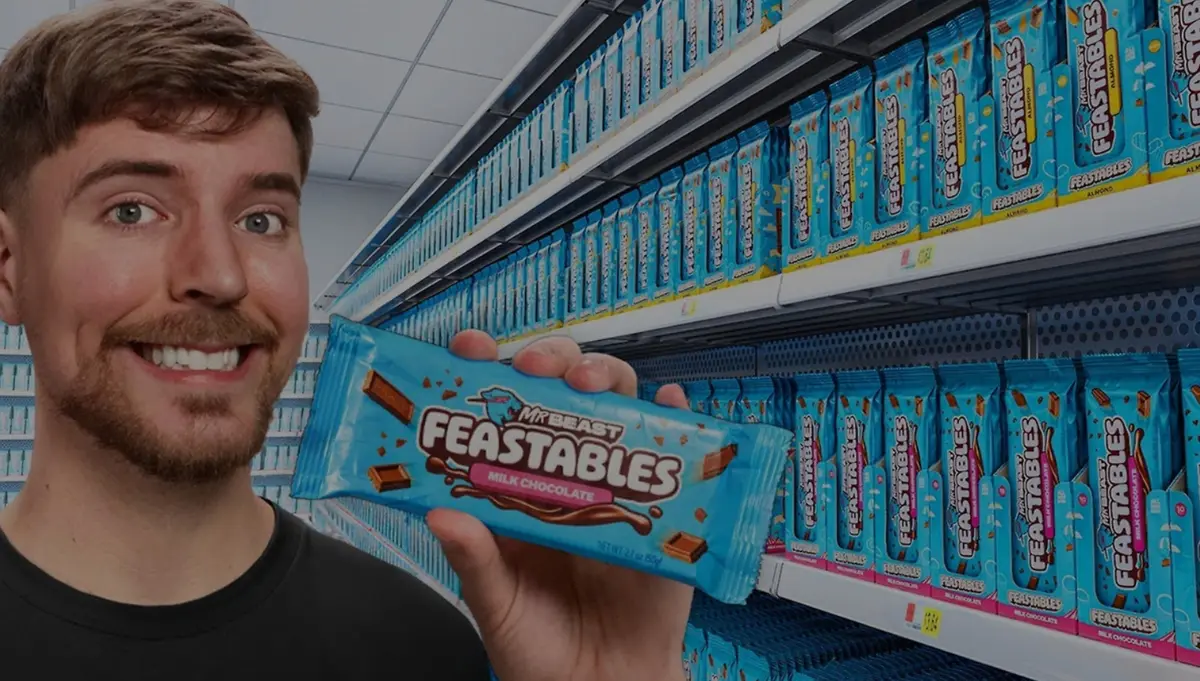
MrBeast makes more money selling chocolate than he does from YouTube, his actual day job. Feastables, the chocolate brand he founded, hit roughly 360 billion won (about $260 million) in annual revenue two years after launch, with around 29 billion won in operating profit.
A large subscriber base does not make a business. Building a product people will pay for, communicating its value, and generating repeat purchase are different skills from being a good creator. Feastables' outcome has many causes, but this piece isolates one: the five-step content marketing structure that is MrBeast's strongest weapon.
1. Manufacture Curiosity About the Product
The primary purchase criterion for chocolate is taste. Feastables leads with taste. "The best-tasting chocolate in the world, with no artificial sweeteners or chemical additives" is the brand's promise.
The problem: taste does not transmit digitally. Shouting "this is delicious" into a camera does not land, and because taste is subjective, no logical proof is available.
MrBeast solved this with the blind test format. Participants compare unbranded famous chocolates against Feastables, and Feastables wins overwhelmingly. As participants explain their choices, the product's taste gets described in consumer language rather than brand language. Viewers come away curious — how good is it if it sweeps the vote?
What transfers: For attributes that resist digital transmission — smell, taste, texture — explain by comparison against something the audience already knows. And let ordinary consumers produce the reaction rather than asserting it yourself. Experiments, tests, and interviews carry more credibility than claims.
2. Engineer the Conversion
Curiosity does not automatically become purchase. Chocolate is not a high-consideration category, but that also means alternatives are everywhere.
MrBeast attached a mechanism to convert content-generated curiosity into transactions: for 30 days, one Feastables buyer per day was drawn to receive $10,000, with a QR code embedded in the product revealing whether you won. He placed the announcement at the very end of the blind test video.
The design is clever. Buying — an act of spending money — reframes as entering a game where you might make money. To improve odds, people buy multiple units. The 30-day window compresses the decision. It converts viewers to customers and raises average order value at the same time.
What transfers: Scale it down. Draw a small number of winners from customers who purchased in a defined window, and choose a prize your specific customers actually want. Surface the mechanic in ad creative, product pages, and the end of your content.
3. Turn the Ad Into the Content
Even a favorite creator triggers resistance when they plainly tell you to buy something. YouTube is not where people go to watch ads.
One video with 67 million views shows how he resolves this. Early in the video, MrBeast explains that he commissioned Feastables ads from various people, paying anywhere from $1 to $10,000. Then he asks the viewer: does a more expensive ad produce a better ad?
From that moment the audience is watching to find the answer. They stay through $1, $50, $100, $500, curious how much the quality actually improves and what a $10,000 ad looks like. Every one of the roughly ten ads they watch is a Feastables ad. But the experience registers as content, not advertising.
What transfers: Put the message you actually want to deliver inside a frame the audience finds interesting on its own. "Our chocolate has clean ingredients and tastes great" reads as an ad. The identical claim inside a "$1 ad vs $10,000 ad" frame reads as content. Nuuly building a 12-part microdrama with the brand as a supporting character applies the same principle.
4. Deliver Social Value as Story
When quality and price are comparable, consumers choose the brand with better social impact. Feastables uses fair trade certified cacao and pays farmers fair wages to eliminate illegal child labor in its supply chain.
The principle for communicating this is unchanged. Lead with what the brand wants to say and nobody engages. So the interesting story goes first.
The relevant video opens with MrBeast excited about an invitation to tour a large chocolate factory. The tour turns out to be a trap; inside, he encounters workers who have lost their memories, and helps them escape. Only at the end does he reveal the story was built on the real situation facing children in West Africa, and explain what the brand does about it.
The message arrives while the audience is already immersed.
What transfers: What you want to say matters mainly to you. Lead with a story that connects to it. Immersion first, message second.
5. Let Content Replace the Product Page
Feastables product pages are so short they look under-built. The reason is clear: customers arrive having already absorbed the product information from content. The page exists to take payment.
The clearest example is a documentary-format piece revealing the entire manufacturing process. It shows caramel for Feastables being made in a lab, naming every ingredient — butter, condensed milk, cream, brown sugar, vanilla, salt — and establishing that no artificial flavors or colors are involved. Then two employees are sent to the production facility to verify that mass production uses the identical ingredients and process as the small batch.
Far more concrete and comprehensible than writing "no artificial flavors" on a product page.
What transfers: If you have a strength competitors cannot easily imitate, use video and imagery that make it vivid. And package that content inside a frame more people will find interesting.
The Part That Gets Forgotten: The Failures
Many assume Feastables succeeded instantly on the strength of MrBeast's reach. It did not.
- Ingredients were reformulated three or more times in the first 12 months
- Early production design errors generated a flood of return inquiries
- Focusing on clean ingredients produced harsh criticism of the taste
- Feedback said package designs were not visually distinguishable
- The message shifted from "better tasting than Hershey's" to "the best-tasting chocolate in the world"
Even the world's largest YouTuber went through extensive trial and error to build one brand. We only remember the version that worked.
Content is among the cheapest instruments available for learning what customers respond to. As three low-budget cases that went viral precisely because there was no money demonstrate, budget does not determine the outcome. Knowing what customers actually want is what lets you identify the single most important thing to do next.