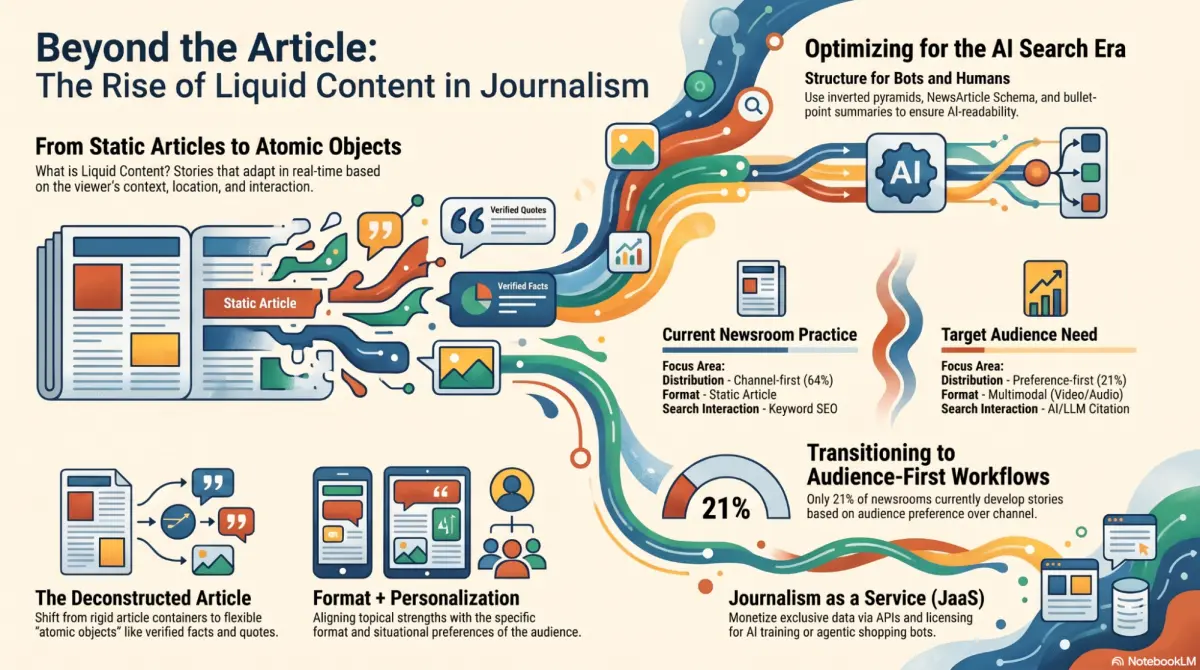
AI is prompting the deconstruction of the traditional news article. Publishers concerned about declining search visibility must adapt their content distribution workflows to surface in Google's AI-powered SERP features and in LLMs.
The article is not dead. But publishers may need to think beyond it and embrace liquid content.
Nikita Roy captured the shift at ONA25:
"The article is no longer the unit of journalism in an AI-mediated world."
She also challenged the audience:
"If you knew nothing about newsrooms, only that people need trusted, verified information, what would you build with today's tech?"
What liquid content means
The Reuters Institute's 2026 trends and predictions report defines it as:
"Content or stories that are not static but adapt in real time based on the viewer's context, location, time, or interaction. AI facilitates this by tailoring content to individual preferences. Requires traditional media companies to move away from authoring 'articles' towards more flexible atomic objects."
The components stay
Traditional article components remain present and valuable: verified information, quotes, data, resources.
Instead of locking them in a rigid article container, they get plugged into flexible content delivery pipelines.
The value shifts from the article as a whole to the facts and figures within it.
Where multimodal content fits
It is more useful to think of multimodal content as what flows through a liquid content distribution system, powered by two components: format and personalisation.
The key is aligning a publisher's topical strengths with the format preferences of its audience.
A tool example
Give Google's Gemini Notebook (formerly NotebookLM) a PDF of a court ruling, a video explainer or a 2,000-word investigation, and it converts them into briefings, infographics, quizzes, podcasts and slide decks.
The author reported mixed experiences converting data analysis reports into accurate infographics — but calls it still a worthwhile tool for testing multimodal options.
Adapting newsroom workflows
Building liquid content workflows requires a CMS able to convert an article into different formats. This should not be a fully machine-based process. Human input is essential.
Instead of forcing a story to fit a default article format, the story is allowed to dictate how it is presented in the way that best resonates with its intended audience.
Steven Wilson-Beales recommends asking:
"What is the essential seed of the story and what are the best formats that will allow that seed to bloom?"
Reformatting content is not new — publishers are already well-versed in headline A/B testing. With AI, formats can be tested the same way.
Personalisation is the harder layer
The more challenging part is the personalization layer.
Finnish broadcaster Yle has been working on personalisation for over a decade. AI can now bring some of those concepts to fruition — such as serving story formats tailored to a user's current need: an audio version for a driver versus a text article for a subway rider.
Live experiments
Publishers are already experimenting in different ways:
- Sky News: revamping workflows to simultaneously develop projects across multiple distribution platforms instead of converting to digital after television broadcast
- Die Zeit: focusing on podcasts as a multiformat opportunity
- AP's Storytelling tool: adapts stories into a variety of formats, from social posts to push alerts
- The Washington Post: launched a late-2025 AI experiment with a customisable "Your Personal Podcast" where the audience chooses topics and hosts
The Post's bumpy rollout shouldn't be an excuse for publishers to avoid AI-powered experiments in their newsrooms — these pioneering projects offer valuable takeaways for building better products.
Structuring articles for AI search
Liquid content is about flexibility, but it still needs structure so Google's AI search features and LLMs can easily surface and cite it.
That means being aware of how AI bots process and extract content, but not writing solely for them. What's good for bots can be good for a publisher's audience.
Elements to consider:
- Don't bury the lede. Apply the inverted pyramid structure
- Use NewsArticle structured data
- Include bullet-point summaries at the top of articles, especially long ones
- Add subheaders to organise and define sections
- Identify key questions, lessons or quotes and highlight them in a quote box or similar artifact
- Leverage internal linking to deepen engagement and broadcast topic authority
The last thing news publishers should do is pivot from writing for search algorithms to writing for AI algorithms.
Smart article structure and formatting can help news content reach both bots and busy human readers.
While news attention may seem to be shrinking, it may be more about matching audiences with their preferred platform and format. In a world plagued by news fatigue, liquid content products could be a transformative experience.
New distribution and monetisation
Liquid content offers a chance to transition from leasing space on third-party platforms to owning content pipes filled with valuable, exclusive data.
The author uses a restaurant as the model:
A restaurant offers a menu of standard dishes but adapts according to patrons' dietary, budget and atmosphere preferences. Similarly, a publisher's content offerings — website, newsletter, app — serve as its menu. Adopting a liquid content workflow moves publishers from a fixed menu to a dynamic à la carte experience tailored to audience preferences.
Monetising publisher data
A 2025 FT Strategies report proposed "journalism as a service" (JaaS), where publishers monetise exclusive data via APIs or licensing.
Financial news publishers may have the current edge, but health, science and sports publishers are sitting on a treasure trove of historic data insights.
Local publications have similar opportunities to become AI-powered community resource centres — or as Splice Media calls it, "Nextdoor for machines."
Affiliate content opportunities
Publishers shouldn't overlook affiliate content.
AI shopping features in the SERPs, paired with updates to Google's site reputation abuse policy, have left some publishers reeling while others seek new opportunities.
Time is working on a data product designed exclusively for bots, recognising the growing potential in agentic AI, where bots make purchases on behalf of users.
Can publishers regain their affiliate content footing by becoming a shopping bot's trusted product review source?
Finding the right distribution platforms
Liquid content can be directed to flow to platforms with the best engagement opportunities.
Sports viewership is growing on social media, with fans watching highlight clips and creator content instead of entire games on broadcast TV.
Publishers must dig into their analytics to understand not only social performance but also how their social posts show up in search. Google is making that easier by adding publisher social and video platform data to Search Console.
Personalising distribution
Google is pushing personalisation in its AI-powered news search features. Preferred Sources helps dedicated consumers connect with favourite publishers and subscriptions.
Barry Adams says Google's personalisation features amount to building an audience loyalty ecosystem. Content engaging a dedicated brand follower — in-depth explainers, for example — becomes a lead magnet for a publisher's other profitable products: newsletters, subscriptions and apps.
Other developments include Nota, using AI to help monetise publisher content as audience interest spikes, and Beakon, an AI-powered reader personalisation service for financial news.
The risks of liquid content
Newsrooms are still channel-led
The Future Newsrooms Study 2026 found most newsrooms (64%) still develop stories based on the channel destination — website, print, TV — rather than audience preference (21%).
Publishers may feel out of pivots, but risk being left behind by brands more open to experimentation.
Loss of meaning
When articles are reduced to informational atoms, the loss of meaning is a real risk.
We have all seen AI Overviews generate misinformation by slicing multiple sources into a Franken-answer. The author has documented Google's AI rewriting headlines on Discover and providing fictional scores for a game that hadn't even started yet.
Publishers may own what flows into the pipes, but Google is at the controls of its Freestyle SERP machine, generating an AI slop concoction with a publisher brand stamped on it.
Reinforcing echo chambers
Focusing on news personalisation may strengthen the echo chambers much of society has willingly embraced over the last decade.
Giving people wider control over their news consumption may lead them to narrow their perspective to one that suits their worldview.
What marketers should take from it
Redefine the content unit from page to fact. What AI cites is the data point, not the URL. Placing named figures and verifiable facts clearly within content is the practical response.
Automate conversion but keep the judgment. Default to automatic conversion and every piece ships in the same five formats.
Do not pivot to writing for bots. Inverted pyramid, structured data, bullet summaries, subheaders and quote boxes are good structure for bots and busy readers alike — not an optimisation for one at the other's expense.
Treat format A/B testing like headline testing. Extending an existing practice lowers the adoption barrier.
Inventory the data you own. The premise behind JaaS is whether you actually hold exclusive data worth selling. Health, science, sports and local archives are worth auditing first.
Design around personalisation's side effects. Echo chamber reinforcement is not an algorithm problem but a question of how choices are presented.
Read multi-format coverage as search strategy. For measured evidence, see 200,000 Impressions in 11 Days.
Being cited is not being seen. The more you atomise into facts, the greater the risk your brand disappears from attribution — see Ghost Citations and AI Halftime Report H1 2026.
AI search is transforming the traditional article format into repositories of flexible data assets that power AI search responses and LLM citations. Publishers should optimise the valuable data they own so they can monetise their products in a liquid content workflow.