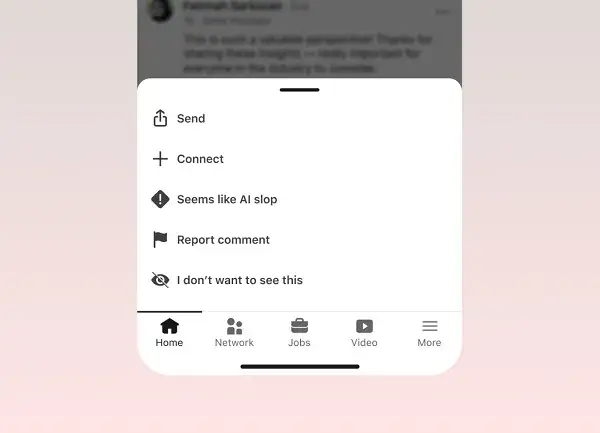
LinkedIn is testing an option that lets members report posts and comments that "seem like AI slop" in-stream. In an image shared by Chief Product Officer Hari Srinivasan, the report action sits in the three-dot menu at the top right of a comment.
What it's for
"We are ramping the ability for members to tell us if they believe a post or comment seems like AI slop," Srinivasan said. "Slop is hard to define and the definition changes; this lets us tune our models and make better feeds." Reported items feed LinkedIn's classification systems, which it is also improving for generally low-quality content.
Authors get told, privately
LinkedIn plans to alert creators when their posts are flagged. "For anyone who shares content, we will test a way to privately flag, in your analytics dashboard, when members feel your post may have come off as inauthentic or heavy use of AI," Srinivasan said. The aim is identifying overuse, not banning assistance: "We want members to get feedback from real humans on what sounds authentic — not just have an AI detector review it and get it wrong."
The bigger signal: rolling an AI feature back
The striking part is that LinkedIn is removing a feature that generated text for users. "We asked ourselves why do people post with AI anyway?" Srinivasan said. "The answer is LinkedIn isn't a one-word kind of place and they feel more confident running their posts through AI. We're taking this learning, removing the 'enhance your post' feature you see when you write a post or message & replacing with a feature that proofreads your words, but does not change your voice."
Given the billions Microsoft has invested in AI, pulling an AI writing feature is notable. LinkedIn had been adding assistants to nearly every step — job ads, applications, posts and articles.
Why this bites harder on LinkedIn
LinkedIn is where people build professional connections based on knowledge and insight. If members simulate that with AI, the network's value erodes. More than 100 million members have completed identity verification, but that trust signal weakens if verified people publish machine-written content.
Other platforms are moving the same way — Pinterest, Snapchat, TikTok, Reddit and X have each taken steps to slow AI-generated posts. See Snapchat Stops Recommending AI Slop and LinkedIn Revenue Grows 12%.
The practical read
Drafting with AI is not banned. What changed is that platforms are treating a human voice as a quality signal. Bulk automated comments and uniformly toned AI prose now cost you on both reach and trust.