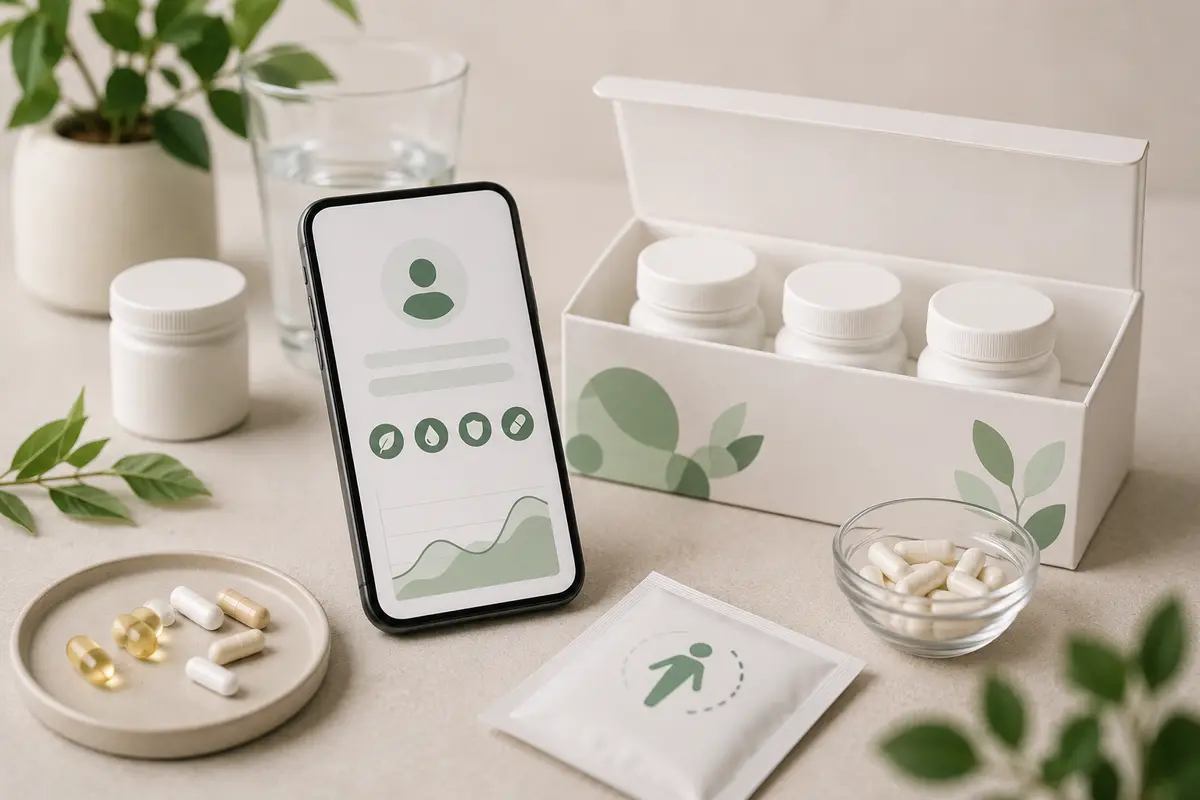
Answer a short health questionnaire and get a supplement stack built for your current state. Pillyze, a personalized supplement subscription service in Korea, has now delivered more than 270,000 such recommendations. The paradox behind that number defines the category: buying supplements is already mainstream, but choosing and actually taking them remains a product-centric experience. Vitamins, omega-3, probiotics, and lutein line the kitchen table, and none of them explains whether you still need it, whether it stacks safely, or when to stop.
Five years near 6 trillion won, 0.2% growth in 2025
Market figures citing the Korea Health Supplement Association put the domestic market on this track:
- 2021: 5.69 trillion won
- 2022: 6.15 trillion won
- 2023: 6.14 trillion won
- 2024: 5.95 trillion won
- 2025: roughly 5.96 trillion won
Growth in 2025 came to 0.2%. The market has not shrunk, but the signal is clear: adding SKUs and buying more impressions no longer moves the number much. When most households already buy supplements, accuracy of choice and a reason to repurchase matter more than finding first-time buyers.
The unit of competition shifts with it. Not ingredient dosage or discount depth, but the entire experience of convincing someone why this product fits them and getting them to actually take it.
More buyers, pickier consumers
Purchase experience reached 83.6% in 2025, the highest level in five years. More than eight in ten consumers have already bought.
As purchase experience accumulates, buyers move from novice to comparison shopper. They check ingredient names, functional claims, daily intake, price, reviews, and advertising language across multiple channels. They look for evidence that fits their own situation rather than efficacy a brand asserts at them.
The marketing conclusion follows. "We packed in premium ingredients" is not enough. Content that says who should choose this, when, and on what criteria becomes the core conversion asset.
Personalized supplements are a service business
As Korea's personalized health functional food framework took effect, the industry moved past selling finished products into a service competition spanning consultation, recommendation, repackaging and combination, and follow-up care. Operators must staff each store with a qualified manager, control safety, quality, and hygiene, and retain records.
One boundary matters. Personalized service is not a medical act — it does not diagnose or treat disease. It helps consumers choose health functional foods based on the health information and lifestyle they provide. So the limits of what you may claim, and the duty to explain, weigh as heavily as recommendation accuracy.
And if personalization stops at a recommendation engine that shows a product bundle after a few survey questions, it is trivially copied. It becomes a service only when consultation context, the reasoning behind a recommendation, and post-purchase intake records connect.
Subscription KPIs: adherence, not delivery cadence
Supplement subscriptions are easy to start as "same products, monthly, at a discount." But when the boxes pile up in a drawer, scheduled delivery becomes the reason to cancel. Customers want continuity and adjustment of intake, not automation of shipping.
Marketing KPIs have to widen accordingly — from orders and average order value to recommendation acceptance rate, 30-day adherence, and repurchase rate after consultation. These measure whether the product entered someone's health routine, not whether they bought a lot. The same failure mode — customers acquired by incentive who never activate — shows up elsewhere; see One in Seven Credit Cards Is Dormant.
AI recommendations win on explainability, not accuracy
AI can narrow a large option set quickly using consultation records, purchase history, and intake patterns. But health-adjacent recommendations do not earn trust simply because an AI made them. The system has to explain what information it used, why it proposed this product, and when a human expert should be consulted.
Trust matters more because the risk of exaggerated online health claims is rising alongside. Korea's Ministry of Food and Drug Safety recorded 58,578 cases of illegal online advertising in food and drug categories in 2022, 59,088 in 2023, and 96,726 in 2024. Note that this figure covers food and pharmaceuticals broadly, not health functional foods alone, and should not be read as the size of the supplement industry's problem.
The data supplement brands need to accumulate is not click history. It is the source of functional claims, the information used in each recommendation, the scope of consumer consent, and the record of consultations and changes. That is what turns AI recommendation into a long-term trust asset rather than a short-term conversion tool. On accumulation mattering more than tool adoption, see What Socar and Samjjeomsam Learned the Hard Way.
Why marketing and operations cannot be separated here
In this structure, marketing and service operations stop being separable. If the level of personalization the advertising promised is not actually delivered in consultation, shipping, and intake management, conversion rates rise while retention falls. Personalization used only as ad copy exposes itself the moment the first payment clears.
The summary is simple. Korea's supplement market is no longer discovering health-conscious consumers for the first time. Purchase experience is high and market size is stuck near 6 trillion won. The next increment of growth will not come from shelving more products. It goes to brands that help consumers understand their own state, explain the reasoning behind a choice transparently, make continued intake achievable, and adjust recommendations as circumstances change.
The next product in this category is not a bottle. It is a health routine that has found a place inside someone's day.