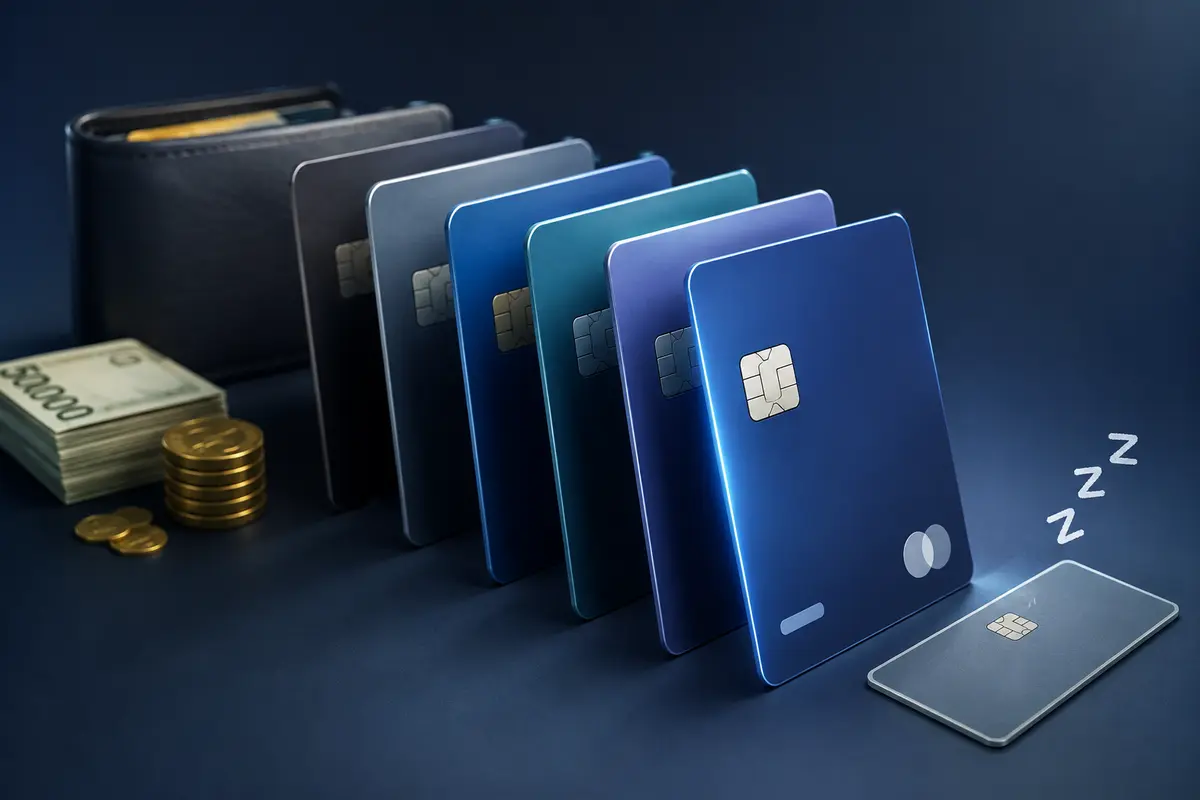
Open a new credit card and the cashback is worth several times the annual fee. Spend a set amount inside a set window and you collect the equivalent of $70 to $150. From the consumer's side there is no reason to say no.
The problem starts afterward. Korea's eight dedicated card issuers ended 2025 with 17.24 million dormant credit cards — up roughly 1.43 million year over year, per the Credit Finance Association's disclosure portal. Dormant cards as a share of all credit cards rose from 12.8% in 2023 to 13.9% in 2024 and 14.9% in 2025.
The question issuers are asking is wrong
The question is not "how much does it take to get someone to sign up." It is "what reason does this customer have to keep using the card after the reward ends."
Korean online communities have a name for the arbitrage: card-tech. Collect the cashback, switch to a card with a nominal annual fee, cancel the original. If an issuer blocks reissue, move to a different issuer.
The acquisition channel changed the first relationship
Card sign-ups once ran through bank branches, big-box stores and airport agents. Today comparison services inside Naver Pay, KakaoPay, Toss, KakaoBank and Banksalad handle much of that role.
Consumers now compare not only annual fees and reward rates but which platform pays the most cashback this month. Because the same card carries different incentives by channel, the channel decision often comes before the card decision.
For issuers it is fast acquisition, but platform costs and consumer cashback rise together. The more a market shifts from creating new demand to moving competitors' customers, the more likely a customer acquired with a bigger incentive leaves for a bigger one. The first relationship forms with the cashback amount, not the card brand.
More cards, not more habits
Korea's credit card count grew from about 124.17 million at the end of 2022 to roughly 133.41 million at the end of 2024 — about 9.24 million more cards, or 7.4%, in two years.
But consumers already hold several. A new card tends to be one more card in the wallet rather than a replacement for the primary one, which is why dormancy grew alongside issuance.
Not all of that dormancy traces to cashback marketing — life changes, ended partnerships, reduced benefits and replacement issuance all contribute. Still, acquisition competition and dormancy rising simultaneously is a signal to re-examine the KPI.
Before calling them cherry-pickers
Customers who take the reward and move on get labeled cherry-pickers. Reading that purely as low loyalty misses the design flaw.
The issuer offered a large reward as an acquisition condition and the customer used the offer rationally. If the campaign was only designed through first purchase, motivation ending when the cashback ends is the expected outcome. The customer is not disloyal; the next scene was never written.
Judging campaigns by sign-ups and first-month spend hides this. Real performance shows up in whether the card is still being used three and six months after the cashback lands.
Design the first 90 days, not the first purchase
The 90 days after issuance is the window for entering a payment habit. The card arrives and needs to be registered in a mobile wallet, autopay for phone bills and utilities needs switching, and the customer has to learn where the benefits apply. If that friction is high, they spend exactly enough to clear the cashback threshold and return to their old card.
The activation funnel
- Immediately after issuance: drive registration in whichever mobile payment service the customer already uses.
- After first purchase: surface the next available benefit based on the categories they actually spent in, and explain qualifying spend and exclusions simply. A customer who expects a benefit and misses it on a technicality stops trusting the issuer, not the product.
- Autopay conversion: design it as a household-expense service, not a promotion. Once phone bills, subscriptions and utilities connect, the card moves from a one-time cashback vehicle to a monthly payment method.
Same reward, different customers
Customers acquired with identical cashback behave differently afterward. Some connect recurring bills and use the card monthly. Some hit the threshold and stop. Some use it for a defined purpose — a trip, a move — and then never again.
Treating all three as one "new member" segment with identical follow-up wastes budget. Segment by acquisition channel, first spend category, transaction frequency and autopay status. The point of personalization is not varying the discount rate; it is finding the friction stopping this specific customer from using the card again.
Move the KPI past sign-up count
Cashback remains a powerful acquisition tool. The problem is not the cashback — it is the absence of a strategy after it.
Channel comparisons need more than sign-up volume. Compare retention and lifetime value separately for comparison-platform customers versus owned-channel customers. High acquisition cost is efficient if the card becomes a primary card for years; a low cost per account that goes dormant right after the promotion is not a cheap customer, it is an expensive failure.
Four checks:
- Is there a 90-day activation funnel (wallet registration → first purchase → autopay conversion)?
- Are retention and LTV compared separately by acquisition channel?
- Do cashback-threshold, small-recurring and autopay customer types get different follow-up?
- Does the KPI extend past sign-ups to 90-day and 180-day usage retention?
This structure is not unique to cards
Strip out the industry and the pattern is familiar: a strong acquisition incentive drives sign-ups, churn arrives when the incentive ends, and the success metric stops at the moment of acquisition. First-order coupons, free subscription trials and new-customer e-commerce discounts all repeat it.
Fixing measurement comes first — the problem only becomes visible in cohorts, as argued in Cohort Retention Beats Growth Rate — the One Chart Investors Open First. And sending identical follow-up to an "average new member" collapses efficiency for the reason described in Your Customer Journey Doesn't Work Because It Was Built for an Average Customer.
One in seven cards sitting dormant does not mean people lack cards. It means they lack a reason to keep using one. When a card acquired with a large reward ends up in a drawer three months later, the likeliest explanation is that nobody wrote the story after the first purchase.