From keywords to questions
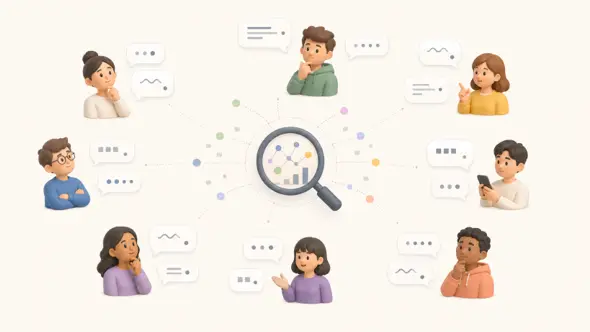
Classic search strategy mapped demand through keywords like “deposit renewal,” search volume and related terms. Generative AI changes the input. People now ask with situation, constraints and goals included: “I just got my first paycheck — given current rates, should I renew my deposit?” or “I need a lump sum in three years and rates are falling. Renew, or look elsewhere?” Same topic, different triggers. TBWA’s Korean data lab argues that capturing those differences is the core of GEO category entry points work.
A category entry point (CEP) is the moment or need that makes a consumer think of a category or brand. As questions become more specific, markets fragment — and each question carries its own trigger and decision criteria.
Estimating questions you can’t see
ChatGPT, Gemini and Perplexity don’t publish user prompts, so brands have to infer them. Tools that classify CEPs from search-intent data exist, but social data offers a way in without specialized software.
Social data means posts, questions, comments and reviews consumers write themselves. Someone who searched “retirement pension management” might write in a community: I have a defined-contribution pension (situation), I haven’t touched it for years (problem), I heard returns are poor (trigger), I don’t know how to manage it (constraint), and I want to do better (goal). That context is the question they’ll put to an AI.
Where to look
- Naver KnowledgeiN: Korea’s largest Q&A platform, rich in detailed questions on finance, health, careers and daily life.
- Aha: a Korean Q&A community organized by categories such as law, medicine and finance.
- Reddit: for global markets, subreddits collect questions, experiences and product comparisons.
- Industry communities and forums: investing forums, parenting groups or fashion communities — each industry has its own gathering place.
Start by finding where your customers actually talk about their problems, not by picking a platform first.
Turning questions into prompts and CEPs
Organize recurring questions by current situation, trigger, problem, selection criteria and goal. That gives you realistic GEO prompts and the CEPs your brand should own. Since you can’t chase every question, filter with three tests:
- Brand fit: does answering it connect naturally to your products and expertise?
- Competitive intensity: is it already dominated, or is there no clear leader yet?
- Frequency: how often do similar situations and concerns appear?
Limits of social data — and why to pair it with search
Social data is noisy: off-topic chatter, AI-generated posts, duplicates and ads all need filtering. It’s also hard to judge how representative a question is; social listening tools estimate mention volume and trends, but not as clearly as search volume.
That’s why the two work together. Search data shows the size and direction of demand; social data shows the context and reasons behind it. GEO expands the unit of analysis from keywords to questions. Pair this with designing for follow-up questions in conversational search, and use the two GEO experiments as a guide to earning citations once you’ve found the questions.