Creator content increasingly informs AI answers.
The reason is simple: a large language model can't have an opinion. It can't decide whether your product is the best moisturizer or the water softener that's the best value.
So when someone asks a subjective question, an LLM borrows a point of view from wherever humans have already shared one.
Reviews, community threads, editorial content, retailer pages and creator content guide these answers — and various teams own all of those sources.
This makes showing up in AI answers less of a content creation issue and more of a coordination problem.
AI needs opinions to build out answers
In Tinuiti's Q1 2026 AI Citation Trends Report (the author is senior director of AI SEO innovation at Tinuiti), roughly 82% of AI citations pointed to earned media, not a brand's own site.
Creators are a fast-rising component of that mix.
Look at YouTube's SERP presence:
| Metric | Change |
|---|
| YouTube keywords included in Google AI Overviews | 3.6 million → 36.2 million year over year |
That's likely partially due to the increase in AI Overviews. Yet YouTube visibility across the entire SERP has been evolving for a long time.
Video has now become a format AI uses when it needs to explain or validate something.
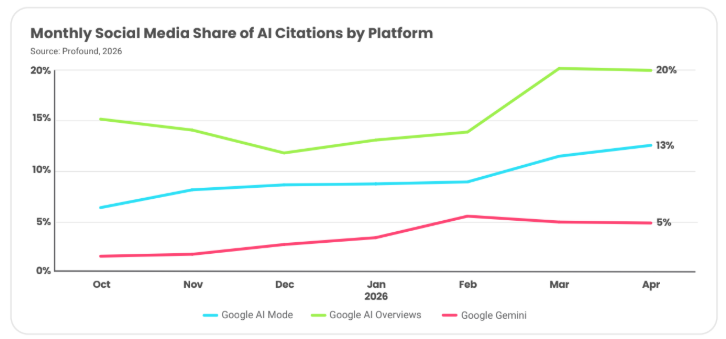
Social's citation share swings hard by category
It's tempting to invest in creators across industries, but the data doesn't necessarily support that approach.
From the Q2 2026 AI Citation Trends Report:
| Prompt category | Share of AI citations driven by social platforms |
|---|
| Apparel | ~13% |
| Over-the-counter health | ~3% |
Social citation trends move quickly. For example, Perplexity's share of citations from social media fell from 31% to 13% in a single quarter as it pulled back from Reddit.
The social platforms that matter in each category continue to evolve, too, requiring deeper research into where LLMs source conversations.
That's exactly why a single team watching one social channel can't see the whole picture.
Traditional search has been signaling to social for a while
It would be easy to file all of this under AI search. But it's a pattern Google has been building toward as consumer behavior has moved to social.
- In 2025, the search engine began automatically adding social media links to Google Business Profiles at scale, surfacing brands' recent posts right on their profiles
- Google has also started to display a short videos block on SERPs and within the search bar — vertical clips under five minutes, pulled from sources like Facebook, YouTube and TikTok
Semrush organic research data for the past year (U.S.):
| Domain | Organic traffic change |
|---|
| YouTube | roughly doubled — now Google's single largest organic domain |
| Facebook | ~+60% |
| Instagram | ~+60% |
Google keeps building surfaces to ingest, display, and now measure social conversations.
In the spirit of search everywhere optimization strategies, it's safe to say there's high value in social conversations and content.
The creators winning citations aren't who you'd expect
The content that wins YouTube citations isn't the obvious kind.
OtterlyAI's YouTube Citation Study 2026 found:
- Long-form video accounts for 94% of AI citation
- 40.83% of cited videos have fewer than 1,000 views
Popularity doesn't predict citation value. Instead, structure does.
Mid-size niche creators tend to make well-structured content — typically with clear titles, clean formatting and a specific focus:
- Comparison videos
- Honest reviews of a category
- How-to-style videos
- Skincare routines
- Tutorials for SaaS
Sentiment affects AI search too
In one client program, when mid-size creators published genuine review content, their language began appearing in citations for branded prompts and in sentiment theme occurrence rates.
A YouTube review and a blog each reached roughly 0.23% citation share on a target term, and it's kept climbing.
AI search leans on creator content because it's authentic and not branded. As a result, flooding search with citation bait breaks the very thing that makes it useful.
The teams doing this well scale creator content when there's a real idea or a brand story worth reinforcing.
The real unlock is one shared objective
Most organizations run influencer and SEO on separate budgets, chasing distinct goals — reach and engagement over here, rankings over there.
Instead, point teams at the same target and encourage them to exchange insights:
- The influencer team gets to see its real role in search
- The SEO team brings citation data and measurement
Micro-influencers and repeated sentiment themes can matter as much as any single high-reach post.
Shared reporting can show which creator content is influencing search and help both teams make better decisions.
The tooling is catching up
In July, Google introduced platform properties in Search Console. This lets you track how your Instagram, TikTok, X and YouTube content performs in Google Search, including the queries that send people to your posts.
These insights can make creator choices evidence-based instead of instinctive.
Align your narrative across the content about your brand
Creator content is only one part of what AI engines encounter when forming a picture of your brand. They also draw from content, PR, commerce, social, affiliate, video and paid.
When those sources reinforce the same narrative, AI models get a clearer picture.
Creators are a smart place to start because they're a growing source of opinions and experiences AI engines draw from.
The opportunity goes beyond any one channel. It's about giving AI engines a consistent story about your brand wherever they look.
Practical takeaways
Revisit the owned-content budget split. If 82% of citations point to earned media, more posts on your own blog cannot reach that 82%.
Draw a different conclusion per category. 13% for apparel versus 3% for OTC health means creator investment should not be pushed industry-agnostically. Measure your own category's citation source mix first.
Stop recruiting on view counts. 40.83% of cited videos have under 1,000 views and long-form accounts for 94% of citations. Structure — clear titles, clean formatting, specific focus — outweighs reach.
Don't manufacture citation bait. Authenticity is the mechanism, so mass production is self-defeating. For when content gets used but the brand stays invisible, see Ghost Citations.
Merge influencer and SEO KPIs. With separate budgets and separate goals, citation data never reaches the casting decision. On metric design, see Do We Show Up in ChatGPT? Four Metrics That Answer 2026's Top Request.
Connect Search Console platform properties immediately. It is the first time brands can see the search performance of their social content directly.
Treat YouTube as a search asset. It is now Google's single largest organic domain — see 200,000 Impressions in 11 Days for treating the channel itself as a search surface.