"Use last month's order data to find customers sensitive to coupon benefits." For any marketer, that single sentence is a familiar ask — and inside most organizations, it's also where things stall. Not knowing who to ask, and a data literacy gap that keeps people from interpreting data themselves even when they know it matters, have long been chronic problems. At Enterprise AI Seoul in May 2026, Sung Han-young, team lead of Woowa Brothers' AI Pro team, shared how the company behind food-delivery app Baedal Minjok solved exactly this — a case study in real enterprise AI adoption.
From Search Tool to Business Coding Agent
Woowa Brothers' internal AI moved through three generations: a first generation limited to simple information search, a second generation of multiple cooperating agents, and now a third generation, a business coding agent called "Mureobose Claw." It's built from a SQL Discovery Agent that turns natural-language requests into complex queries, a Knowledge Discovery Agent that searches scattered internal knowledge in one place, and a Support Automation Agent that automates repetitive tasks.
The Results, in Numbers
The results are concrete. When one staff member pointed the AI at a specific wiki folder, it worked through multiple reasoning passes and proposed its own data feature analysis table and outlier-detection criteria. In another case, estimating the total cost of a marketing coupon with complex constraints — "once daily, under specific usage conditions" — was completed in about 30 minutes by simulating usage rates and issuance volume by scenario. Company-wide, active user share rose from 25% to over 50%, positive feedback on AI responses reached 95%, question-resolution time on work channels dropped 21%, and monthly usage passed 20,000 uses.
The Real Lever Was Adoption Design, Not the Tool
Sung's central point is that success came from how the tool was rolled out, not what was rolled out. Most companies stay stuck in an individual-productivity model — one employee chatting one-on-one with an LLM. Woowa Brothers instead focused on team-based problem solving through shared Slack channels, running a repeating adoption loop: company-wide exposure (announcements, newsletters, training) → hands-on experience → accumulated success stories → habit formation in daily work. As Sung put it, "no AI agent adoption works well from day one" — the deciding factor was designing the tool into an organizational habit, not the tool itself.
Woowa Brothers frames its AI maturity as a five-stage roadmap: task assistance (2024), task automation (2025), and currently partial task intelligence (Stage 3), heading toward joint-decision-level intelligence (Stage 4) and eventually full task autonomy (Stage 5). The talk closes on an open question: once AI becomes the optimized decision-maker, what work is left for humans?
What Marketers Should Take From This
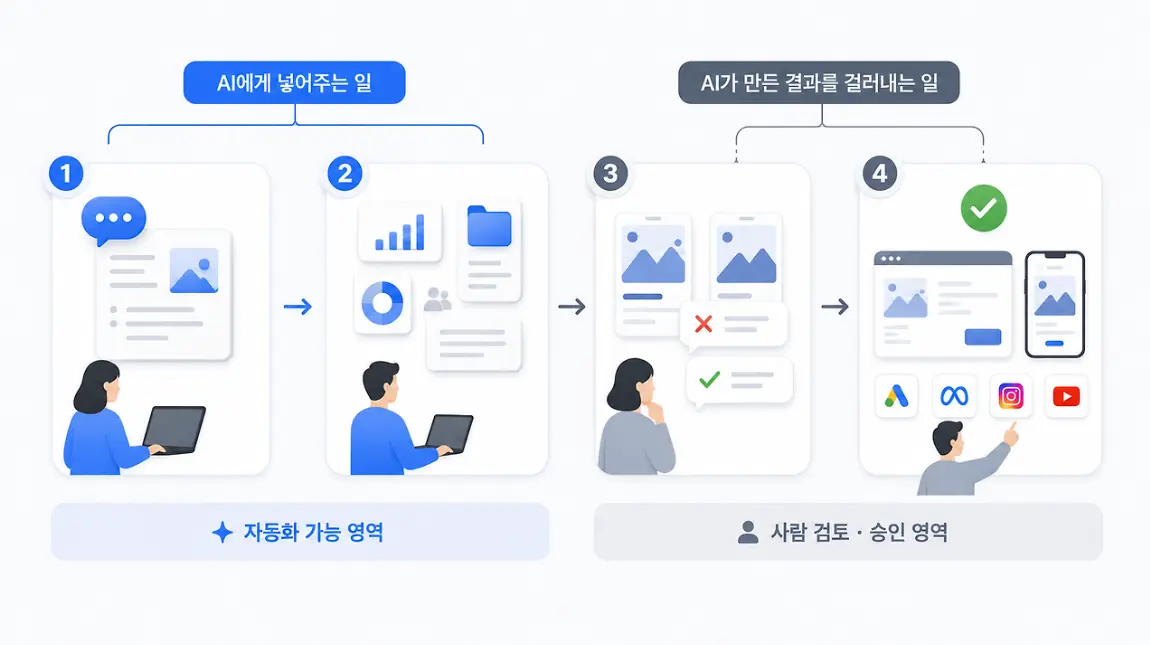
The lesson for marketers is that success in enterprise AI adoption is measured by organizational rollout design, not model performance. No matter how capable the tool, if usage stays confined to individuals chatting privately with an LLM, the organization's data literacy gap never actually closes. Recurring marketing data requests — like finding coupon-sensitive customers or simulating coupon budgets — are best handled by an agent working inside a shared team channel, structurally solving the bottleneck of relying on one specialist.
At the same time, as AI takes over execution steps like writing SQL and running simulations, human value shifts toward defining what to ask and why. What marketing organizations need to build now isn't just an AI tool rollout — it's the habit of asking good questions and validating the answers, embedded as a team practice. Related reading: our pieces on why 88% of enterprise AI projects fail and why AI giants are investing in people, not models go deeper on this same shift. For help designing AI adoption inside a marketing team, Best Partner's services can support your rollout.