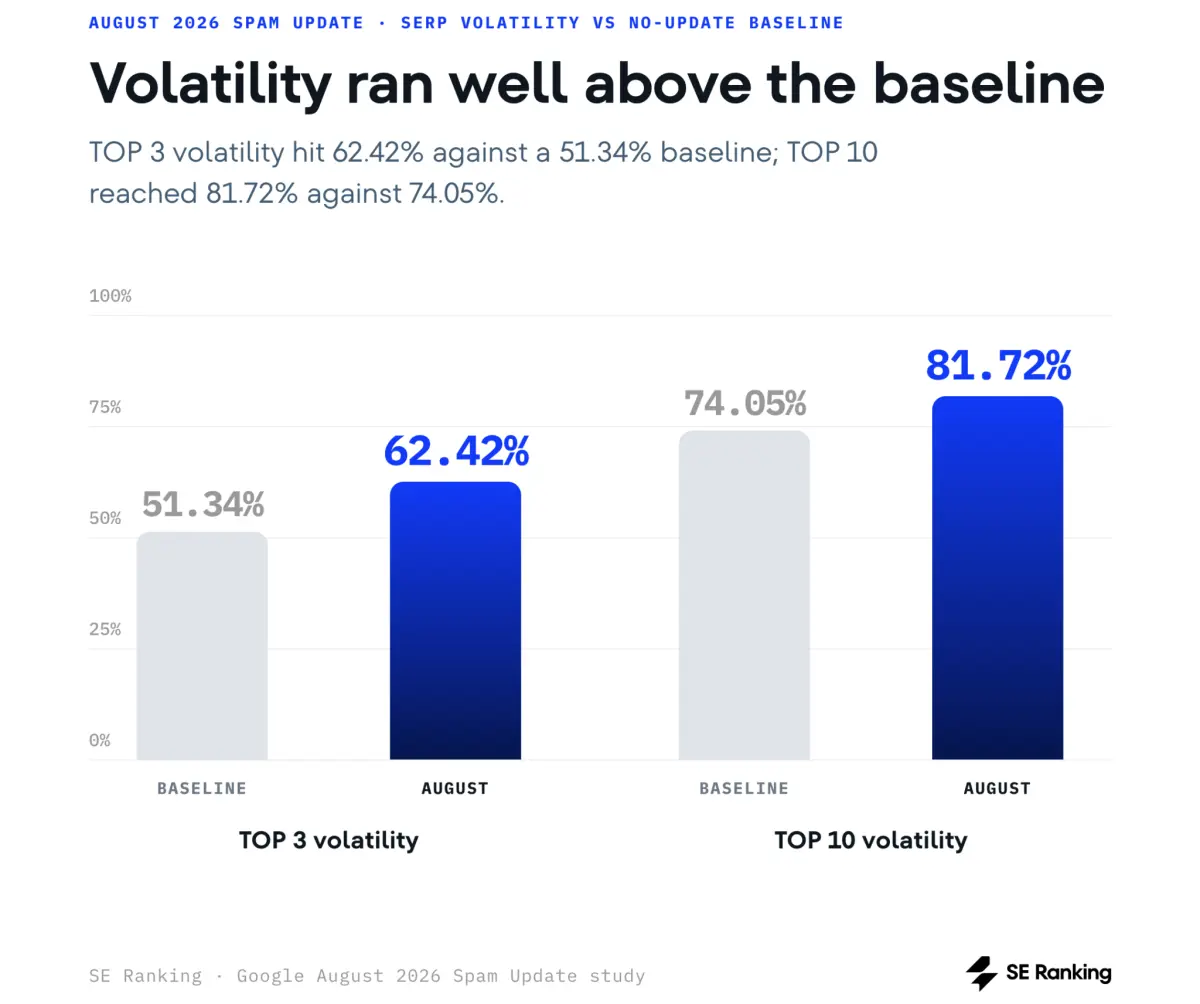
New data confirms what many SEOs felt in real time: Google's August 2026 spam update was unusually disruptive. According to SE Ranking, 16.71% of URLs that had been ranking in Google's top 10 fell beyond position 100 for the same keyword during the update — compared with 9.2% during a comparable five-day period in July with no confirmed update. That's an 82% increase, making a top-10 URL roughly 1.8 times more likely to vanish from the top 100.
The numbers behind the volatility
All 20 tracked industries were hit
The turbulence wasn't concentrated in one niche. Across the 20 industries SE Ranking tracked, top-10 volatility ranged from 74.64% in real estate to 85.55% in fashion and beauty. Notably, YMYL categories — real estate and healthcare among them — were the steadiest of the group, though even they saw heavy movement.
What the data can't tell you
The study compared U.S. organic rankings for the same 100,000 keywords across 20 industries, using August 17 and August 22 snapshots (immediately before and after the update) against a July 26–31 baseline. Because tracking stopped at position 100, the data can't distinguish between deindexed URLs and pages that simply fell below 100. SE Ranking also didn't run URL- or domain-level analysis, so it doesn't show which site types or spam tactics were disproportionately punished.
What to do with this
A fall from top 10 to beyond position 100 is not normal churn — and this update produced that outcome at nearly double the usual rate. If specific pages lost traffic sharply from mid-to-late August, check Search Console for keyword-level ranking drops before blaming seasonality.
Keep in mind that Google's big swings are often more surgical than they look. As we found in Has Google Demoted Listicles? A 60,000-Query Study Says Yes — but Only Surgically, demotions tend to target specific query classes rather than whole sites — so diagnose by keyword cluster, not by domain-level panic. And while you rebuild rankings, make sure the traffic you still have is earning its keep: SEO's Blind Spot Starts After the Click — Making Content Answer for Conversions, Not Traffic is the companion discipline for moments like this.