PPCSearch Engine Land
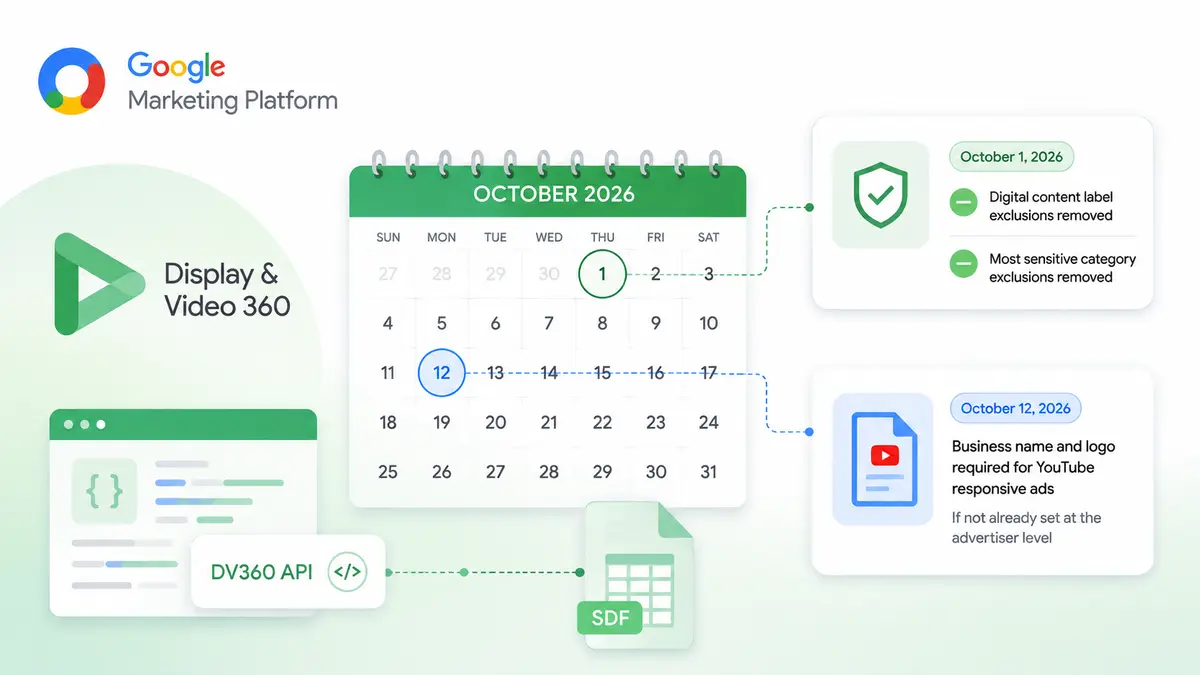
DV360 Is Dropping Content Exclusion Options — Two October Deadlines
Google is removing digital content label and sensitive category exclusions from the DV360 API and requiring business identity for YouTube responsive ads.
Google Marketing Live was almost three months ago, and enough announcements have shipped to separate the meaningful changes from the features that still need time.
For B2B advertisers, that distinction matters. B2B has often felt like an afterthought while Google focused on commerce features, leaving advertisers to adapt those tactics to lead generation themselves — which can shift performance toward users with different intent than originally targeted.
This year, however, Ginny Marvin released "42 Launches Redefining Lead Generation," the closest thing Google has given B2B advertisers to a roadmap.
Google changed how limited-budget campaigns with target-based bid strategies are optimized. Campaigns with a "limited by budget" status on tCPA/tROAS will now deliver more consistently to a stated target rather than overperforming it.
This news shocked the entire Google Ads world, but B2B accounts should treat it as more urgent than ecommerce.
Two reasons. Lead gen campaigns tend to sit in "limited by budget" often, and tCPA and tROAS values are frequently stale — set at launch and rarely revisited as the campaign matures.
Any campaign quietly beating an old target now risks exposure to expanded targeting into less desirable networks, where incremental cost adds up quickly.
Smart Bidding Exploration moved out of beta and became globally available in all languages for Performance Max campaigns without a product feed.
Google reports search campaigns using Smart Bidding Exploration see 27% more unique converting users on average. That figure came from a mature account that had done the measurement and first-party data work first, but it demonstrates the feature can be extremely powerful for B2B and lead gen advertisers.
Google launched direct integrations for Mailchimp, ActiveCampaign, Klaviyo, and Google Drive, plus partner API connections with Zapier, Stape, Adswerve, Bloomtech, and Treasure Data. Map view also launched, making it easier to audit where account data is actually deployed.
Why this matters: offline conversion import is a direct prerequisite for journey-aware bidding, value-based bidding, and multichannel campaigns like Performance Max, Demand Gen, and AI Max to deliver anything beyond cheap volume.
And the main reason B2B accounts do not import CRM data is often an engineering queue issue rather than a strategic one. These direct connectors clear that path.
The sequence for feeding CRM outcomes back is laid out in how Google Ads lead quality gets decided in your CRM.
This lets a Target CPA search campaign learn from every stage in the lead-to-sale path rather than the form fill or limited down-funnel quality alone. The bidding algorithm reads the entire funnel when deciding which clicks to bid on.
It resolves a longstanding structural problem in B2B PPC optimization. First announced at Think Week 2025, it has been in beta a long time — expected, given the complexity and the need to ensure a transformational feature works as intended.
GML focused heavily on AI innovation this year. One key innovation for B2B and lead gen is business agents for leads: a Gemini chat agent inside the search ad, grounded by your website, that answers questions and fires a pre-filled form after the user shows intent.
It is currently tested in specific verticals with substantial work remaining before wide availability. In the meantime, advertisers should ensure pricing, features, security, and integration pages are accurate and easily understood by LLMs, so comparison shoppers get the information.
AI Max has been out about a year and got a lot of stage time at GML, but it should be heavily scrutinized by B2B advertisers.
A study from PPC Live showed:
That is a predictable result when the model optimizes to a form fill without understanding the down-funnel impact. Query expansion inflates the top of the funnel, landing page expansion pushes prospects to pages that educate rather than convert, and generated copy flattens positioning that took time to build manually.
On June 11, Google gave advertisers a temporary delay on the automatic migration from Dynamic Search Ads to AI Max campaigns, from September 2026 to February 2027, and restored DSA campaign creation on the 15th. It is not a full reprieve, but the pullback signals the feature isn't ready for prime time. Improvements are expected before February; this false start should still make B2B advertisers wary.
Establishing a baseline against that timeline is what Google's newly expanded AI Max testing and planning tools are actually useful for.
A major GML theme was Ads in AI Mode. AI Overviews represent the most transformative period in Google Search, but there is much to figure out before B2B advertisers benefit.
The expectation that you simply trust Google's algorithm to understand your customers and find them through signals hasn't been frictionless over the years. Similar to Performance Max channel reporting, it could take years of raising issues before that transparency arrives.
In the meantime, B2B advertisers should:
Google has shipped a lot of the foundation while many transformational features remain in beta. The teams that come out ahead are the ones investing in offline conversion data, addressing stale bid targets, and running controlled experiments while a control group still exists.
Lead gen campaigns frequently sit in 'limited by budget' status and their tCPA/tROAS values are often stale from launch. Campaigns quietly beating an old target now risk expanded targeting into less desirable networks.
Offline conversion import is a prerequisite for journey-aware bidding, value-based bidding, and multichannel campaigns to deliver beyond cheap volume. Direct connectors remove the engineering queue that usually blocked B2B accounts.
PPC Live's study found average CPC dropped 59% and clicks nearly tripled, while cost per lead rose from $493 to $850 — the predictable outcome of optimizing to form fills without down-funnel understanding.
Serving is limited to AI Max and Performance Max, and reporting gives little transparency into when or why an ad served. For now, move conversion actions down-funnel and monitor lead quality closely.
To apply what you just read to your own site, start with a free audit of where things are now.
A strategist replies within 24 hours on business days.
Google is removing digital content label and sensitive category exclusions from the DV360 API and requiring business identity for YouTube responsive ads.
Greg Finn reflects on the road from exact match close variants to AI Mode: what automation took away, what it left, and why authenticity now matters more.

Google's new YouTube creative guidance puts numbers on ad elements: 12% for human voice, 3% for text overlays, 4% for early branding.