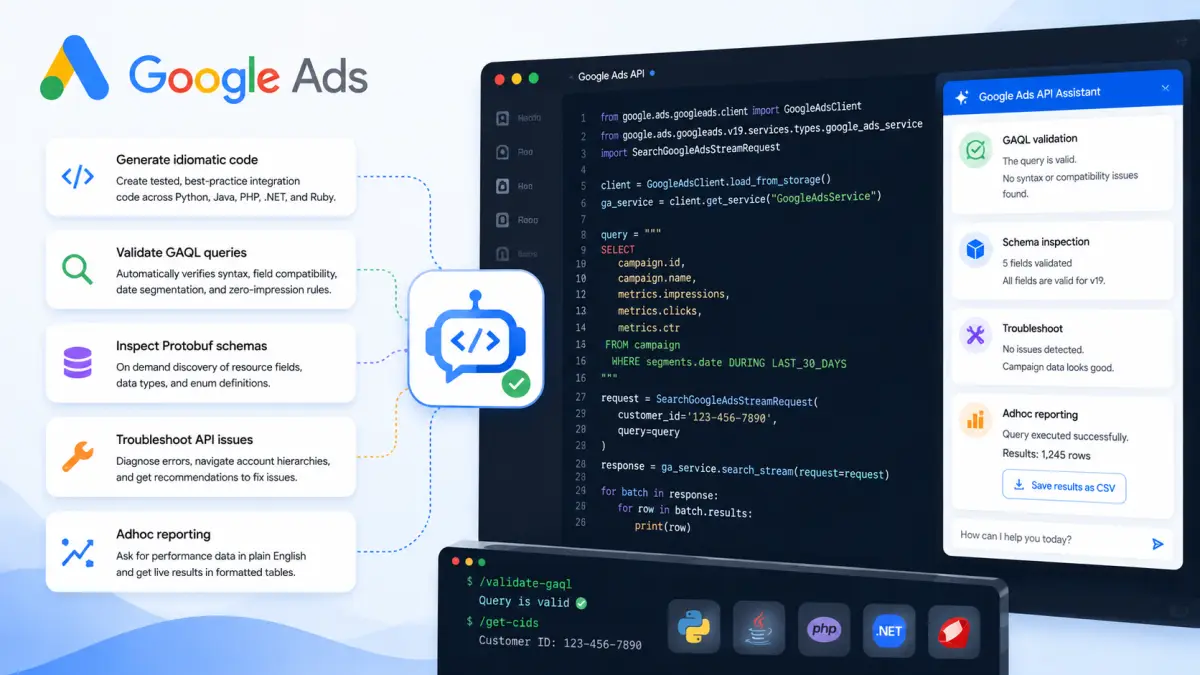
Google has released version 4.0.0 of the Google Ads API Developer Assistant, and the headline change is architectural. Instead of the standalone, per-project workspace setup of earlier versions, the assistant now installs once as a globally available plugin, so its Google Ads-specific rules, skills, and diagnostic commands work across multiple projects and development environments. The release adds dual-platform support for Google's Antigravity and Anthropic's Claude Code, and it is not backward compatible with previous versions.
What the new version does
Grounding AI coding in real API definitions
The assistant is built to answer from the Google Ads API's actual definitions rather than whatever the underlying model happens to remember. It generates integration code in Python, Java, PHP, .NET, and Ruby following tested API best practices, and it answers API questions by combining embedded architectural rules with local Protobuf schema inspection. That schema grounding is aimed squarely at the classic failure mode of AI-assisted API work: hallucinated fields and configurations that don't exist in the version you're running.
GAQL validation and ad hoc reporting
The most practical addition is automated validation of Google Ads Query Language (GAQL) queries. Syntax, field compatibility, date segmentation, and zero-impression rules are all checked in a single step before a query runs — replacing the multi-turn loop where an AI model keeps guessing at why a query is broken. Developers can also request performance data in natural language; the assistant builds and validates the GAQL, runs it against the account, and returns live results as formatted tables or a CSV.
Conversational troubleshooting
The assistant diagnoses offline conversion upload failures, manager account hierarchy issues, and Performance Max listing filters. Instead of working through individual API errors, you can ask account-level questions like which ads have problems and how to fix them.
Why it matters
This is Google moving its developer tooling to where developers increasingly are: inside AI agents. It sits on the same trendline as ad platforms handing more operational decisions to AI — see ChatGPT Ads Adds Automated Bidding — Plus Platform Targeting and View-Through Conversions — and simplifying measurement infrastructure, as with Google Unifies Google Tag and Tag Manager — With No-Code Event Tracking.
For agencies and in-house teams, the barrier to custom reporting automation just dropped. Google Ads API work used to require a dedicated developer; with validated, schema-grounded expertise inside an AI coding tool, building something like a weekly campaign performance export becomes a far smaller lift. The flip side: as that automation gets commoditized, pulling the data stops being a differentiator. The teams that win are the ones who know what to ask of it.