Tech/AI모비인사이드
OpenAI DevDay 2026 Recap — ChatGPT Becomes a Shared Workspace for People and Agents
OpenAI DevDay 2026 introduced the always-on agent Dots, GPT-6.1 Sol and ChatGPT Spaces. A recap of the shift from model races to work platforms.

LLM, RAG, fine-tuning — the terms pile up in meetings. Everyone nods, and then nobody can define them out loud. You do not need to memorize them like flashcards. AI evolved in a sequence: it learned language, then became an expert in specific domains, then stepped into the physical world. Follow that arc and the vocabulary connects.
The starting point is the LLM (Large Language Model) — a model trained on vast amounts of human text. It does not assemble words at random; it understands the context of a question and predicts the most natural continuation. ChatGPT and Claude both sit on this foundation.
Two concepts determine capability.
Even a large model returns nonsense when the instruction is vague. How precisely you write the prompt changes output quality dramatically on the same model.
There are two main ways to adapt a general model to your operation.
Fine-tuning adds your internal data — equipment manuals, internal policies — to an existing model through further training. A manufacturer can build a Q&A assistant specific to its own plant.
RAG (Retrieval-Augmented Generation) works like an open-book exam. Just before answering, the system retrieves external documents or current database records and composes the answer from them. In a distribution center where data changes hourly, the model checks today's live inventory before responding.
Fine-tuning trains; RAG consults. Frequently changing data favors RAG, while stable specialist knowledge favors fine-tuning.
Because of hallucination — the model producing convincing but fabricated information. In casual conversation it is a joke. On an industrial site, one wrong answer can halt a line or create a safety incident. Fine-tuning and RAG are the control mechanisms for that risk.
Once accuracy is under control, the model moves beyond answering into AI agents that set goals, plan, and execute. Purchase order checks, dispatch requests, and settlement work are increasingly handled this way.
Multimodal AI is where the model leaves the text box, understanding images, video, and audio alongside text. Inspection systems that analyze factory camera feeds in real time to catch micro-scratches and defects are the common example.
Field deployment adds two constraints: security and latency. On-device AI runs the model directly on the chipset inside a phone, robot, or machine rather than routing through cloud servers. Data never leaves the site, and network delay disappears.
The destination is physical AI — a stage where the model judges and acts in the physical world through 3D vision as its eyes and a robot as its body. Older robots repeated pick-and-place from fixed positions. A physical AI robot recognizes randomly stacked boxes, sorts them itself, and handles parts of varying shapes safely.
The center of gravity in AI is moving from chat windows to logistics and manufacturing floors. But the real question in an adoption review is not a definition. It is "which problem on our floor does this actually solve?" Answer that, and the relevant vocabulary narrows on its own.
For a view on turning AI tools into an actual working system, see AX Design Starts in a Note App.
Decide by how often the data changes. Inventory and order data that shift daily favor RAG; stable policies and manuals favor fine-tuning. Many deployments use both.
Not completely. The practical approach is to ground answers in retrieved documents via RAG, show sources, and keep a human review step for high-stakes outputs.
When data cannot leave the site for security reasons, or when real-time control and inspection tasks cannot tolerate network latency.
Conventional robots repeat fixed positions and sequences. Physical AI perceives the scene through 3D vision and sorts or handles randomly placed objects on its own.
To apply what you just read to your own site, start with a free audit of where things are now.
A strategist replies within 24 hours on business days.
OpenAI DevDay 2026 introduced the always-on agent Dots, GPT-6.1 Sol and ChatGPT Spaces. A recap of the shift from model races to work platforms.
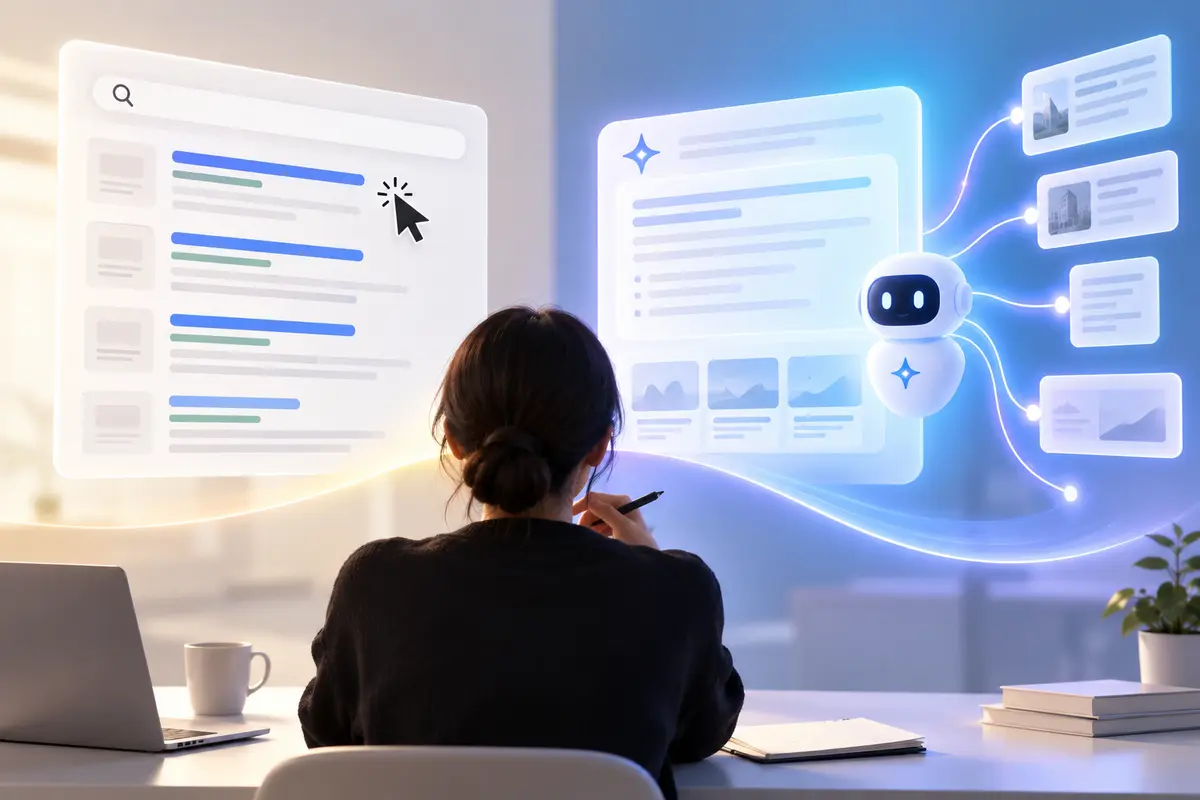
Zero-click GEO explained from TBWA's observations: 68% of U.S. Google searches end without a click, so extend existing SEO content into AI citations.
Claude Fable 5.1 improves coding and research while cutting cache costs, reducing false safety interventions, and introducing regulatory watermarking.