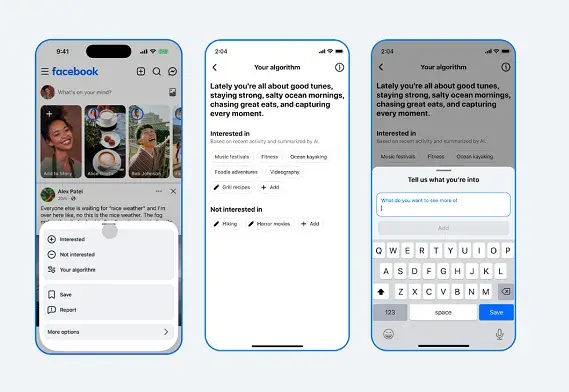
Facebook has launched plain-language algorithm controls that let users tell the system what they want to see. The feature builds on the existing Your Algorithm option: users can add or remove topics the system thinks they like, or type requests into a new chatbot prompt.
What's new
Add and remove topics in your own words
Users can edit the list of inferred interests or describe what they want more or less of. The updates apply to both the main feed and Reels, and the system responds immediately.
Follow-up questions on feedback
After tapping "Interested" or "Not interested," Facebook may ask follow-up questions about what you liked or disliked. "You can easily tell us, in your own words, what you want to see more or less of, and your recommendations will update in real time," Facebook said.
Powered by LLMs
The system uses Meta's latest AI to understand natural language. "LLMs can incorporate the interests, context, and intent behind natural language, unlocking an algorithm you can actually talk to," Facebook said, with recommendations adapting within the same session.
Will people use it?
Social Media Today was skeptical:
- Facebook already offers a reverse-chronological feed, but it can't be set as the default and resets every time users return.
- Mass account deletions predicted after Cambridge Analytica never happened.
- ZDNet reported most social media users never update privacy settings, and the Washington Post reported in 2024 that only a fraction of parents use controls for their kids' apps.
Users complain about their feeds but rarely change settings. Still, those who do now have a more direct tool.
What it means for brand pages
Clear topics survive filtering
If users filter by topic, pages with a fuzzy identity are easier to filter out. Defined content pillars help.
The reasons behind "Not interested" get learned
Follow-up answers may capture specific dislikes — repetitive creative, heavy sales copy — and feed them into recommendations.
Early engagement matters more
With recommendations shifting in real time within a session, weak early response may push posts down faster.
Action items for marketers
- Define three or four content pillars for your page and stay inside them.
- Remove "Not interested" triggers: repeated creative, hard-sell copy and context-free link posts.
- Align feed and Reels, since the same controls apply to both.
- Watch the ad side too. See Meta Ad Placement Controls Are Disappearing, and for how Meta rewards conversation quality, read Threads Gems Explained.