How would you get your brand discovered without a search engine? How would you make sure potential buyers learn about your brand, your products, and the problems you solve?
You'd have to find your audience where they already spend time. Get your best ideas in front of them, create entry points into relevant conversations, and build relationships with the people and platforms they already trust.
That sounds like a marketing strategy rather than an SEO strategy. But it's what SEO now requires.
Take search engines out of the equation
Search has changed dramatically in the past two to three years, and AI is accelerating the shift. The signals that help your brand perform in search increasingly come from beyond your website — the people who mention you, the publications that reference you, the communities that discuss you, and the platforms where your expertise appears.
Imagine the unimaginable: tomorrow, Google disappears. Then what?
You'd still have a product. You'd still need to reach your target audience. You'd still want people to know about your studies, experiments, product improvements, customer stories, and the problems you solve. Everything the same — except you couldn't post content in SEO-smart ways and wait for rankings to bring people in.
So the question changes. Instead of "how do we rank this page?" you start asking:
- Where does our audience already pay attention?
- Who already has their trust?
- Which communities shape their thinking?
- Which platforms influence their decisions?
- Which conversations should we be part of?
- Which stories, studies or examples are worth distributing?
- Where do we need a presence before someone ever searches?
Distribution is no longer optional
For years, many content creators treated distribution as an afterthought. The process was: make content better than the competition, publish, get indexed, build a few links, wait for it to rank, turn free Google traffic into leads and buyers.
That isn't enough anymore, because AI Overviews are eating away at clicks. AI Mode and other AI-driven search experiences reduce the need to open a website by wrapping the information in a paragraph or two. Recently, user experience and answer quality have started pushing past the hallucination problem that made those platforms unusable before. As a result, search volume on the top keywords you were betting on may be dropping close to zero.
What's left for SEOs is to figure out distribution generally, and to make sure solid SEO fundamentals actually hold: indexability and crawlability, internal linking, semantics, taxonomy, content design and layout, consistency.
The trouble is that we aren't always aware our discipline is one — often small — part of the distribution process. On the search everywhere optimization pyramid, owned content SEO might be the last thing you want to focus on right now.
What should platforms know about you?
If you want to teach Google, Perplexity or ChatGPT something about your brand, be consistent with the information they find.
- Does your website properly cover who you are and what you do?
- Is that information on your About page?
- Do you stress the same points on social profiles?
- Do trade show descriptions reflect the same information?
- Do you stick to the theme in podcast interviews and public appearances?
- Does it match on review sites?
A proper distribution process gives you multiple touchpoints presenting important information with the consistency AI needs to understand who you are. Only consistent information sticks consistently with search platforms and LLMs.
Given the inaccuracies in AI visibility tracking and personalization by user context, location and past activity, measurement amounts to educated guessing and directional insight. What you can affect is the input. What information exists about your brand, and on which platforms? Are those the platforms being cited? Are you on the podcasts your audience listens to? Is your company featured in the magazines your buyers read? Does your brand appear in newsletters your prospects actually open?
What ranking pages now have in common
Look at the pages performing well today. Many have things generic SEO content can't fake.
Proprietary data. Original studies. Internal experiments. Customer stories. Product insights. Industry-specific findings. Founder or expert opinions. Examples from real work.
These assets are valuable because they aren't interchangeable. Anyone can write another ultimate guide. Not everyone can publish original data from their own customers, platform, process or market experience.
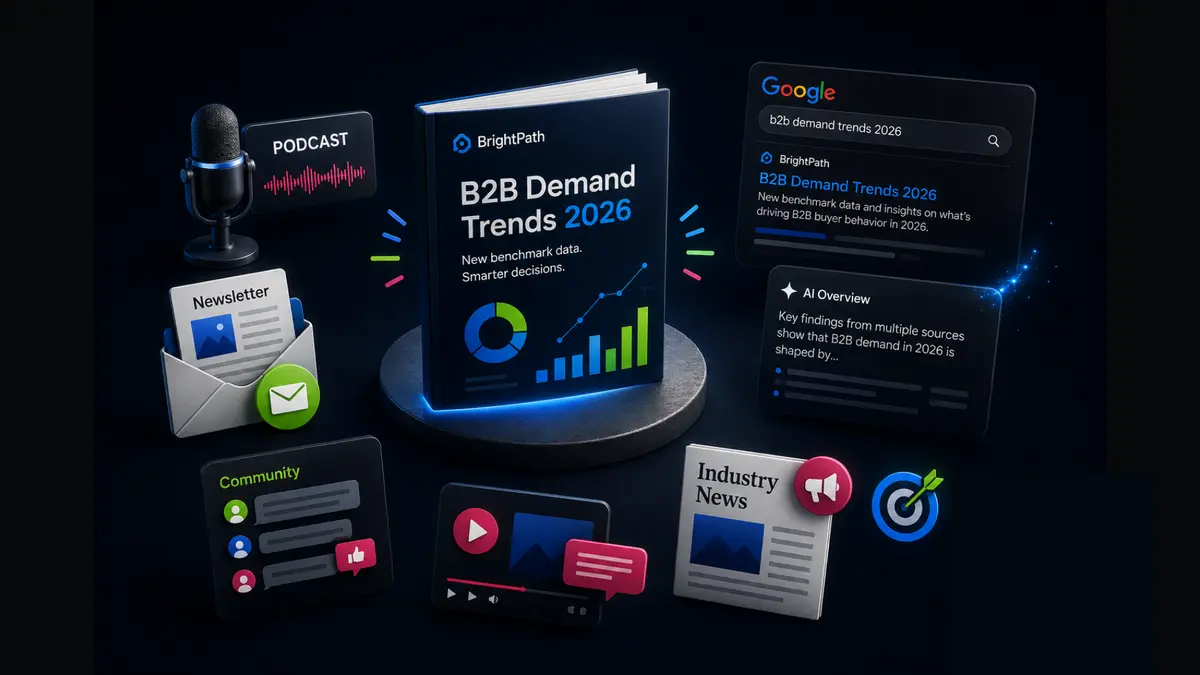
But the asset is only half the story. The other half is distribution. Publish proprietary data that nobody sees, references, quotes, discusses or builds on, and the impact stays limited. Distribute it properly and it starts generating signals across the web. People mention it. Publications reference it. Communities discuss it. Videos summarize it. Newsletters link to it. AI systems may pick up the association. That external footprint supports search.
The structure matches what Link Building Works Better When You Stop Thinking Only About Links describes: links are an outcome, not a unit of work.
The search everywhere optimization pyramid
Your audience doesn't discover, compare and decide only on Google. They move across platforms, listen to podcasts, read newsletters, scroll LinkedIn, watch YouTube, search Reddit, ask AI tools, see ads, follow creators, and ask peers.
The layers:
- Audience research — where does your audience actually spend time?
- Monitoring and alerts — which conversations should you know about?
- Industry publications and third-party presence — where can you borrow trust?
- Distribution — how do your ideas reach people beyond your own site?
- Owned content — what assets do you create once the other layers are clear?
Most companies start at layer five, cranking out content nobody clicks and hoping search engines reward it. The more useful move is building the first four layers first.
Use ads to accelerate distribution
Organic distribution can be your preferred channel, but don't rule out ads as part of the distribution layer — especially early, where they act as a shortcut.
Take Reddit. Many subreddits contain exactly the audience you want. But if your profile is new, or you lack trust in that community, participating organically is difficult. Building a mailing list off a properly targeted Reddit Ads campaign is much faster than warming up a fresh account while navigating algorithmic and moderation challenges.
The same applies elsewhere: Google Ads through YouTube and display, Performance Max depending on setup, Meta Ads targeting by interests, demographics and brand affinities. Ads don't replace organic distribution. But remove search engines from the mix for a moment and ads become one of the tools that reach the audience directly.
Other people's audiences
For newer brands, one of the quickest entry points into a new market is leveraging other people's audiences (OPA).
Most marketers think about email only in terms of their own list — how to grow it, how to raise open rates, how to get more clicks. Those questions matter. But someone else almost certainly already has the audience you want. They may sell a related product, solve a different problem for the same customer profile, or run a newsletter, private community, membership site or podcast your audience already trusts.
The outreach can be simple: "I have this offer or resource. It could be useful for your audience. I can offer a kickback, create free training, or give you exposure to my network. Would you be open to including this in your next newsletter?"
The author of the original piece put his agency on the map partly by contributing SEO tutorial videos to private membership sites. They got free training content; he got exposure to a warm audience. Because the introduction came through a trusted platform, some of that trust transferred. That's distribution.
What this means for marketers
It's easy to get trapped in a narrow view of SEO: keywords, rankings, pages, links, technical fixes. Those still matter, but they're only part of how a brand gets discovered and understood. If your entire SEO strategy depends on getting clicks from search results, it's fragile.
A stronger strategy helps your audience discover you across the places they already trust while creating the signals search engines and AI systems use to understand your brand. The sequence: find your audience, build the distribution layer, create assets worth talking about, get your ideas into the right conversations, then let search and AI pick up the signals you're generating everywhere else.
Measurement is starting to catch up. The platform properties covered in Search Console Now Shows the Search Demand Behind Your Social Content put off-domain content's search performance into the same metric system for the first time. The argument for building distribution first was long an unmeasurable conviction; now it is at least partly checkable against numbers.