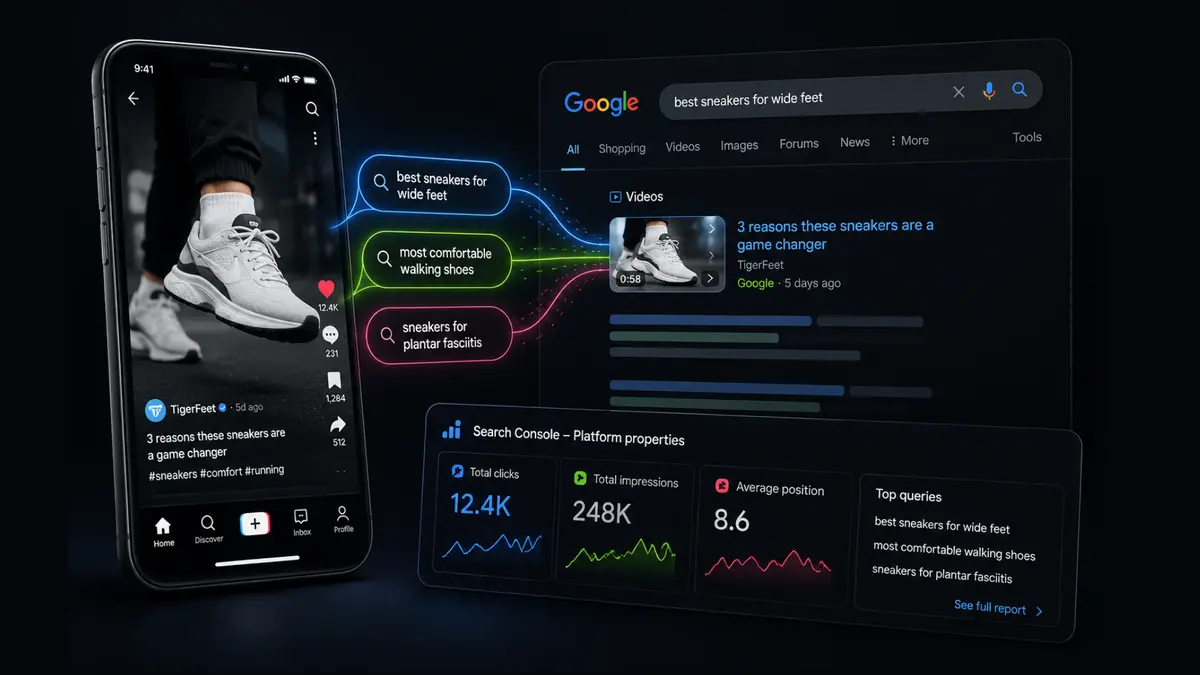
For its entire life, Google Search Console has spoken one language: your website. Pages, queries, clicks, impressions, all tied to a domain you own and verify. On July 7 that changed. Platform properties let you verify a social or video account and receive the same first-party search performance data Search Console has always given site owners.
The metrics are the familiar ones — clicks, impressions, CTR, average position, and the actual queries behind them — pointed at your social presence instead. Coverage spans Search, Discover and News, which means a TikTok clip or a YouTube Short can be tracked across all three surfaces the same way you'd track a blog post.
Why connection timing matters more than evaluation
One detail outranks the feature set: there is no historical backfill. Data collection starts the moment you verify. Every week spent deciding whether this is useful is a week of query data you cannot get back.
So invert the usual sequence. Rather than evaluating and then connecting, connect every active account first and evaluate once data exists.
Three ways it actually gets used
Google's guidance points less at better reporting than at a workflow.
Query groups drive planning
The Insights report clusters the search terms driving traffic into top, trending-up and trending-down groups. Captions, hashtags and next topics get planned against demand that already exists rather than guesses about it.
The 24-hour filter sets response timing
If a post starts pulling search traffic within a day of publishing, you can catch it while it is still live — cross-promoting to another platform or timing a follow-up.
Format comparisons settle arguments with numbers
URL-based comparison filters put Shorts against long-form, or Reels against static posts. "Should we put more into short-form?" gets a real answer instead of a preference.
Creator partnerships get a different evidence base
The same three mechanics reshape creator work. Query groups show the conversations you already have traction in — and by omission, the ones you are absent from.
That changes the brief. Instead of picking creators on reach and hoping relevance follows, you can point at specific query territory you don't occupy and brief against it. Creator spend gets redefined from buying an audience you hope overlaps with yours to buying coverage of conversations you don't own yet.
Measurement gains a dimension too. During a live campaign you can tell whether creator content is earning genuine search visibility or only in-app impressions. Both sides of the negotiation work from the same evidence, and the conversation moves from follower counts to which queries each party actually shows up for. It points in the same direction as 75% of LinkedIn's AI Citations Come From People, Not Company Pages: personal accounts, not brand channels, increasingly serve as the entry point to discovery.
The limitation you have to name upfront: no competitive view
Platform properties only work on accounts you can verify, which means your own data and nothing else. No competitor view, no share of voice, no category benchmark.
Every other search discipline has some form of competitive visibility — who outranks you, what competitors likely bid on, whose backlinks look like what. Here you get a perfectly clear view of yourself and darkness elsewhere. Three practical consequences:
- You can't tell good from great. Is 400 clicks a month strong for your category or embarrassing? There is no external reference point, only your own history.
- You'll spot demand, not competition. Query groups confirm people search a topic and find you. They won't reveal that three competitors are better positioned for it.
- Absence of data isn't absence of opportunity. A query showing nothing might mean no demand — or healthy demand going entirely to someone else. The report can't distinguish the two.
So this data belongs next to conventional keyword and SERP research, not in place of it.
What SEOs gain
Framing this as one more report understates it. The better framing is a new content inventory that behaves like the one you already manage. Platform properties speak the vocabulary SEOs already work in, so social content folds into existing workflows instead of sitting in another team's silo.
Concretely: gap and overlap analysis, checking whether a query is already answered by the brand's own social content before commissioning a page for it. Treating captions and titles like meta titles — annotate the rewrite date, compare either side of it. Applying structural thinking off-site, comparing playlists or formats to reason about grouping and cannibalization for content that doesn't live on your domain at all.
Two caveats worth raising with clients first. Standard Search Console reporting delays apply, so the 24-hour view is not a real-time dashboard. And coverage varies by platform and content type while the rollout matures, so early numbers are directional rather than definitive.
What this means for marketers
Step back and the release confirms a direction Google has been building toward for years. The results page stopped being a list of blue links long ago. Short-video carousels, latest-posts carousels and "what people are saying" modules were already there. Platform properties simply hand marketers an instrument for a part of the SERP that was going unmeasured.
Three consequences follow. The SEO/social divide keeps dissolving — once both are measured in the same tool with the same metrics, separate owners and separate budgets get harder to defend. Feed-based discovery becomes as strategically important as query-based search. And Google is now shipping product on the assumption that search behavior is cross-platform, in the same vein as Google dropping search profile thresholds to 35K followers.
This week's work is simple. Connect every active social account. Then get SEO into that reporting — query groups and format comparisons are exactly the kind of data that should shape a content calendar, and at most brands that decision is currently made without SEO in the room.