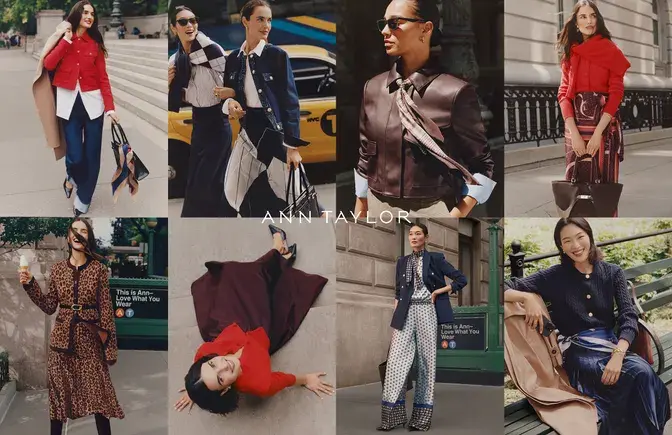
Ann Taylor is running its first major integrated marketing campaign since 2017. It is called "This Is Ann." But the most instructive part of this brand relaunch is not the creative — it is the order of operations. The campaign lands on ground a Substack newsletter has been warming since February.
What 'This Is Ann' Actually Is
The creative follows one busy mother through her day: heading to work, grabbing casual coffee with a friend, moving between roles without changing who she is. Shot in New York City, photographed and directed by Dan Martensen with videography by Garrett Hardy Davis. The fall collection carries sharply cut blazers, silk scarves, and tailored separates.
The brand describes it as a "reintroduction of Ann Taylor to the world." It was developed in-house, not by an outside agency.
Physical activation follows. On September 8, during New York Fashion Week, Ann Taylor opens an experiential space in SoHo — campaign imagery, a street cart, and a newsstand stocked with magalogs, postcards, and custom-wrapped issues of Daily Front Row. In early 2027, the label launches its first brand ambassador program.
The Newsletter That Came First
In February 2026, Ann Taylor launched The Desk, a Substack publishing career and style advice. It is also extending Style 101, a digital video series where fashion experts answer wardrobe questions.
Retailers are moving to newsletters for two reasons. Social feeds are too crowded to carry brand storytelling intact. And generative AI chatbots scrape forums and editorial sites to answer user queries — meaning a brand with no owned text corpus simply does not exist inside AI answers.
The Desk is newsletter marketing and AI-search insurance at the same time.
When a Heritage Label Sells Again
Founded in 1954, Ann Taylor entered the 2020s with plunging sales and the bankruptcy of its then-parent. It now sits inside KnitWell Group, a privately held holding company formed three years ago that also markets Loft, Talbots, and Chico's.
Others have walked this path. Coach won back Gen Z with a creator-heavy strategy — same assets, different register. Newman's Own reselling a 40-year-old promise to millennials works on the same logic: do not invent a new promise, translate the existing one.
Ann Taylor's angle is breaking reductive stereotypes about corporate women — not the woman in the suit, but the one juggling work, social life, and family without losing her own style.
Three Takeaways for Marketers
Sequence the relaunch: community first, campaign second
February newsletter, August campaign, September pop-up, 2027 ambassadors. That order is deliberate. Attention generated by a campaign needs an owned channel to land in, or it dissipates. A big launch followed by a single landing page produces a very different result.
Ambassadors from customers, not celebrities
Ann Taylor's program will spotlight "authentic voices of the women who love and wear the brand." That is a different casting logic from follower-count influencer buying — and it lines up with recent creator-economy data showing brand fit now outranks audience size.
Brand equity compounds; it does not get replaced
A name in use since 1954, a last campaign in 2017, a reinterpretation in 2026. Same principle as six years of the same jingle and what brand equity compounding looks like. Being old is not a liability — it is inventory competitors cannot buy.
The transferable question is not about pop-ups or Fashion Week. It is whether you own a channel that accumulates your story before you spend on a campaign. As with Chipotle putting a creator on the kids' menu, when the channel exists first, the campaign is something you stack on top.