Since 1982, Newman's Own salad dressings, juices, sauces, cookies, and pet food have been staples for baby boomers and Gen Xers who grew up watching Paul Newman on screen. The problem is generational. Newman died in 2008, and millennials do not know his filmography.
That is the assignment for new Chief Marketing Officer Mark Anthony Edmonson.
What Replaces the Movie Star
Two pillars:
- The promise of good ingredients, tied to current food trends like high protein and better-for-you positioning.
- The fact that the company gives 100% of its profits every year to charities helping children facing adversity.
Edmonson believes those messages resonate with millennials, who he describes as largely purpose-driven consumers, citing a recent CapitalOne Shopping report on millennial shopping statistics:
- 47% believe companies should take a stance on social issues
- 59% recently purchased a product because a small business was selling it
- 31% hold stronger commitments to brands aligned with their values
"Millennials care about their communities, they care about their planet, and they want to build a stronger future for the future generations," Edmonson said. "That's where Newman's Own fits so well into their lives."
Competing as a Challenger
Edmonson considers Newman's Own a challenger brand in crowded CPG categories where rivals hold significantly larger marketing budgets. The tools available are renewed social efforts, retail marketing, and fresh packaging.
The structural distinction matters here. Unlike larger companies that donate a small share of budget to a cause periodically, Newman's Own is owned by the brand's namesake foundation and has built purpose into the business for decades. Cumulative giving exceeds $600 million. Last year that money supported nutrition education and school food, taught indigenous children to grow, gather, and cook Native foods, and funded camps inclusive of kids facing medical challenges.
Why the Tagline Changed
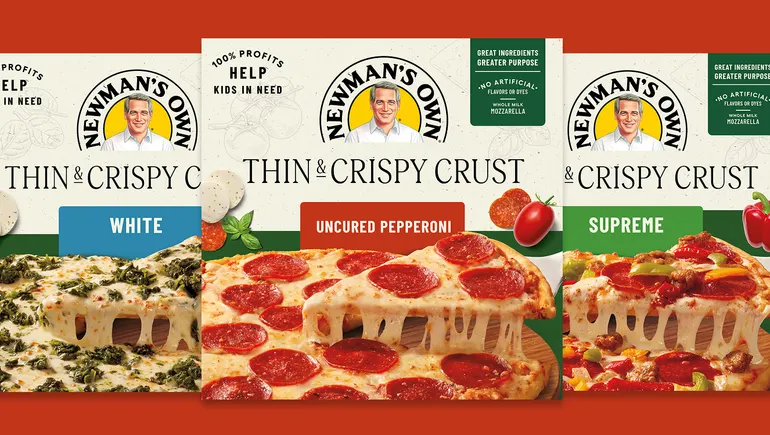
The most instructive change is on the package. Pizza boxes now carry protein callouts, and two old taglines were retired:
- Before: "100% of profits to charity" and "We give it all away"
- Now: "Great Ingredients. Greater purpose." and "100% of profits help kids in need"
The reason is trust, not copywriting. For a demographic that, per Edmonson, often distrusts big CPG companies, the old line raised questions rather than answering them: do all the profits really go to charity, and how does the money actually help? The new line names the beneficiary.
New packaging has rolled out for pizzas, dressings, and beverages, with the rest of the portfolio scheduled for Q4 or Q1 of next year.
Retail Media and Creator Strategy
Over recent months the brand has pushed its mission through retail media activations at Walmart, Target, Chewy, Amazon, and Kroger, including sponsored search ads and displays.
In April, the company released smaller, more affordable salad dressing bottles with new flavors at Walmart, boosted through the retailer's displays and site search. On social, a content creator discussed the collaboration, the product, and the charitable contributions while making a salad.
The reported results:
- $3.50 return for every $1 of ad spend
- 49% conversion rate
- 43% digital penetration
- 70% new-to-brand rate
That last figure is the interesting one. Most of the volume came from buyers new to the brand rather than repeat purchasers.
The Creator Criteria Changed, Not Just the Creators
In May the brand revised its social strategy, moving away from larger creators whose scripted videos sounded "descriptive." The goal became content that reads as authentic — creators who share the company's values, believe its story, and can amplify it with their own audiences.
- A TikTok creator made protein-rich ice cream using Hint-O-Mint Newman-O's cookies.
- The brand joined the viral dot cake trend by partnering with a Connecticut bakery, co-developing a recipe that topped a popular Cake Cup with Newman-O's as the dots. The video called it the brand's "sweetest collaboration yet," with the mission and Connecticut roots told in the comments.
Last month the channels joined the "That's my why" trend, where people share their underlying motivations. "Paul Newman didn't just start a food brand…" the TikTok post read over a reel of the actor's photos. "He started a brand built to give back. 100% of our profits help kids in need. And that's our why."
It drew nearly 20,000 likes, 377 comments, 331 shares, and roughly 900 new followers.
Three Takeaways
Purpose survives scrutiny only when it is structural. A foundation owning the company is not something a campaign can manufacture, which is precisely why it holds up against millennial skepticism.
The tagline swap was a trust fix, not a copy fix. "We give it all away" is beautiful and unverifiable. "100% of profits help kids in need" names a recipient. For a suspicious audience, specificity beats poetry.
Nostalgia is a bridge, not a destination. Many millennials recognize the brand because their parents kept it in the house, and that recognition is the entry point for trust. A stronger millennial relationship then reaches their children — a transfer pattern consistent with research showing mothers outrank creators in Gen Alpha brand choice.
Also worth watching: the widening range of ways brands convert values into advertising assets, as when Liquid Death turned data center backlash into a 90-second campaign.
Bottom Line
Edmonson's stated one-year objective is to become "more culturally relevant with this millennial consumer," where relevancy means "helping them understand our unique value in their lives." The work is restating a 40-year-old asset in a new generation's language.