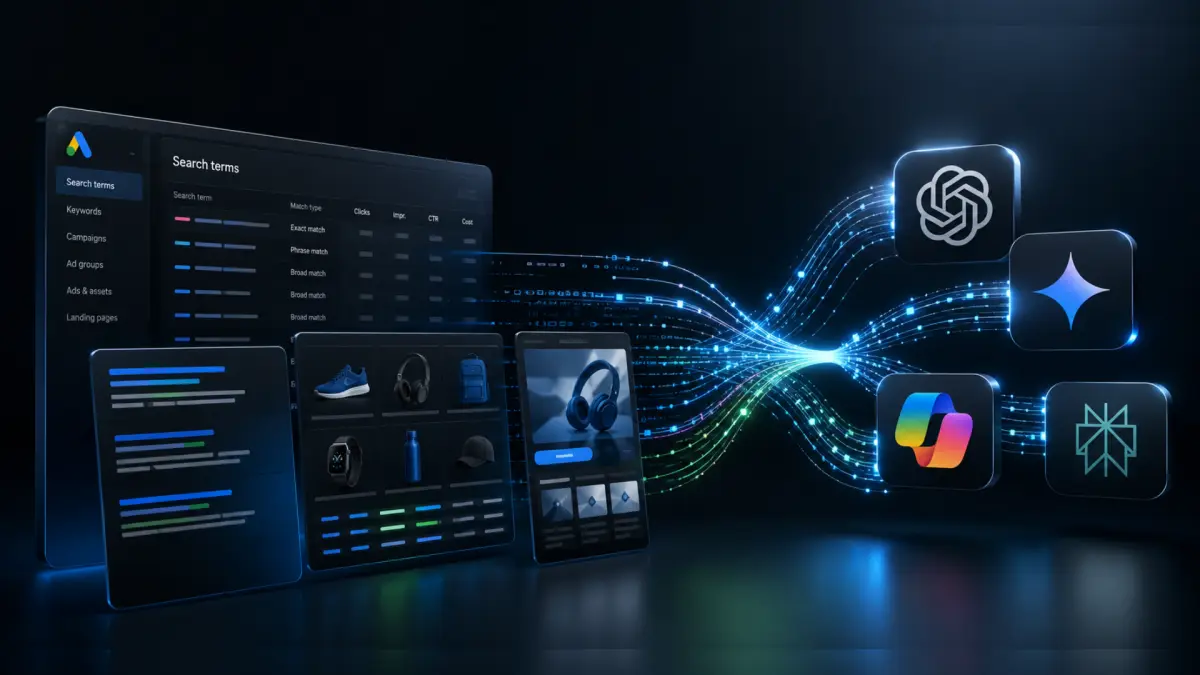
Ask most marketing teams how they plan to stay visible in AI search and you hear content strategy, SEO audits and schema projects. What rarely comes up is the paid search account they have been running for years. That is a big miss: the things AI search tools reward — clear answers, structured product data, strong landing pages, messaging that matches how people talk — are things paid search practitioners influence every day.
Your ad account already knows how customers search
Most businesses treat Google Ads as a place where budget goes in and leads come out. It is also one of the richest sources of data about how customers actually search: how they phrase problems, compare options and decide what to buy.
- Search term data shows the exact language customers use at every stage, including long conversational queries that resemble AI prompts
- Ad copy performance data reveals which value propositions, offers and phrasings earn clicks and conversions
- Conversion data identifies which products, services and pages drive revenue, not just traffic
- Product feed infrastructure — structured titles, attributes, images, pricing — is already formatted for machine consumption
- Landing pages are built for relevance, clarity and speed to satisfy Quality Score and CPC standards
Every one of those maps to something AI search systems use when deciding which businesses to mention.
The search terms report previews AI prompts
The biggest behavioral shift AI search introduced is query length. People do not type "crm small business" into ChatGPT — they type "what's the best CRM for a five-person landscaping company that mostly needs scheduling and invoicing?" Broad match, Performance Max and AI Max have been matching ads to exactly those long, natural-language searches for years, and the record sits in your search terms report.
One HVAC client exported 12 months of search terms and found questions like "why is my AC running but not cooling the house" and "best HVAC company for older homes near me." Grouping those conversational searches by theme and then searching the client's own site for a clear, quotable answer to each one exposed the gap between what customers ask and what AI tools can pull.
At a plumbing company, the report surfaced dozens of queries like "how much does it cost to replace a water heater in a condo." Those searches converted well, but the website said nothing concrete about pricing. Google Ads profited from that gap; ChatGPT will simply cite a competitor that published the answer.
Your best ad copy never reaches your site
Ad copy has already been tested with real buyers, and your highest-performing ads reflect real intent. That messaging usually never surfaces outside the ad platform — the website says one thing while the ads that convert say another. AI tools only see the website; they never see your ads.
Find your best-performing headlines and descriptions, then make sure those same claims and offers appear as plain text on the pages your ads point to. If "24/7 emergency service — arrival in 90 minutes or less" is your best-converting headline, that promise belongs on the page. Conveniently, ad copy is exactly what AI tools like to quote: specific numbers, timeframes, guarantees and prices rather than vague marketing language.
Product feeds power both paid and organic AI visibility
If you run Shopping campaigns, the feed is your most leveraged asset. The structured data built for Google Merchant Center — accurate titles, complete attributes, quality images, current availability and pricing — is now what AI shopping tools use to decide which products to show. Feed quality is a primary eligibility signal for whether Shopping and Performance Max ads appear in AI Overviews and AI Mode. On OpenAI's side, ChatGPT's shopping results draw from product feeds, which led to product feed ads rolling out in May.
Rewrite short or keyword-stuffed titles in plain language, fill in the optional fields you have been skipping, keep pricing and availability current, and submit your feed directly to AI search tools that accept one.
The five-step framework
Step 1: Open the gates. Confirm your site is indexed in Bing and verified in Bing Webmaster Tools, since ChatGPT searches rely on Bing's index. Audit robots.txt so OAI-SearchBot and other AI crawlers you want are not blocked.
Step 2: Mine search terms for conversational intent. Export 12 months across campaigns, filter for five-plus words, questions and comparisons, group by theme and conversion value, and turn the result into a prioritized list of questions the site must answer explicitly. This replaces speculative "what might people ask ChatGPT?" exercises with demand you already paid to discover.
Step 3: Republish winning ad copy as citable page content. Identify top responsive search ad assets by conversion performance and verify each high-performing claim exists as crawlable on-page text — exact numbers, exact guarantees. Add schema markup so there is no ambiguity about what the page says.
Step 4: Upgrade the product feed for AI platforms. Rewrite titles in descriptive natural language, complete optional attributes, verify pricing and availability. Keep it updated in Merchant Center for Google's AI results and submit it to OpenAI so ChatGPT's shopping results use your actual data.
Step 5: Measure, then test paid AI placements. Set up analytics tracking for visits from chatgpt.com, perplexity.ai and copilot.microsoft.com to establish a baseline. Then confirm your Google campaigns can appear in AI Overviews and AI Mode via Shopping, Performance Max or AI Max for Search, explore Copilot placements in Microsoft Advertising, and consider ChatGPT's self-serve ads if that is where your audience is.
The bottom line
AI search visibility is being pitched as something new that requires new spend. If you already run paid search, the hard part is done — the customer data, the proven messaging and the feeds are all paid for. What is missing is the connection between what is in the ad account and where AI tools look. Skip it and you end up funding two strategies: one that learns and one that guesses.
For what happens when AI answers contradict your ads, see When AI Overviews Contradict the Ad Right Above Them; for the earned-media side of citations, see From Media Relations to Machine Relations.