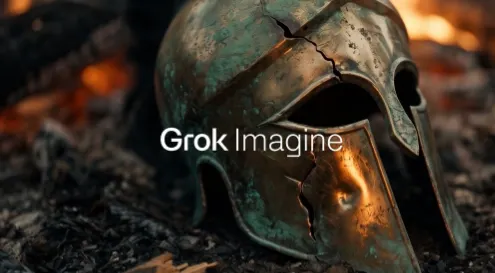
X is inviting creators to generate their own interpretations of Homer's The Odyssey using its latest Grok Imagine AI tools.
The competition appears to have sprouted from X owner Elon Musk's personal ambition to create an alternate version of the story, due to his dislike of Christopher Nolan's recent interpretation.
The Terms
Per X:
"Create a compelling scene from Homer's The Odyssey that shows what Grok Imagine's video and voice capabilities can do. We're awarding $100K, $50K, and $25K to the top three videos submitted by quoting this post."
- Length: 3 to 5 minutes
- Requirement: at least 1 minute of dialogue in English
- Judging: ranked on Verified Premium Home Timeline impressions, then judged on quality and creativity
- Eligibility: U.S. users 18+ only
- Deadline: August 31, 2026, with winners announced shortly after
X's Prize Campaign History
This is the latest effort from X to incentivize posting through cash rewards, showcase feature additions, and drive up usage.
- January: a $1 million prize for the most popular X article of the month, part of a push for more long-form content
- A $1 million prize for the best Super Bowl ad generated by Grok, with winners then used in an X promotion
However, these incentive schemes have only sparked short-term engagement, and X seems to quickly lose interest in such initiatives.
In November 2025, X launched a "Certified Bangers" account designed to highlight the best X posts every month. It published the top bangers for that month, then never posted to the account again.
The Extra Weight Here
The Odyssey push carries an additional emphasis: Musk has vowed his Grok AI tools will be able to generate a better version of the story than Nolan's rendition before the year is out.
Musk has accused Nolan of "desecrating" the story by casting non-white actors in key roles, labeled Nolan "an anti-white racist" for those casting choices, and said Nolan "has shown total contempt for the Greek people."
Worth a reminder: both Homer's The Odyssey and Nolan's film are works of fiction and are not based on historical fact.
Nonetheless, Musk is clearly upset, and when the world's richest man is offended, he does something about it. In this case, that something will lead to a wave of AI slop versions of the story, showcasing generic depictions set to derivative music. Musk will laud the AI versions as superior either way, which is really all he wants out of this.
Four Takeaways
This case illustrates the structural limits of prize-based UGC campaigns.
Impression-based first-round judging distorts participation. Ranking on Verified Premium Home Timeline impressions favors accounts that already have followers over work quality. Incentive for newer creators falls, and diversity of entries falls with it.
Prize campaigns do not persist. As X's own history shows, engagement disappears with the deadline. Turning it into a community asset requires a post-prize distribution plan.
When the creative motive sits outside the brand, so does the output. The real motive here is a personal argument rather than tool promotion. When a campaign's narrative separates from product value, participation grows without accumulating as brand equity — the exact inverse of the principle that repetition and accumulation, not one-off spectacle, build brands.
The distribution environment for mass-generated AI is already tightening. As seen in Google's spam update targeting scaled content abuse, campaigns whose goal is mass generation produce output with a short distribution life.
Bottom Line
$175,000 in prizes, an August 31 deadline, winners shortly after. Whether the campaign leaves behind genuine Grok Imagine use cases or a month of noise is a question X's previous campaigns have largely already answered.