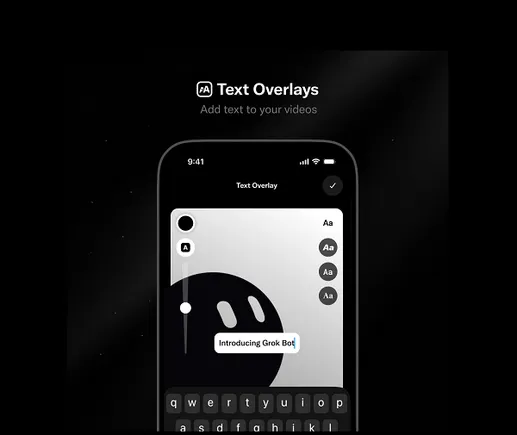
X announced that users on iOS can now add text overlays to video uploads. Demonstrated by X engineer Allegra Jacchia, the option is a simple way to place text and emojis over a clip.
A small update, in context
As a feature, it is unremarkable — rival apps have offered this for years. As an X update, it matters, because it shows how far behind the platform's creation and editing tools have been.
X shipped an updated video editor including green screen recording in July of last year; this overlay option extends that work.
"Video-first" versus what happened
In 2024, then-CEO Linda Yaccarino repeatedly said X would become a "video-first platform." In-stream video consumption on X has indeed risen substantially.
The causality is the interesting part. That growth tracks a broader industry-wide rise in video creation and consumption rather than anything X built. X's algorithm has also amplified video posts to increase time spent in-app.
The slate of X Original video programming announced in May 2025 — celebrity-led projects with Khloe Kardashian, Tucker Carlson and others — largely faded away with little audience response.
What marketers should take from it
1. Keep production outside X
A text overlay tool is not a reason to produce video inside X. Captions, overlays and cuts are safer handled in external tools with a finished file uploaded. Native platform editors lag badly on features and change often.
2. On-screen text is not optional
The arrival of overlays is an acknowledgment of sound-off consumption. Autoplaying feed video is watched muted. The core message needs to appear as on-screen text within the first three seconds.
3. Reach is still an algorithmic decision
X amplifies video posts, but its reach-restriction logic runs in parallel. For checking whether your own posts are restricted, see X Open-Sources Its Reach Code — and a Tool to Check If Your Posts Are Restricted.