We are well past the halfway point of 2026 and businesses are nervous. Google answers more questions without sending clicks off its own platform. AI platforms remain the shiny object despite not yet delivering meaningful referral traffic. Attribution is still broken, and leaders are asking whether SEO is still worth the investment.
Two companies faced the same climate and responded in opposite ways. One took its foot off the gas because the ROI no longer matched history. The other doubled down, seeing an opening against a competitor that had dominated its market for more than a decade.
Both decisions carry risk. The difference is framing: one focused on what it could lose by continuing to invest, the other on what it could gain while everyone else pulled back.
Stable Markets Protect Market Leaders
Catching a market leader under normal conditions is enormously difficult. They have stronger brand recognition, larger content libraries, better backlink profiles, more first-party data, and years of customer reviews and third-party validation — plus the budgets, teams, and historical performance data to keep compounding all of it.
When everyone plays by the same rules, the leader's head start compounds. Publishing a few more articles or improving several category pages will not erase years of accumulated authority. At best it prevents the gap from widening. To close it, the market itself — and what it rewards — has to change.
That is exactly what is happening.
Doubt Creates Opportunity
Search behavior no longer lives entirely inside Google's ecosystem. Buyers have more ways to find answers, and no business has figured out how to win across all of them.
That uncertainty weakens advantages leaders spent years building. Their content libraries, reporting models, and proven playbooks were designed for scale — and for a more predictable search environment.
The size and legacy that made them dominant now slow them down:
- more outdated content to reassess
- more stakeholders to convince
- stricter measurement requirements
- more existing revenue they are afraid to disrupt
Investing in an unknown channel is hard when every dollar must immediately prove a direct return.
The leader is still ahead and will not be overtaken overnight. But we are no longer running on a straight track. The course changed, and everyone is learning it at the same time — which creates a chance to close ground faster than a stable market ever would.
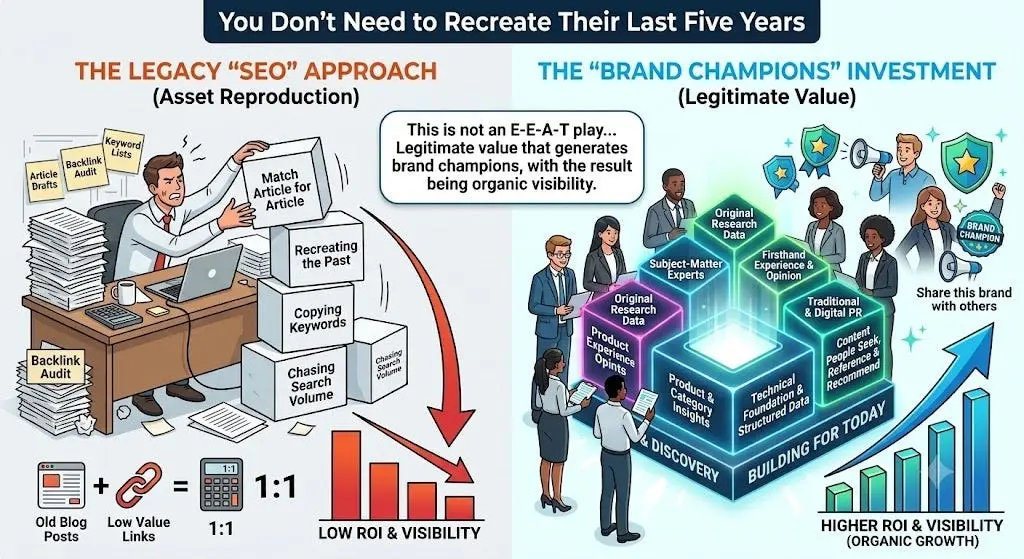
You Don't Need to Recreate Their Last Five Years
Closing the gap does not mean recreating everything the leader did. You do not need to match them article for article, backlink for backlink, keyword for keyword. Much of what worked over the past five years will not deliver the same value over the next five.
Invest instead in assets that matter, and put them where customers search, research, and decide:
- Original research and proprietary data
- Recognizable subject-matter experts
- Firsthand experience and credible opinions
- Strong product, service, and category insights
- Customer reviews, case studies, and other proof — yes, this is SEO
- Traditional and digital PR
- Clean technical foundations and accessible structured information
- Content people actively seek, reference, and recommend — not content chosen by search volume
These are not "SEO assets" or "GEO assets." They are evidence that your business deserves to be discovered, cited, and trusted. Not an E-E-A-T play to lift a score, but legitimate value that produces brand champions, with organic visibility as the result.
Build for where the market is today, not for the leader's past.
Stop Using Referral Traffic as the Only Scoreboard
The uncomfortable truth: AI platforms may not send meaningful referral traffic anytime soon. That does not make visibility worthless. It makes referral traffic an incomplete measurement.
Clicks still matter. So do:
- branded search demand
- direct traffic
- assisted conversions
- mentions and citations
- answer visibility
- sales conversations influenced by content
Also worth measuring: whether the traffic you still earn converts at a higher rate because customers encountered the brand throughout their research.
The goal is not to invent softer metrics to excuse declining traffic. It is to recognize that last-click sessions alone no longer capture visibility's impact on customer decisions.
The Biggest Risk Is Waiting With Everyone Else
Waiting feels safe when competitors are equally uncertain. But when everyone pauses, even smaller, intentional investments create outsized advantage.
Warren Buffett's most quoted line fits the moment: "Be fearful when others are greedy, and be greedy when others are fearful."
This is not an argument for going all in on AI, publishing 100x content, or paying someone who promises "AI rankings." It is about investing in the research, expertise, customer proof, brand recognition, and technical foundations your competitors will wish they had once the market clarifies.
By then, those assets are not something a competitor beats by publishing a slightly longer article with one more data point. They become defensible resources that are expensive and slow to replicate — which is why 99% of competitors will not attempt it.
Uncertainty does not eliminate risk. It gives you a choice between the risk of investing now and the risk of falling further behind.
Build for the Next Five Years
You probably cannot outspend the leader or recreate their success overnight, and you will not close the gap by copying their playbook and hunting for shortcuts.
But you may never get a better opening than a moment when customer behavior is shifting, proven strategies are breaking, and everyone else is waiting for certainty.
You do not need to recreate the previous 50 years. You need to start winning the next five.
For why technical debt is the real bottleneck in AI visibility, see Most AI Visibility Gains Are Just Technical Debt Repayment; for designing link assets and brand mentions together, see Link Building Works Better When You Stop Thinking Only About Links.