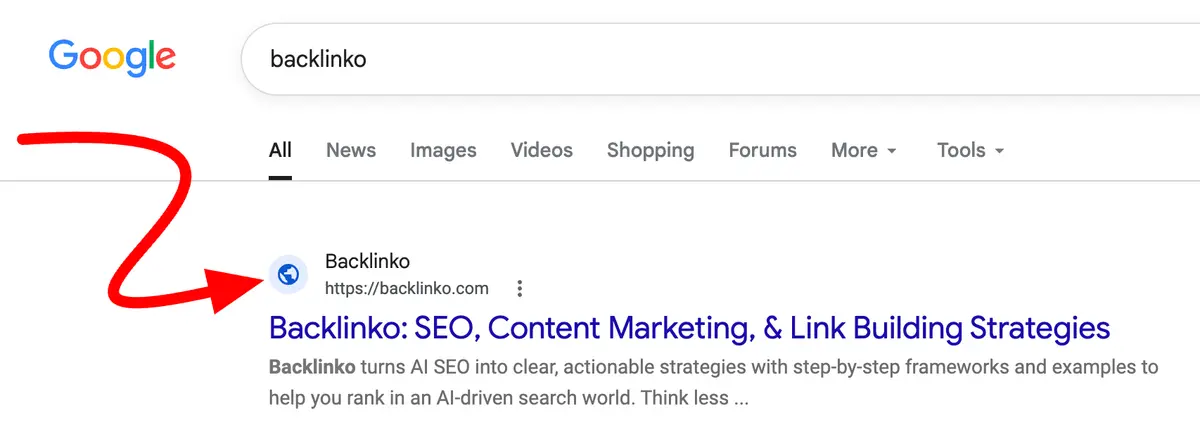
Complaints about missing favicons in search results spiked all week. On Friday, August 21, Google confirmed the Google Search favicon bug is on their side, not yours.
What Google Said
Rajan Patel, Google's VP of Engineering for Search, said: "It's an issue on our end. We identified the issue and we're addressing it as quickly as we can. Sorry that this happened."
The symptom is straightforward. Sites are serving valid favicons, but Google cannot pull them, so the snippet renders the default globe icon instead. Some sites have already been restored; others, LinkedIn among them, were still showing the placeholder as of Friday — nearly a full week after the issue began.
Why One Icon Is a Performance Problem
On mobile results, the favicon is close to the only visual element that separates one brand from another. Titles and URLs share the same shape across every result; the icon does not. When every listing wears the same grey globe, even users who know your brand cannot pick you out of the page at a glance. Clicks fall.
The harder part is that the drop is indistinguishable from a ranking or content problem. Search Console will show flat impressions, fewer clicks, lower CTR — and nothing else. Without the context, teams start rewriting titles and meta descriptions on pages that were never broken.
What to Check Now
Separate your problem from Google's
A globe icon is not automatically Google's fault. Confirm that the favicon file is reachable, that robots.txt is not blocking its path, that the rel="icon" declaration still exists on the homepage, that the file is at least 48×48 pixels, and that the same file is used site-wide. If all five check out and you still get a globe, you are caught in the outage. The crawl-accessibility items in Four Technical SEO Fundamentals for AI Search cover the same ground if you want a fuller sweep.
Do not read this week's CTR as a result
If CTR fell last week, the outage belongs on the list of candidate causes. If it recovers this week, that is Google restoring service, not your optimization working. Neither direction is valid evidence for a title or snippet test.
Annotate the window
Mark the mid-to-late August window in your analytics or dashboard now. If you cannot explain that dip when the quarterly report is written, you are left with a valley nobody can account for.
Working on Someone Else's Platform
The scale here is small but the shape is familiar: a meaningful part of your performance sits on infrastructure you do not control. It is the same structure described in Reddit's ChatGPT Search Citations Fell 86% in Four Days. There are only two responses. Keep what you control — files, tags, accessibility — permanently correct, and keep what you do not control isolated and annotated in your reporting.