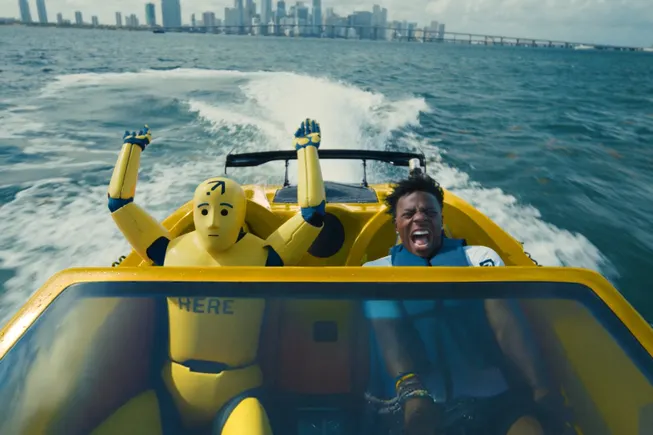
The 2026 FIFA World Cup concluded with a decidedly American spectacle: a bombastic closing ceremony that brought the world's biggest celebrities to the stage — including one known mainly by his username.
Darren Watkins Jr., aka IShowSpeed.
- Recently named one of Forbes' Top 10 Creators
- The new face of Expedia
- The main character of an upcoming anime series
- The first Black creator to hit 50 million YouTube subscribers
- Dubbed "Gen Z's ESPN" and, for one hour, the mayor of Lima, Peru
How does a kid from Ohio become a global megastar? By being himself and streaming it live.
Like many streamers, he started in gaming, going viral for explosive reactions to gameplay moments. As his platform grew, he suddenly had the whole world at his fingertips, leading to a career-defining move to IRL (in-real-life) streaming.
Throughout his travels he filmed himself meeting new people, discovering new cultures and getting into instantly viral shenanigans, while taking his audience with him every step of the way.
What IRL means for brands
IShowSpeed is arguably the world's most famous IRL streamer, but he's far from the only one. The format is growing across social platforms as creators stream their travels, their experiences at events like Coachella, and slices of their everyday lives.
When viewers tune in to these livestreams, they see it more as spending time with a friend than watching an entertainer perform.
The passion of fandom collides with the intimacy of real life, and amid the ongoing battle for attention, that point of collision is where brands find consumers at their most engaged.
How IRL captured Gen Z
Creators have been brands' through-line to Gen Z for a while, and it largely comes down to trust. They follow influencers because they find them relatable, authentic and honest; 87% of Gen Zers will buy a product because an influencer they followed recommended it.
IRL streamers bring these factors into a new dimension.
It fills a unique social need
Gen Z had their high school and college experiences disrupted by COVID lockdowns. Virtual connection became just as powerful as in-person bonding, because for a while, it was all they had.
IRL streamers offer an adventure into someone else's everyday, with the creator serving as the catalyst for a genuine community where members build relationships with one another.
And while Gen Z craves more in-person experiences nowadays, the IRL format is naturally more conducive to IRL engagement — a favourite streamer could come to their hometown, or attend the same concert or sporting event, bringing the community together.
The psychological element
IRL content that puts emotionality front and center provides genuine catharsis.
For a generation that lives in fear of being "cringe," IRL and reaction content gives them a kind of proxy: IRL streamers, and the brands that partner with them, meet audiences in a place where they feel like they can be themselves.
Addressing the risks
Working with livestreamers used to be a gamble. Real-time content is unpredictable and brands have far less control over the final content than in a scripted video. For the particularly cautious, spontaneity screens as unmitigated risk.
However, brands' wariness has faded as streamers have commanded greater cultural capital.
- Listerine worked with music streamers on Twitch for a series of streams chronicling the recording of a soundtrack made of mouthwashing sounds
- e.l.f. has partnered with streamers to host shoppable livestreams
What real-world environments add
Real-world settings give creators more to play off, but they also introduce additional risks:
- People on the street
- Connectivity and networking challenges
- Permitting and access considerations
- The general hazards of everyday life in public spaces
Being in public also makes it easier for viewers (and bad actors) to find a creator's exact location, and unfortunately, stalking and harassment are not unheard of.
Big-name creators often hire their own security, but many others cannot. If a brand is involved in the stream, audiences will expect that brand to do its due diligence in preventing potential incidents.
Brands have navigated safety challenges by partnering with IRL streamers in strategic locations, often tied to major events like the World Cup and the Super Bowl, where filming rules are more transparent, security is on-site, and brand representatives can easily intervene.
The technical constraint
Lapses in Wi-Fi and cellular signal in real-world environments can lead to dropped streams, jeopardizing the reach and impact of a sponsored broadcast.
Connectivity solutions are expensive, meaning a limited number of big-name creators can actually afford them. Fortunately, the industry is working to make IRL streaming tools more accessible to smaller-scale creators, which in turn opens up more opportunities for brands.
Authenticity at the core
Authenticity may be a perennial marketing buzzword, but the rise of IRL streaming has unearthed a new layer of what it means to be authentic.
In a world where anything can be scripted, clipped out of context, modified and deepfaked, the spur-of-the-moment realness of IRL streaming is a powerful connective force.
It's also a delicate one. Audiences have expectations for the content and flow of a stream; creators have a unique engagement style and vision.
A mismatched brand partnership can shatter goodwill with fans. Streamers seem like "sellouts" rather than using their platform to promote brands they genuinely believe in.
Unsurprisingly, brand fit has become a top priority for creators in choosing partnerships and sponsorships.
Kai Cenat, another popular IRL streamer and the mind behind Streamer University, famously rejected a Met Gala invite because the brand that invited him wasn't a fit.
Working with a streamer, or any popular creator, is an investment in credibility. Brands have to act as a creative partner, not a director. Embrace the power of spontaneity, and let them do their thing.
Practical takeaways
Reframe measurement from viewing to accompanying. If audiences experience it as time with a friend rather than a performance, dwell time and community interaction say more than reach and views.
Book safety diligence as a brand cost. Stalking and harassment risks are real and audiences hold the brand responsible — which is exactly why major-event tie-ins are the practical workaround.
Put connectivity in the campaign budget. A dropped signal erases the reach of a sponsored broadcast, and the cost of connectivity solutions belongs on the brand's line, not the creator's.
Treat brand fit as a precondition, not a negotiating chip. Kai Cenat turning down the Met Gala signals that creators will refuse large opportunities over fit. On the mechanics of livestream selling, see Live Commerce Success Comes Down to One Thing: Early Traffic.
Build creator capability in-house as well — see Gap Turns Employees Into Influencers.
Don't underprice a bad partnership. As Connected Content: 80% Say a Bad Ad Is Worse Than No Ad At All shows, a mismatch costs more than doing nothing.