Picture a shopping mall in its 1980s heyday and what comes to mind may well be the Sherman Oaks Galleria — a San Fernando Valley landmark namedropped in Frank Zappa's "Valley Girl" and a filming location for "Fast Times at Ridgemont High."
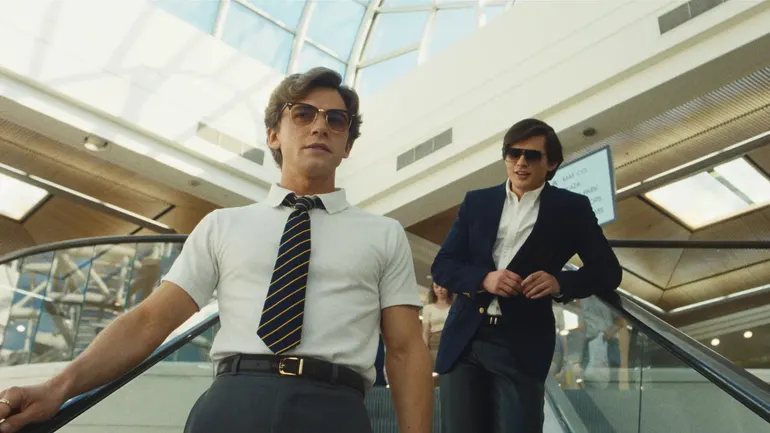
The mall was also a stomping ground for author Bret Easton Ellis in his teen days. That time and place is recreated in his autofictional novel "The Shards," adapted into a series for FX by producer Ryan Murphy.
Rebuilding an entire mall
To bring the world of "The Shards" to life, FX is hosting an experiential activation at the Galleria on Aug. 1–2, offering guests a chance to revisit the highlights of an '80s-era mall.
The activation was done in collaboration with brands Maybelline and Licorice Pizza.
Kenya Hardaway, senior vice president of integrated promotions and multi-platform marketing at FX, explained:
"['The Shards'] is rooted in so many elements of the '80s that are of interest to audiences today: the element of analog, third spaces, mall culture. There was a great opportunity to lean into that, and as the Sherman Oaks Galleria is such an iconic space in Southern California that's part of the story that's being told, we felt it was a perfect location."
What visitors can do
Guests swipe a collectible credit card and participate in a series of interactive experiences.
- Licorice Pizza — the record store chain founded in 1969, closed in the late '80s and reopened several years ago, hosting a period-specific vinyl listening station powered by RadioShack
- Maybelline's Fit Me Matching Kiosk — makeup artists helping guests find the right foundation shade plus other glam products
- An arcade, photo booth and t-shirt customisation station
- A retro movie theater photo op with a sneak peek of the series
- Free soft serve by Creamy Boys Ice Cream, an LA chain founded in 2020
"We really wanted the primary stores and retail and engagements that guests would typically find in an early '80s mall setting. We have a great mix of partners: not only ones that were available in the 80s, but ones who are currently trending with our audience and were able to help us create a retro moment, like Creamy Boys." — Hardaway
The partner logic is instructive. Period accuracy was not the only filter — Creamy Boys, founded in 2020, has nothing to do with the eighties but everything to do with what Gen Z likes now.
Three trends intersecting
The activation sits at the confluence of several consumer and marketing trends:
1. Gen Z nostalgia
2. The return of the mall
3. The resurgence of experiential marketing
The mall revival, in data
Gen Z consumers have helped revive malls across America, with the cohort's share of foot traffic at malls increasing 57% year over year, according to PwC.
The return of mall culture has animated recent back-to-school efforts by youth-focused brands including American Eagle and Aéropostale, arriving alongside a resurgence in experiential marketing that was sidelined during the pandemic.
"Modern-day mall culture started in the '80s. That's really when you started to see the birth of these really large mall complexes being a destination for young adults. It had a time where it faded a bit, and we're starting to see that come back." — Hardaway
Targeting two generations at once
The Galleria experience engages two groups:
- A younger, Gen Z audience hungry for the pre-digital world
- An older cohort that remembers the Sherman Oaks Galleria of yore
That cross-generational approach puts FX in line with other marketers working the same territory. One asset satisfying two distinct motivations: for the younger group it is discovering an era they never experienced; for the older group it is confirming a memory.
What marketers should take from it
When the location is part of the story, the activation reads differently. The Sherman Oaks Galleria is not an arbitrary venue but a real space that appears in the work. Without that alignment, the same production is just a pop-up.
Mix current brands into period recreation. Perfect historical accuracy produces a museum. Brands the present audience actually likes are what create a reason to attend.
Design nostalgia for two cohorts. People who lived through the era and people who missed it arrive for different reasons. Satisfying both doubles the addressable audience.
Tie experiential to content distribution. The number of people who attend is frequently smaller than the number who see it circulate socially. For turning a school space into a creative studio, see Ugg Puts an Indie Pop Band at the Centre of Back-to-School; for turning a commute into brand inventory, see The Deodorant Ad That Renamed Subway Stations.